LIBPhys, Physics Department, Faculty of Sciences and Technology, Nova University of Lisbon, 2825-149 Caparica, Portugal.
Instituto de Telecomunicacoes, Instituto Superior Tecnico (IST), Technical University of Lisbon, 1049-001 Lisboa, Portugal.
Sensors (Basel). 2020 Jul 22;20(15):4078. doi: 10.3390/s20154078.
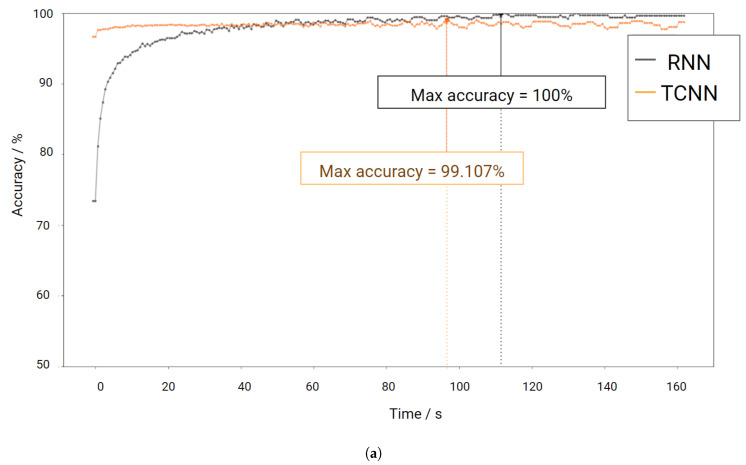
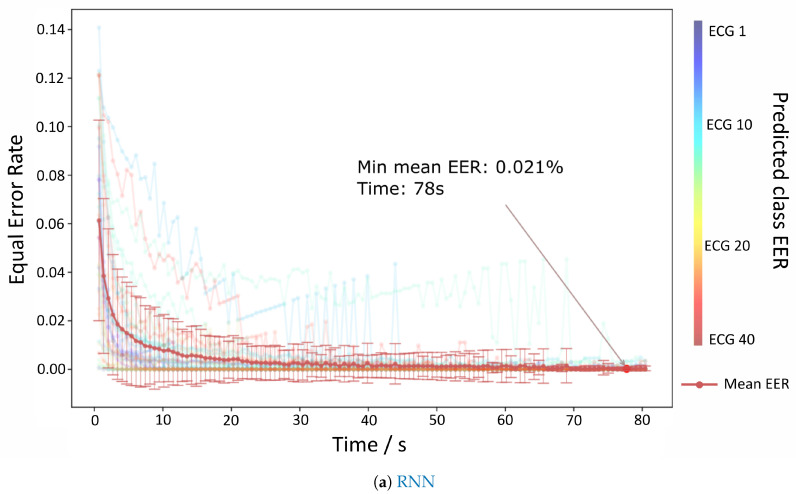
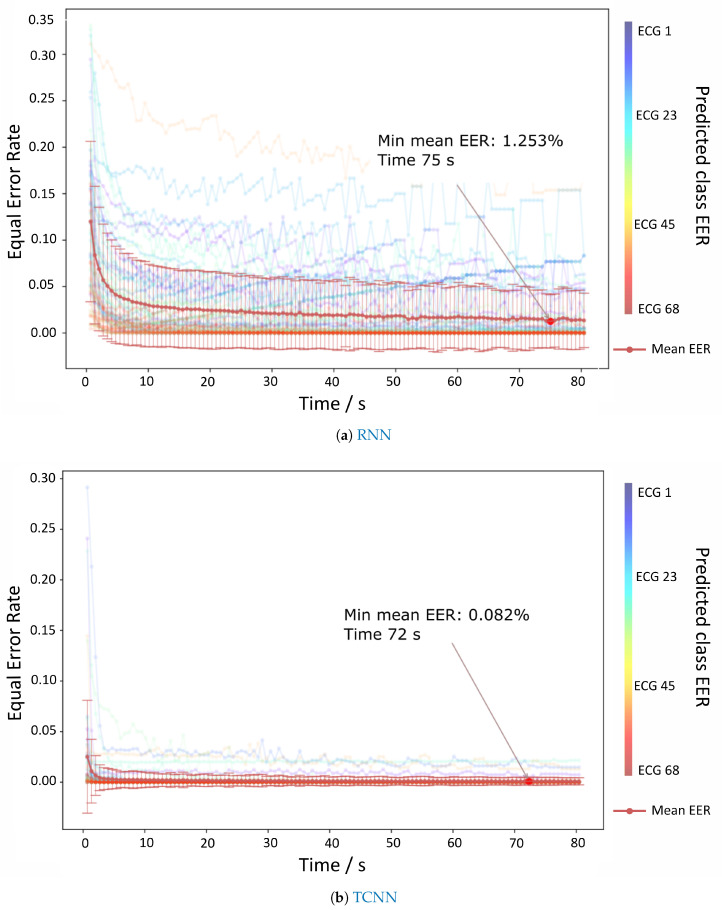
The field of biometrics is a pattern recognition problem, where the individual traits are coded, registered, and compared with other database records. Due to the difficulties in reproducing Electrocardiograms (ECG), their usage has been emerging in the biometric field for more secure applications. Inspired by the high performance shown by Deep Neural Networks (DNN) and to mitigate the intra-variability challenges displayed by the ECG of each individual, this work proposes two architectures to improve current results in both identification (finding the registered person from a sample) and authentication (prove that the person is whom it claims) processes: Temporal Convolutional Neural Network (TCNN) and Recurrent Neural Network (RNN). Each architecture produces a similarity score, based on the prediction error of the former and the logits given by the last, and fed to the same classifier, the Relative Score Threshold Classifier (RSTC).The robustness and applicability of these architectures were trained and tested on public databases used by literature in this context: Fantasia, MIT-BIH, and CYBHi databases. Results show that overall the TCNN outperforms the RNN achieving almost 100%, 96%, and 90% accuracy, respectively, for identification and 0.0%, 0.1%, and 2.2% equal error rate (EER) for authentication processes. When comparing to previous work, both architectures reached results beyond the state-of-the-art. Nevertheless, the improvement of these techniques, such as enriching training with extra varied data and transfer learning, may provide more robust systems with a reduced time required for validation.
生物识别领域是一个模式识别问题,其中个体特征被编码、注册,并与其他数据库记录进行比较。由于心电图 (ECG) 难以复制,因此它们在生物识别领域的应用越来越多,用于更安全的应用。受深度神经网络 (DNN) 表现出的高性能的启发,并为了减轻个体 ECG 显示的内在可变性挑战,本工作提出了两种架构来改进当前在识别(从样本中找到已注册的人)和认证(证明该人是其声称的人)过程中的结果:时变卷积神经网络 (TCNN) 和循环神经网络 (RNN)。这两种架构都基于前一种的预测误差和最后一种的对数给出相似性得分,并输入到相同的分类器——相对得分阈值分类器 (RSTC) 中。
Fantasia、MIT-BIH 和 CYBHi 数据库。结果表明,总体而言,TCNN 的表现优于 RNN,在识别方面的准确率分别达到近 100%、96%和 90%,而在认证过程中的等错误率 (EER) 分别为 0.0%、0.1%和 2.2%。与之前的工作相比,这两种架构都达到了超越现有技术的结果。然而,这些技术的改进,例如通过丰富训练数据和迁移学习来增加多样性,可能会提供更稳健的系统,同时减少验证所需的时间。