Department of Cell Biology & Biochemistry, Texas Tech University Health Sciences Center, Lubbock, TX 79430, USA.
Department of Anesthesiology, Virginia Commonwealth University, Richmond, VA 23298, USA.
Int J Mol Sci. 2023 Jan 18;24(3):1895. doi: 10.3390/ijms24031895.
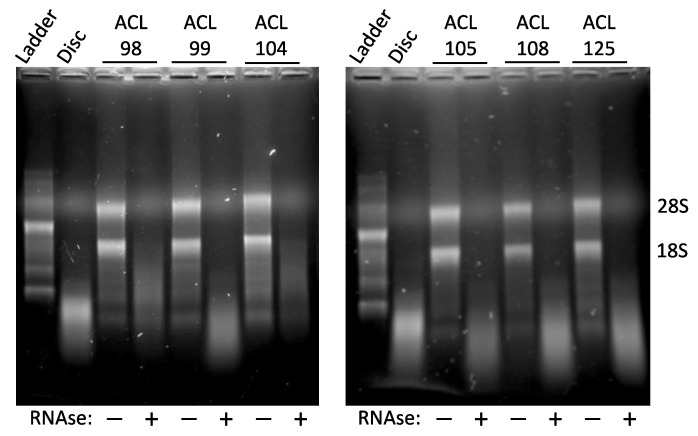
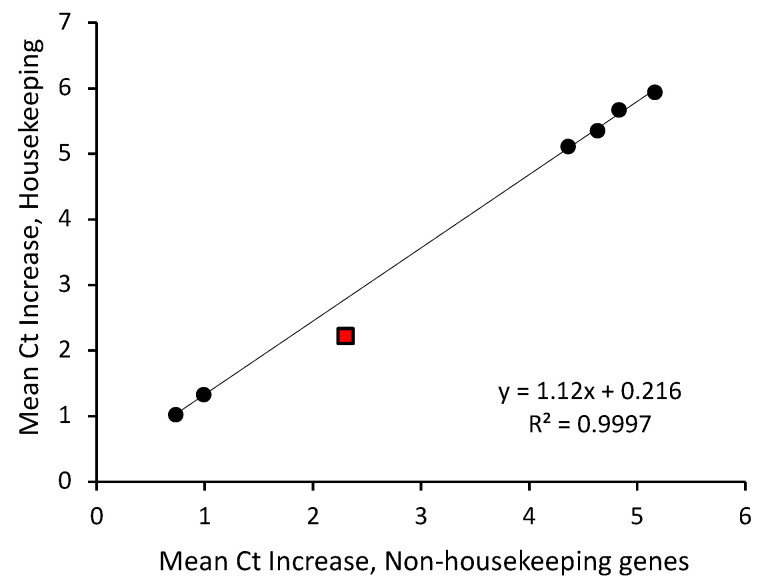
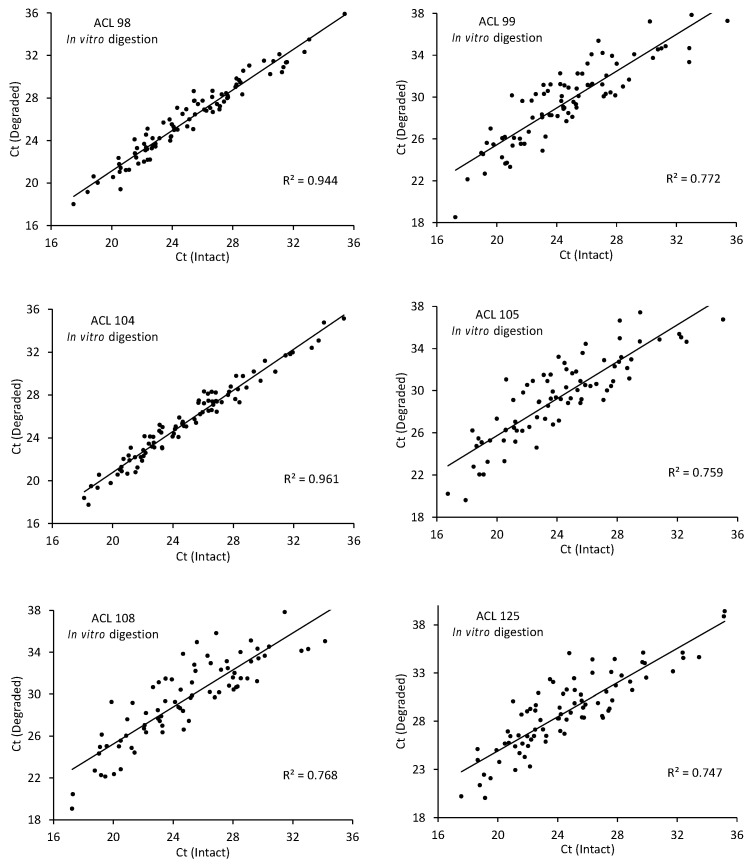
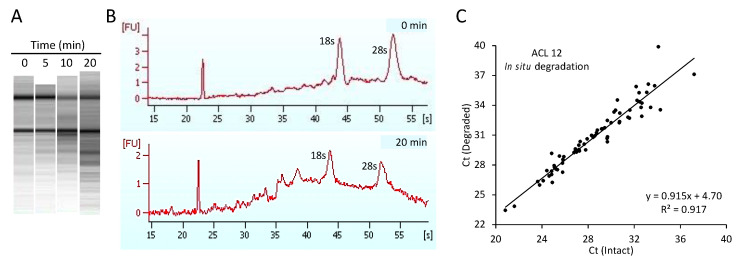
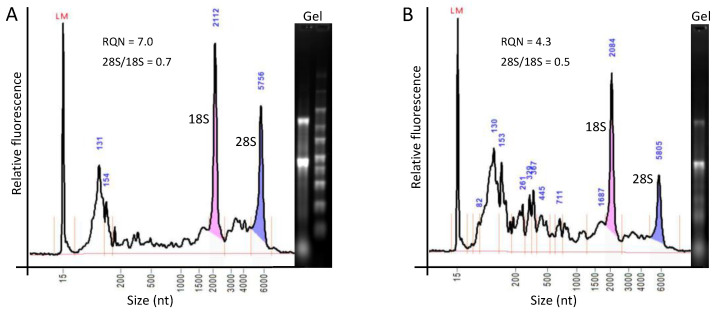
Correlating gene expression patterns with biomechanical properties of connective tissues provides insights into the molecular processes underlying the tissue growth and repair. Cadaveric specimens such as human knees are widely considered suitable for biomechanical studies, but their usefulness for gene expression experiments is potentially limited by the unavoidable, nuclease-mediated degradation of RNA. Here, we tested whether valid gene expression profiles can be obtained using degraded RNA from human anterior cruciate ligaments (ACLs). Human ACL RNA (N = 6) degraded in vitro by limited ribonuclease digestion resemble highly degraded RNA isolated from cadaveric tissue. PCR threshold cycle (C) values for 90 transcripts (84 extracellular matrix, 6 housekeeping) in degraded RNAs variably ranged higher than values obtained from their corresponding non-degraded RNAs, reflecting both the expected loss of target templates in the degraded preparations as well as differences in the extent of degradation. Relative C values obtained for mRNAs in degraded preparations strongly correlated with the corresponding levels in non-degraded RNA, both for each ACL as well as for the pooled results from all six ACLs. Nuclease-mediated degradation produced similar, strongly correlated losses of housekeeping and non-housekeeping gene mRNAs. RNA degraded in situ yielded comparable results, confirming that in vitro digestion effectively modeled degradation by endogenous ribonucleases in frozen and thawed ACL. We conclude that, contrary to conventional wisdom, PCR-based expression analyses can yield valid mRNA profiles even from RNA preparations that are more than 90% degraded, such as those obtained from connective tissues subjected to biomechanical studies. Furthermore, legitimate quantitative comparisons between variably degraded tissues can be made by normalizing data to appropriate housekeeping transcripts.
将基因表达模式与结缔组织的生物力学特性相关联,可以深入了解组织生长和修复的分子过程。尸体标本,如人类膝盖,被广泛认为适合生物力学研究,但它们在基因表达实验中的用途可能受到 RNA 不可避免的核酸酶介导降解的限制。在这里,我们测试了从人类前交叉韧带 (ACL) 中使用降解的 RNA 是否可以获得有效的基因表达谱。体外有限核糖核酸酶消化的人类 ACL RNA(N = 6)类似于从尸体组织中分离的高度降解的 RNA。降解 RNA 中 90 个转录物(84 个细胞外基质,6 个管家)的 PCR 阈值循环(C)值比从相应非降解 RNA 获得的值高,这反映了预期的目标模板在降解制剂中的损失以及降解程度的差异。降解制剂中 mRNA 的相对 C 值与非降解 RNA 中的对应水平强烈相关,无论是对于每个 ACL 还是对于所有 6 个 ACL 的汇总结果都是如此。在降解制剂中,核酸酶介导的降解产生了类似的、强烈相关的管家基因和非管家基因 mRNA 的丢失。原位降解产生了类似的结果,证实了体外消化有效地模拟了冷冻和解冻的 ACL 中内源性核糖核酸酶的降解。我们得出结论,与传统观点相反,即使是从经历生物力学研究的结缔组织中获得的超过 90%降解的 RNA 制剂,基于 PCR 的表达分析也可以产生有效的 mRNA 谱。此外,通过将数据标准化到适当的管家转录物,可以对不同程度降解的组织进行合法的定量比较。