National Medical Research Centre of Cardiology Named after Academician E.I. Chazov, Ministry of Health of the Russian Federation, 15A 3-rd Cherepkovskaya Street, 121552 Moscow, Russia.
State Research Center of the Russian Federation, Institute of Biomedical Problems of Russian Academy of Sciences, 76A Khoroshevskoye Shosse, 123007 Moscow, Russia.
Int J Mol Sci. 2023 Jan 20;24(3):2079. doi: 10.3390/ijms24032079.
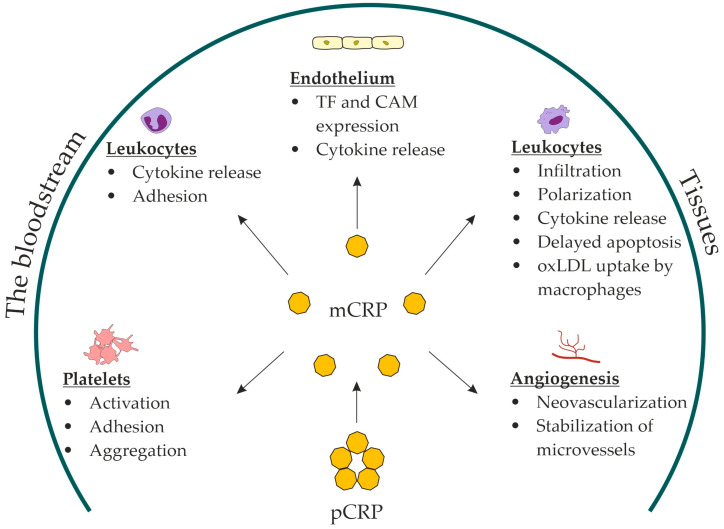
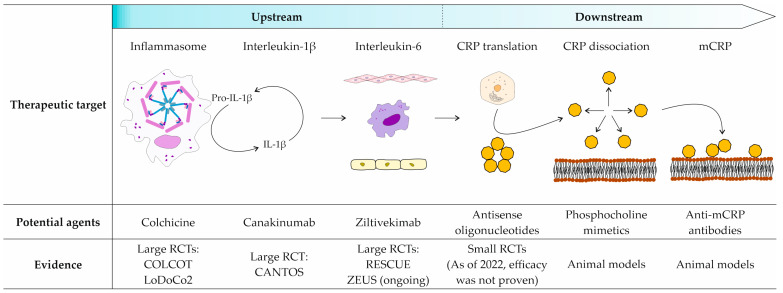
This review aimed to trace the inflammatory pathway from the NLRP3 inflammasome to monomeric C-reactive protein (mCRP) in atherosclerotic cardiovascular disease. CRP is the final product of the interleukin (IL)-1β/IL-6/CRP axis. Its monomeric form can be produced at sites of local inflammation through the dissociation of pentameric CRP and, to some extent, local synthesis. mCRP has a distinct proinflammatory profile. In vitro and animal-model studies have suggested a role for mCRP in: platelet activation, adhesion, and aggregation; endothelial activation; leukocyte recruitment and polarization; foam-cell formation; and neovascularization. mCRP has been shown to deposit in atherosclerotic plaques and damaged tissues. In recent years, the first published papers have reported the development and application of mCRP assays. Principally, these studies demonstrated the feasibility of measuring mCRP levels. With recent advances in detection techniques and the introduction of first assays, mCRP-level measurement should become more accessible and widely used. To date, anti-inflammatory therapy in atherosclerosis has targeted the NLRP3 inflammasome and upstream links of the IL-1β/IL-6/CRP axis. Large clinical trials have provided sufficient evidence to support this strategy. However, few compounds target CRP. Studies on these agents are limited to animal models or small clinical trials.
这篇综述旨在探讨 NLRP3 炎性小体到动脉粥样硬化性心血管疾病中单体 C 反应蛋白(mCRP)的炎症途径。CRP 是白细胞介素 (IL)-1β/IL-6/CRP 轴的最终产物。其单体形式可以通过五聚体 CRP 的解离以及在一定程度上的局部合成在局部炎症部位产生。mCRP 具有独特的促炎特征。体外和动物模型研究表明,mCRP 在以下方面发挥作用:血小板激活、黏附和聚集;内皮细胞激活;白细胞募集和极化;泡沫细胞形成;和新血管生成。mCRP 已被证明沉积在动脉粥样硬化斑块和受损组织中。近年来,首批发表的论文报告了 mCRP 检测方法的开发和应用。这些研究主要证明了测量 mCRP 水平的可行性。随着检测技术的最新进展和首批检测方法的引入,mCRP 水平的测量应该变得更加容易获得和广泛应用。迄今为止,动脉粥样硬化的抗炎治疗靶向 NLRP3 炎性小体和 IL-1β/IL-6/CRP 轴的上游环节。大型临床试验提供了充分的证据支持这一策略。然而,很少有化合物针对 CRP。这些药物的研究仅限于动物模型或小型临床试验。