Hadzik Jakub, Błaszczyszyn Artur, Gedrange Tomasz, Dominiak Marzena
Department of Dental Surgery, Faculty of Medicine and Dentistry, Medical University of Wrocław, 50-367 Wrocław, Poland.
Department of Orthodontics, TU Dresden, 01069 Dresden, Germany.
J Clin Med. 2023 Jan 24;12(3):924. doi: 10.3390/jcm12030924.
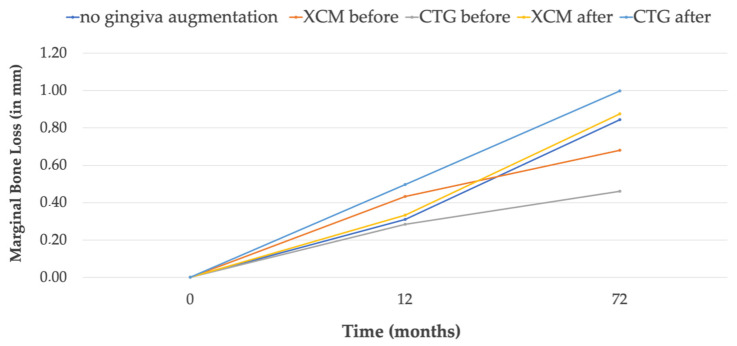
Proper horizontal and vertical thickness of the gingival connective tissue has been proven to be one of the success criteria in dental implant and reconstructive surgery. When thin tissue is found, gingiva augmentation methods can be used to increase the quality and volume of the tissue. Many methods have been described, among them pedicle soft-tissue flaps or autogenic tissue grafts. As an alternative to patients' own tissue, xenogenic materials can be used for grafting. The fundamental issue is to choose a material that will ensure the maximum therapeutic effect, while also minimizing the negative influence on the patient's health. The aim of this study was to compare gingival augmentation procedures using a palatal connective tissue graft (CTG) and an xenogenic soft-tissue substitute, Geistlich Mucograft (xenogeneic collagen matrix; CMX), and assess whether the timing of the graft surgery influences the clinical outcomes. The original study was a randomized control trial with a total of 75 implants placed. The patients received the soft-tissue thickening 3 months before the implant placement or 3 months after the implant placement (depending on the group). A connective tissue graft (CTG) or Geistlich Mucograft were used (depending on the group). For both the CTG and Geistlich Mucograft, better clinical outcomes were observed for maintaining the alveolar bone level and the thickness of the attached gingiva compared to the control group with no gingival augmentation. The Geistlich Mucograft showed good clinical performance in comparison to the control. Soft-tissue augmentation with the CTG before the implant placement was found to be most efficient method in terms of a stable increase of the tissue thickness since, throughout the entire observation period, the greatest increase of 1.035 mm (SD = 0.73 mm) in thickness was observed. Statistically important differences in the tissue thickness baseline compared after 5 years were observed for groups G1 vs. G2b (no augmentation vs. CTG before), G1 vs. G3b (no augmentation vs. CTG after) and for groups G2b vs. G3a (CTG before vs. CMX after).
牙龈结缔组织合适的水平和垂直厚度已被证明是牙种植和重建手术成功的标准之一。当发现组织较薄时,可采用牙龈增厚方法来提高组织的质量和体积。已经描述了许多方法,其中包括带蒂软组织瓣或自体组织移植。作为患者自身组织的替代物,异种材料可用于移植。根本问题是选择一种能确保最大治疗效果,同时又能将对患者健康的负面影响降至最低的材料。本研究的目的是比较使用腭部结缔组织移植(CTG)和异种软组织替代物Geistlich Mucograft(异种胶原基质;CMX)进行牙龈增厚手术,并评估移植手术的时机是否会影响临床结果。原研究是一项随机对照试验,共植入75颗种植体。患者在种植体植入前3个月或植入后3个月接受软组织增厚(取决于分组)。使用结缔组织移植(CTG)或Geistlich Mucograft(取决于分组)。与未进行牙龈增厚的对照组相比,对于CTG和Geistlich Mucograft,在维持牙槽骨水平和附着龈厚度方面均观察到了更好的临床结果。与对照组相比,Geistlich Mucograft表现出良好的临床性能。在种植体植入前使用CTG进行软组织增厚被发现是增加组织厚度最有效的方法,因为在整个观察期内,观察到厚度最大增加了1.035毫米(标准差=0.73毫米)。在5年后比较各组织厚度基线时,观察到G1组与G2b组(无增厚与术前CTG)、G1组与G3b组(无增厚与术后CTG)以及G2b组与G3a组(术前CTG与术后CMX)之间存在统计学上的显著差异。