Department of Oral Implantology, Peking University School and Hospital of Stomatology & National Center of Stomatology & National Clinical Research Center for Oral Diseases & National Engineering Laboratory for Digital and Material Technology of Stomatology & Beijing Key Laboratory of Digital Stomatology & Research Center of Engineering and Technology for Computerized Dentistry Ministry of Health & NMPA Key Laboratory for Dental Materials, No.22 Zhongguancun South Avenue, Haidian District, Beijing, 100081, People's Republic of China.
Int J Implant Dent. 2021 Aug 2;7(1):69. doi: 10.1186/s40729-021-00356-5.
The objective of this study was to compare patient-reported outcome measures (PROMs) and clinical outcomes after augmentation with xenogeneic collagen matrix (XCM) or free gingival graft (FGG) during different postoperative phases.
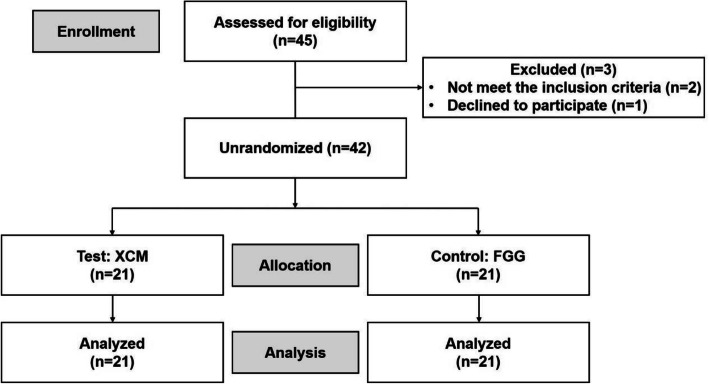
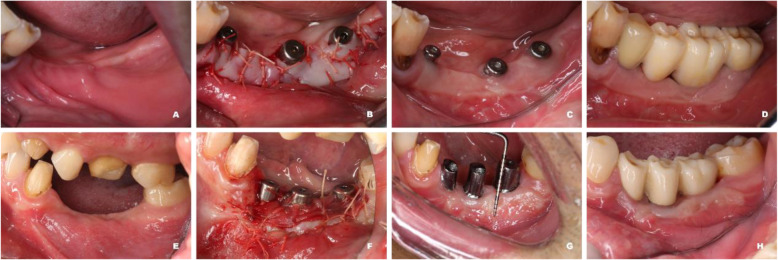
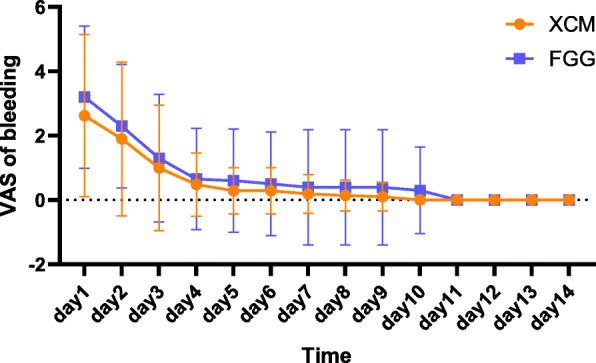
Forty-two patients (21 per group) with keratinized mucosa width (KMW) of < 2 mm at buccal implant sites in the posterior mandible were enrolled. All underwent vestibuloplasty and were allocated to either FGG (control) or XCM (test) group. Intraoperative morbidity of pain, stress, nausea, tolerance to time, and acceptance of surgery were evaluated immediately after surgery. The severity and duration of subjective pain, swelling, and bleeding were compared within a 2-week postoperative period. The willingness to retreat and satisfaction were assessed at 6 months. All PROMs were obtained using questionnaires and visual analog scales. The buccal KMW and other peri-implant parameters were also evaluated.
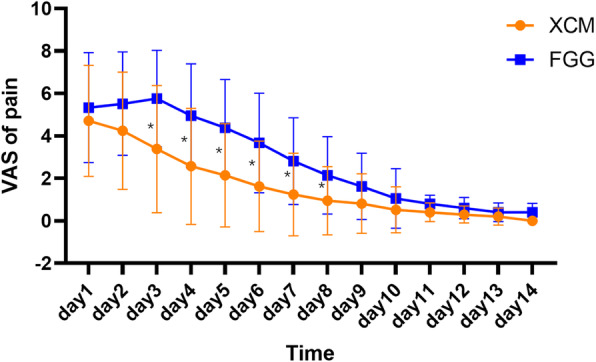
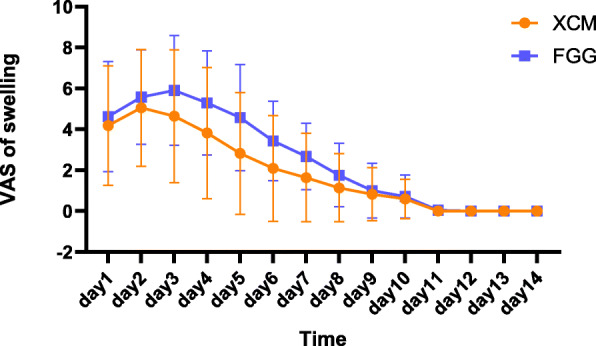
No significant between-group differences were observed in PROMs immediately after surgery, except acceptance of surgery (0, 0-30.0 vs. 30, 0-50.0, p = 0.025). At 2 weeks, pain severity (46.7 ± 25.9 vs 61.9 ± 20.2, p = 0.040) and duration (5.52 ± 3.57 vs 8.48 ± 2.80, p = 0.005) were significantly lower in the test group, and pain perception during speaking and chewing was significantly higher for FGG, with no significant between-group differences in swelling and bleeding. At 6 months, the test group showed a higher willingness to retreat (76% vs 43%, p = 0.021); however, satisfaction with treatment outcomes was similar in both groups. At 6 months, the gain of KMW was significantly higher in FGG than in XCM (XCM: 1.57 ± 1.69 mm, FGG: 2.68 ± 1.80 mm, p = 0.003). Other peri-implant parameters did not show significant differences.
Within the limitation of the present nonrandomized study, XCM demonstrated more positive PROMs than FGG during different postoperative phases, mainly for less pain perception during the early healing stage, but was inferior to FGG in terms of gain of KMW. For KMW augmentation in the posterior mandible, XCM may be indicated when patients can bear little pain.
ChiCTR1900022575 , date of registration: 17/4/2019, retrospectively registered.
本研究旨在比较不同术后阶段使用异种胶原基质(XCM)或游离牙龈移植物(FGG)进行牙槽嵴增量后患者报告的结局测量(PROMs)和临床结局。
42 名(每组 21 名)下颌后牙颊侧种植位点角化黏膜宽度(KMW)<2mm 的患者纳入研究。所有患者均行前庭成形术,并随机分为 FGG(对照组)或 XCM(试验组)组。术后即刻评估术中疼痛、应激、恶心、对时间的耐受和手术接受度等术中发病率。比较术后 2 周内主观疼痛、肿胀和出血的严重程度和持续时间。术后 6 个月评估再治疗意愿和满意度。所有 PROMs 均采用问卷和视觉模拟评分进行评估。还评估了颊侧 KMW 和其他种植体周围参数。
术后即刻,两组间 PROMs 无显著差异,除手术接受度外(0、0-30.0 与 30、0-50.0,p=0.025)。术后 2 周时,试验组疼痛严重程度(46.7±25.9 与 61.9±20.2,p=0.040)和持续时间(5.52±3.57 与 8.48±2.80,p=0.005)均显著较低,FGG 组患者在说话和咀嚼时的疼痛感知度更高,但肿胀和出血无显著差异。术后 6 个月时,试验组有更高的再治疗意愿(76%比 43%,p=0.021);然而,两组治疗效果满意度相似。术后 6 个月时,FGG 组 KMW 增加量明显高于 XCM 组(XCM:1.57±1.69mm,FGG:2.68±1.80mm,p=0.003)。其他种植体周围参数无显著差异。
在本非随机研究的限制范围内,XCM 在不同术后阶段的 PROMs 优于 FGG,主要表现在早期愈合阶段疼痛感知度较低,但在 KMW 增加方面逊于 FGG。对于下颌后牙 KMW 增量,当患者能承受较小疼痛时,XCM 可能是一种选择。
ChiCTR1900022575,注册日期:2019 年 4 月 17 日,回顾性注册。