Tounsi Achraf, Temimi Marouane
Department of Civil, Environmental, and Ocean Engineering, Stevens Institute of Technology, 1 Castle Point Terrace, Hoboken, NJ 07030 USA.
Nat Hazards (Dordr). 2023;116(3):2819-2870. doi: 10.1007/s11069-023-05842-0. Epub 2023 Feb 8.
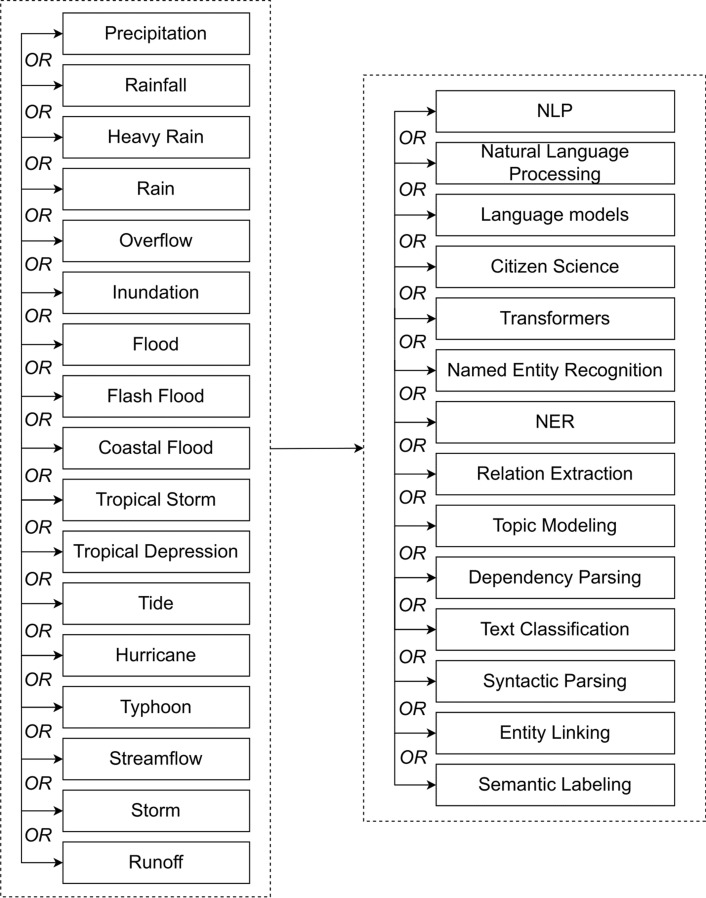
Natural language processing (NLP) is a promising tool for collecting data that are usually hard to obtain during extreme weather, like community response and infrastructure performance. Patterns and trends in abundant data sources such as weather reports, news articles, and social media may provide insights into potential impacts and early warnings of impending disasters. This paper reviews the peer-reviewed studies (journals and conference proceedings) that used NLP to assess extreme weather events, focusing on heavy rainfall events. The methodology searches four databases (ScienceDirect, Web of Science, Scopus, and IEEE Xplore) for articles published in English before June 2022. The preferred reporting items for systematic reviews and meta-analysis reviews and meta-analysis guidelines were followed to select and refine the search. The method led to the identification of thirty-five studies. In this study, hurricanes, typhoons, and flooding were considered. NLP models were implemented in information extraction, topic modeling, clustering, and classification. The findings show that NLP remains underutilized in studying extreme weather events. The review demonstrated that NLP could potentially improve the usefulness of social media platforms, newspapers, and other data sources that could improve weather event assessment. In addition, NLP could generate new information that should complement data from ground-based sensors, reducing monitoring costs. Key outcomes of NLP use include improved accuracy, increased public safety, improved data collection, and enhanced decision-making are identified in the study. On the other hand, researchers must overcome data inadequacy, inaccessibility, nonrepresentative and immature NLP approaches, and computing skill requirements to use NLP properly.
自然语言处理(NLP)是一种很有前景的工具,可用于收集在极端天气期间通常难以获取的数据,如社区反应和基础设施性能。天气报告、新闻文章和社交媒体等丰富数据源中的模式和趋势,可能会为潜在影响以及即将发生的灾害的早期预警提供见解。本文回顾了使用NLP评估极端天气事件的同行评审研究(期刊和会议论文集),重点关注强降雨事件。该方法在四个数据库(科学Direct、科学网、Scopus和IEEE Xplore)中搜索2022年6月之前发表的英文文章。遵循系统评价和元分析的首选报告项目以及元分析指南来选择和优化搜索。该方法最终确定了35项研究。在本研究中,考虑了飓风、台风和洪水。NLP模型应用于信息提取、主题建模、聚类和分类。研究结果表明,NLP在研究极端天气事件方面的应用仍然不足。该综述表明,NLP有可能提高社交媒体平台、报纸和其他数据源的有用性,从而改善天气事件评估。此外,NLP可以生成新的信息,补充地面传感器的数据,降低监测成本。研究确定了NLP使用的关键成果,包括提高准确性、增强公共安全、改善数据收集和加强决策。另一方面,研究人员必须克服数据不足、难以获取、NLP方法缺乏代表性和不成熟以及计算技能要求等问题,才能正确使用NLP。