Centre for Epidemiology and Biostatistics, Melbourne School of Population and Global Health, The University of Melbourne, Melbourne, Australia.
Menzies School of Health Research and Charles Darwin University, Darwin, NT, Australia.
Malar J. 2023 Feb 14;22(1):54. doi: 10.1186/s12936-023-04483-9.
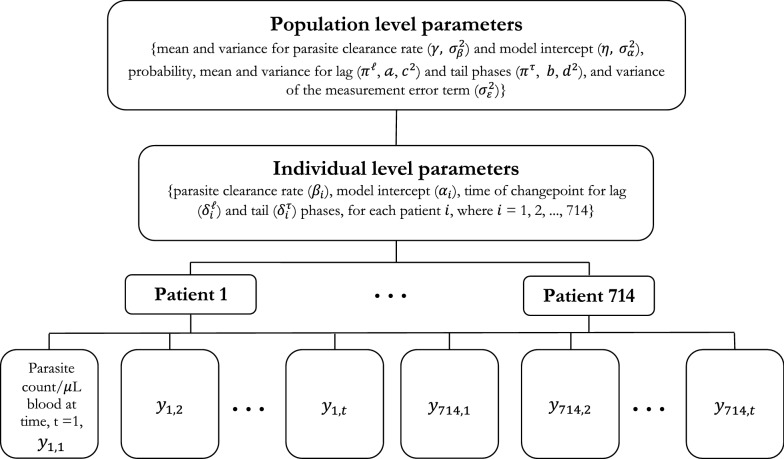
The incidence of zoonotic Plasmodium knowlesi infections in humans is rising in Southeast Asia, leading to clinical studies to monitor the efficacy of anti-malarial treatments for knowlesi malaria. One of the key outcomes of anti-malarial drug efficacy is parasite clearance. For Plasmodium falciparum, parasite clearance is typically estimated using a two-stage method, that involves estimating parasite clearance for individual patients followed by pooling of individual estimates to derive population estimates. An alternative approach is Bayesian hierarchical modelling which simultaneously analyses all parasite-time patient profiles to determine parasite clearance. This study compared these methods for estimating parasite clearance in P. knowlesi treatment efficacy studies, with typically fewer parasite measurements per patient due to high susceptibility to anti-malarials.
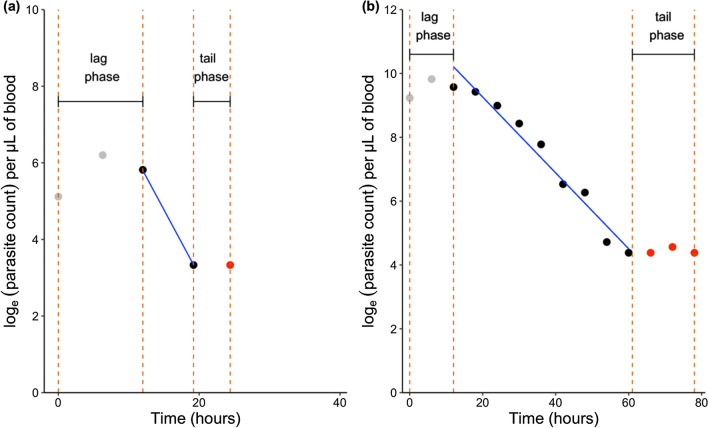
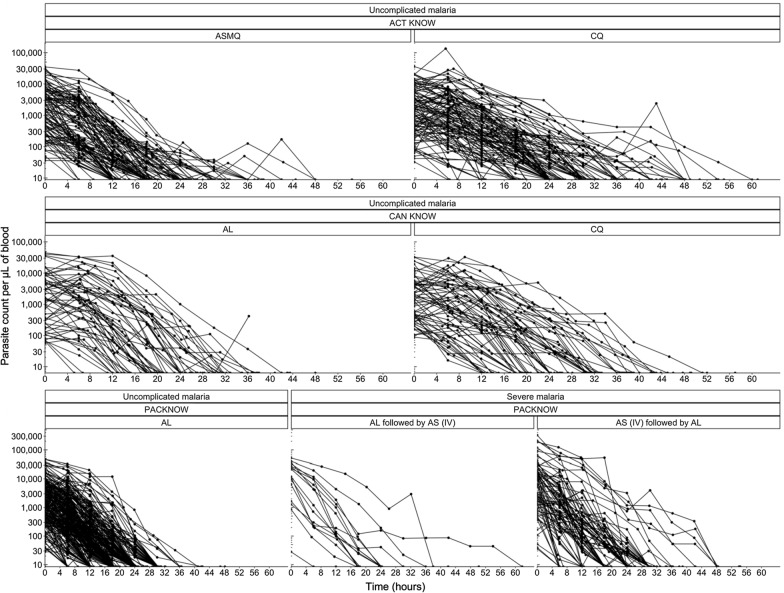
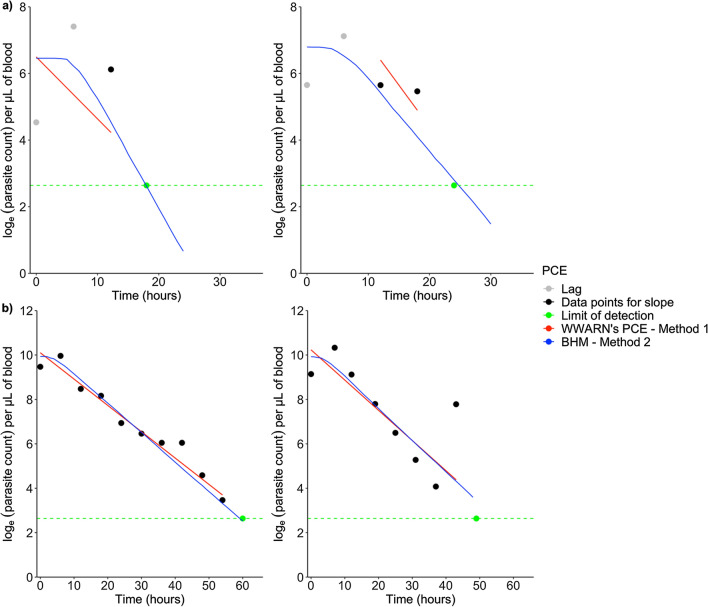
Using parasite clearance data from 714 patients with knowlesi malaria and enrolled in three trials, the Worldwide Antimalarial Resistance Network (WWARN) Parasite Clearance Estimator (PCE) standard two-stage approach and Bayesian hierarchical modelling were compared. Both methods estimate the parasite clearance rate from a model that incorporates a lag phase, slope, and tail phase for the parasitaemia profiles.
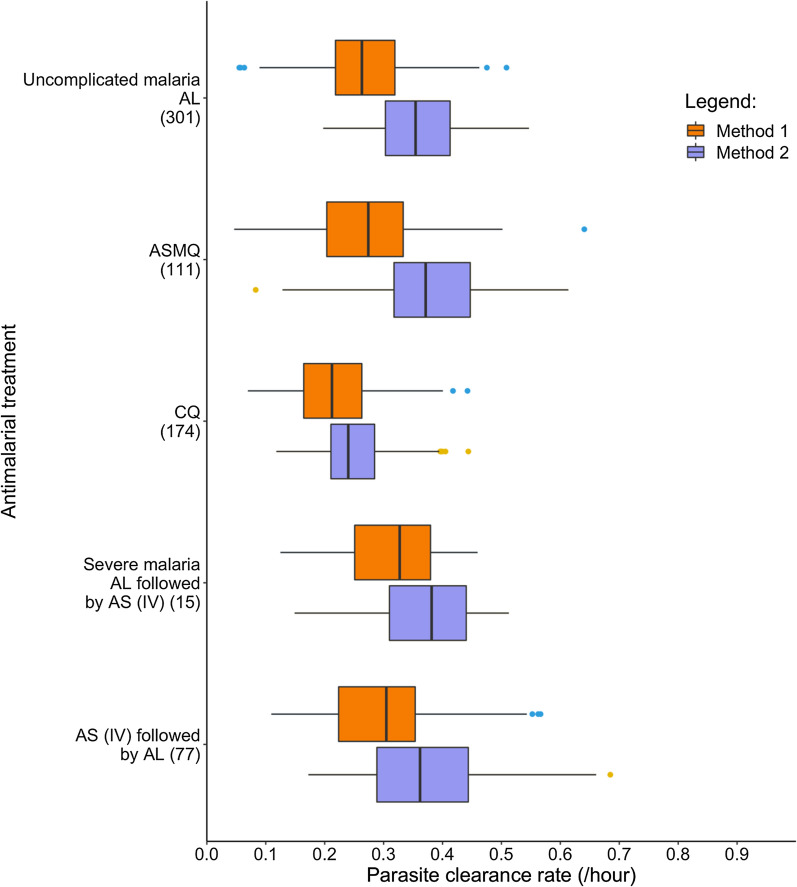
The standard two-stage approach successfully estimated the parasite clearance rate for 678 patients, with 36 (5%) patients excluded due to an insufficient number of available parasitaemia measurements. The Bayesian hierarchical estimation method was applied to the parasitaemia data of all 714 patients. Overall, the Bayesian method estimated a faster population mean parasite clearance (0.36/h, 95% credible interval [0.18, 0.65]) compared to the standard two-stage method (0.26/h, 95% confidence interval [0.11, 0.46]), with better model fits (compared visually). Artemisinin-based combination therapy (ACT) is more effective in treating P. knowlesi than chloroquine, as confirmed by both methods, with a mean estimated parasite clearance half-life of 2.5 and 3.6 h, respectively using the standard two-stage method, and 1.8 and 2.9 h using the Bayesian method.
For clinical studies of P. knowlesi with frequent parasite measurements, the standard two-stage approach (WWARN's PCE) is recommended as this method is straightforward to implement. For studies with fewer parasite measurements per patient, the Bayesian approach should be considered. Regardless of method used, ACT is more efficacious than chloroquine, confirming the findings of the original trials.
人畜共患疟原虫 knowlesi 在东南亚的感染发病率正在上升,这导致了临床研究来监测抗疟药物治疗 knowlesi 疟疾的疗效。抗疟药物疗效的一个关键结果是寄生虫清除。对于恶性疟原虫,寄生虫清除通常使用两阶段方法进行估计,该方法包括估计个体患者的寄生虫清除,然后将个体估计值汇总以得出人群估计值。另一种方法是贝叶斯层次模型,它可以同时分析所有寄生虫-时间患者的情况,以确定寄生虫清除。本研究比较了这些方法在评估 knowlesi 疟治疗疗效研究中的寄生虫清除,由于对抗疟药物的高度敏感性,每个患者的寄生虫测量通常较少。
使用来自 714 例 knowlesi 疟疾患者的数据,并纳入三项试验,比较了世界抗疟网(WWARN)寄生虫清除估计器(PCE)的标准两阶段方法和贝叶斯层次模型。这两种方法都从一个模型中估计寄生虫清除率,该模型包含一个滞后期、斜率和寄生虫血症曲线的尾部期。
标准两阶段方法成功地估计了 678 例患者的寄生虫清除率,由于可获得的寄生虫血症测量值数量不足,有 36 例(5%)患者被排除在外。贝叶斯层次估计方法应用于所有 714 例患者的寄生虫血症数据。总体而言,贝叶斯方法估计的人群平均寄生虫清除速度较快(0.36/h,95%可信区间[0.18,0.65]),而标准两阶段方法为 0.26/h(95%置信区间[0.11,0.46]),且具有更好的模型拟合度(通过视觉比较)。基于青蒿素的联合疗法(ACT)治疗 P. knowlesi 比氯喹更有效,这两种方法都得到了证实,标准两阶段方法的平均估计寄生虫清除半衰期分别为 2.5 和 3.6 小时,而贝叶斯方法分别为 1.8 和 2.9 小时。
对于寄生虫测量频繁的 P. knowlesi 临床研究,建议使用标准两阶段方法(WWARN 的 PCE),因为这种方法易于实施。对于每个患者的寄生虫测量值较少的研究,应考虑贝叶斯方法。无论使用哪种方法,ACT 都比氯喹更有效,这证实了原始试验的结果。