Toure Offianan Andre, Landry Tiacoh N'Guessan, Assi Serge Brice, Kone Antoinette Amany, Gbessi Eric Adji, Ako Berenger Aristide, Coulibaly Baba, Kone Bouakary, Ouattara Oumar, Beourou Sylvain, Koffi Alphonsine, Remoue Franck, Rogier Christophe
Malariology Unit, Pasteur Institute of Côte d'Ivoire, Abidjan, Côte d'Ivoire,
Malaria and Anopheles Research and Management Unit, Pierre Richet Institute, Bouake, Côte d'Ivoire.
Infect Drug Resist. 2018 Oct 26;11:2031-2038. doi: 10.2147/IDR.S167518. eCollection 2018.
Parasite clearance is useful to detect artemisinin resistance. The aim of this study was to investigate parasite clearance in patients treated with artesunate + amodiaquine (AS + AQ) and artemether + lumefantrine (AL): the two artemisinin-based combination therapies (ACTs) recommended in the first-line treatment of uncomplicated malaria in Côte d'Ivoire.
This study was conducted in Bouaké, Côte d'Ivoire, from April to June 2016. Patients aged at least 6 months with uncomplicated malaria and treated with AS + AQ or AL were hospitalized for 3 days, and follow-up assessments were performed on days 3, 7, 14, 21, 28, 35, and 42. Blood smears were collected at the time of screening, pre-dose, and 6-hour intervals following the first dose of administration until two consecutive negative smears were recorded, thereafter at day 3 and follow-up visits. Parasite clearance was determined using the Worldwide Antimalarial Resistance Network's parasite clearance estimator. The primary end points were parasite clearance rate and time.
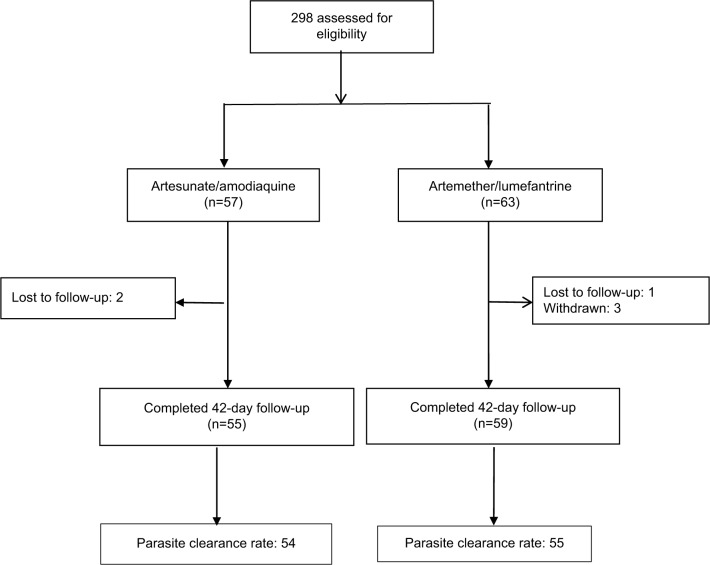
A total of 120 patients (57 in the AS + AQ group and 63 in the AL group) were randomized among 298 patients screened. The median parasite clearance time was 30 hours (IQR, 24-36 hours), for each ACT. The median parasite clearance rate had a slope half-life of 2.36 hours (IQR, 1.85-2.88 hours) and 2.23 hours (IQR, 1.74-2.63 hours) for AS + AQ and AL, respectively. The polymerase chain reaction-corrected adequate clinical and parasitological response was 100% and 98.07% at day 42 for AS + AQ and AL, respectively.
Patients treated with AS + AQ and AL had cleared parasites rapidly. ACTs are still efficacious in Bouaké, Côte d'Ivoire, but continued efficacy monitoring of ACTs is needed.
寄生虫清除情况对于检测青蒿素耐药性很有用。本研究的目的是调查接受青蒿琥酯+阿莫地喹(AS+AQ)和蒿甲醚+本芴醇(AL)治疗的患者的寄生虫清除情况:这是科特迪瓦用于治疗非复杂性疟疾一线治疗中推荐的两种基于青蒿素的联合疗法(ACTs)。
本研究于2016年4月至6月在科特迪瓦的布瓦凯进行。年龄至少6个月的非复杂性疟疾患者接受AS+AQ或AL治疗,住院3天,并在第3、7、14、21、28、35和42天进行随访评估。在筛查时、给药前以及首次给药后每隔6小时采集血涂片,直至连续两次涂片结果为阴性,此后在第3天和随访时采集。使用全球抗疟药物耐药性网络的寄生虫清除率估算器来确定寄生虫清除情况。主要终点是寄生虫清除率和清除时间。
在298例筛查患者中,共有120例患者(AS+AQ组57例,AL组63例)被随机分组。每种ACT的寄生虫清除时间中位数为30小时(四分位间距,24 - 36小时)。AS+AQ组和AL组的寄生虫清除率中位数的斜率半衰期分别为2.36小时(四分位间距,1.85 - 2.88小时)和2.23小时(四分位间距,1.74 - 2.63小时)。在第42天,AS+AQ组和AL组经聚合酶链反应校正的充分临床和寄生虫学反应分别为100%和98.07%。
接受AS+AQ和AL治疗的患者寄生虫清除迅速。ACTs在科特迪瓦的布瓦凯仍然有效,但需要持续监测ACTs的疗效。