Garbe Enrico, Thielemann Nadja, Hohner Sina, Kumar Animesh, Vylkova Slavena, Kurzai Oliver, Martin Ronny
Septomics Research Center, Friedrich Schiller University and Leibniz Institute for Natural Product Research and Infection Biology - Hans Knöll Institute, Jena, Germany.
Institute for Hygiene and Microbiology, University of Würzburg, Würzburg, Germany.
Microbiol Spectr. 2023 Feb 14;11(2):e0025323. doi: 10.1128/spectrum.00253-23.
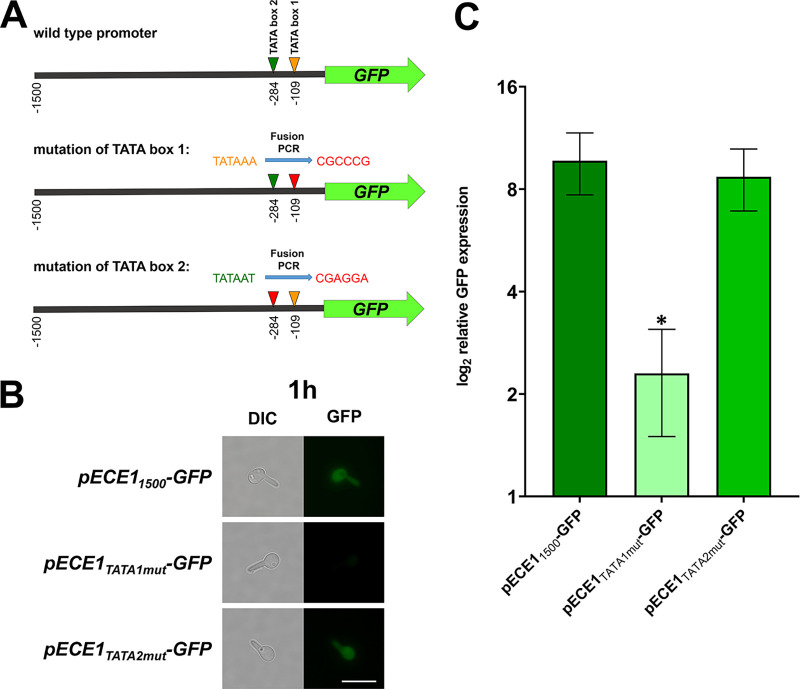
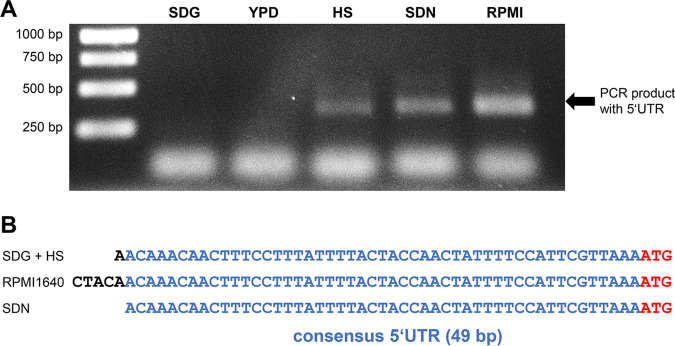
The formation of hyphae is a key virulence attribute of Candida albicans as they are required for adhesion to and invasion of host cells, and ultimately deep-tissue dissemination. Hyphae also secrete the peptide toxin candidalysin, which is crucial for destruction of host cell membranes. The peptide is derived from a precursor protein encoded by the gene which is strongly induced during hyphal growth. Previous studies revealed a very complex regulation of this gene involving several transcription factors. However, the promoter of the gene is still not characterized. Here, we present a functional analysis of the intergenic region upstream of the gene. Rapid amplification of cDNA ends (RACE)-PCR was performed to identify the 5' untranslated region, which has a size of 49 bp regardless of the hyphae-inducing condition. By using green fluorescent protein (GFP) reporter constructs we further defined a minimal promoter length of 1,500 bp which was verified by RT-qPCR. Finally, we identified the TATA element required for the expression of the gene. It is located 106 to 109 bp upstream of the start codon. Our results illustrate that despite a very short 5' UTR, a relatively long promoter is required to secure transcription, indicating a complex regulatory machinery tightly controlling the expression of the gene. In recent years it was shown that secretion of the toxic peptide candidalysin from hyphae of the major human fungal pathogen Candida albicans contributes heavily to its virulence. The peptide is derived from a precursor protein which is encoded by the gene whose transcription is known to be closely associated with formation of hyphae. Here, we used a GFP reporter system to determine the length of the promoter and were able to show that it has a minimal size of 1,500 bp. Surprisingly, the gene has a very short 5' UTR of only 49 bp. In accordance with this, the TATA element required for transcription is located 106 to 109 bp upstream of the start codon. This indicates that expression is controlled by a very long promoter allowing a complex network of transcription factors to contribute to the gene's regulation.
菌丝的形成是白色念珠菌的一个关键毒力属性,因为宿主细胞的黏附、侵袭以及最终的深部组织播散都需要菌丝。菌丝还会分泌肽毒素念珠溶素,这对于破坏宿主细胞膜至关重要。该肽源自一个由基因编码的前体蛋白,该基因在菌丝生长过程中被强烈诱导。先前的研究揭示了该基因非常复杂的调控机制,涉及多个转录因子。然而,该基因的启动子仍未得到表征。在此,我们对该基因上游的基因间区域进行了功能分析。进行了cDNA末端快速扩增(RACE)-PCR以鉴定5'非翻译区,无论菌丝诱导条件如何,其大小均为49bp。通过使用绿色荧光蛋白(GFP)报告基因构建体,我们进一步确定了最小启动子长度为1500bp,这通过RT-qPCR得到了验证。最后,我们确定了该基因表达所需的TATA元件。它位于起始密码子上游106至109bp处。我们的结果表明,尽管5'UTR非常短,但需要一个相对较长的启动子来确保转录,这表明存在一个复杂的调控机制来严格控制该基因的表达。近年来研究表明,主要人类真菌病原体白色念珠菌的菌丝分泌的有毒肽念珠溶素对其毒力有很大贡献。该肽源自一种前体蛋白,该前体蛋白由基因编码,已知其转录与菌丝形成密切相关。在此,我们使用GFP报告系统确定了该启动子的长度,并能够表明其最小大小为1500bp。令人惊讶的是,该基因只有49bp的非常短的5'UTR。与此一致的是,转录所需的TATA元件位于起始密码子上游106至109bp处。这表明该基因的表达由一个非常长的启动子控制,允许一个复杂的转录因子网络参与该基因的调控。