Department of Anaesthesia and Intensive Care Medicine, Third Faculty of Medicine, Charles University and University Hospital Královské Vinohrady, Prague, Czech Republic.
Ottawa Hospital Research Institute, Ottawa, ON, Canada.
Sci Rep. 2023 Feb 14;13(1):2632. doi: 10.1038/s41598-023-29042-9.
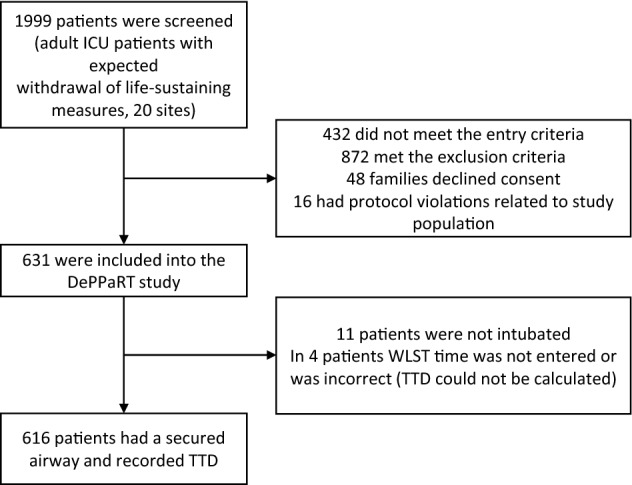
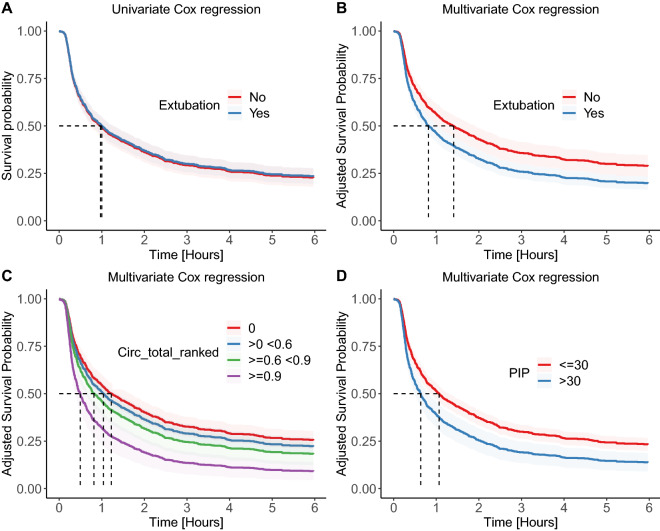
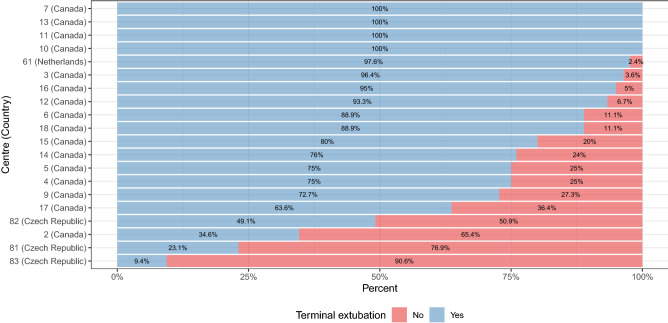
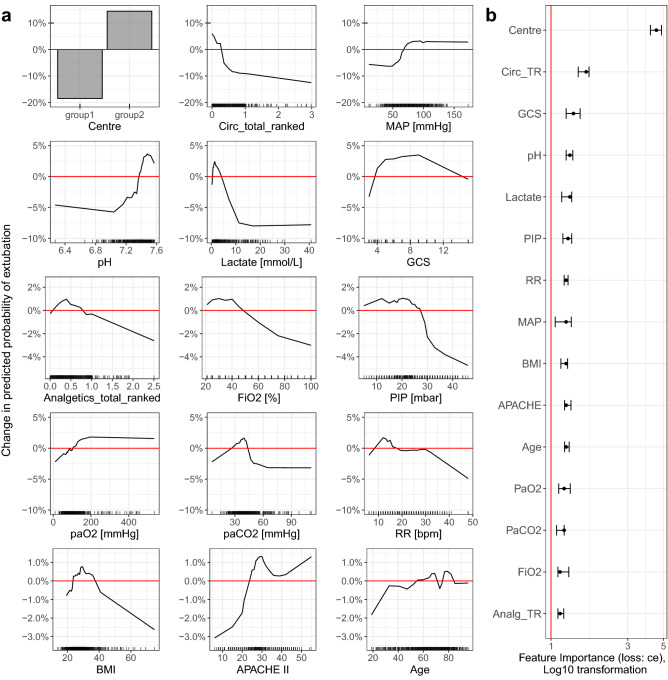
Procedural aspects of compassionate care such as the terminal extubation are understudied. We used machine learning methods to determine factors associated with the decision to extubate the critically ill patient at the end of life, and whether the terminal extubation shortens the dying process. We performed a secondary data analysis of a large, prospective, multicentre, cohort study, death prediction and physiology after removal of therapy (DePPaRT), which collected baseline data as well as ECG, pulse oximeter and arterial waveforms from WLST until 30 min after death. We analysed a priori defined factors associated with the decision to perform terminal extubation in WLST using the random forest method and logistic regression. Cox regression was used to analyse the effect of terminal extubation on time from WLST to death. A total of 616 patients were included into the analysis, out of which 396 (64.3%) were terminally extubated. The study centre, low or no vasopressor support, and good respiratory function were factors significantly associated with the decision to extubate. Unadjusted time to death did not differ between patients with and without extubation (median survival time extubated vs. not extubated: 60 [95% CI: 46; 76] vs. 58 [95% CI: 45; 75] min). In contrast, after adjustment for confounders, time to death of extubated patients was significantly shorter (49 [95% CI: 40; 62] vs. 85 [95% CI: 61; 115] min). The decision to terminally extubate is associated with specific centres and less respiratory and/or vasopressor support. In this context, terminal extubation was associated with a shorter time to death.
同情护理的程序方面,如终末拔管,研究较少。我们使用机器学习方法来确定与病危患者生命终末期拔管决定相关的因素,以及终末拔管是否会缩短死亡过程。我们对一项大型、前瞻性、多中心队列研究进行了二次数据分析,该研究名为预测死亡和治疗后生理学(DePPaRT),该研究从 WLST 开始收集基线数据以及 ECG、脉搏血氧仪和动脉波形,直到死亡后 30 分钟。我们使用随机森林方法和逻辑回归分析了与 WLST 中进行终末拔管决定相关的预先定义因素。Cox 回归用于分析终末拔管对 WLST 到死亡时间的影响。共纳入 616 例患者进行分析,其中 396 例(64.3%)被终末拔管。研究中心、低或无血管加压支持以及良好的呼吸功能是与拔管决定显著相关的因素。未调整的死亡时间在拔管和未拔管患者之间没有差异(拔管患者的中位生存时间为 60[95%CI:46;76]min,未拔管患者为 58[95%CI:45;75]min)。相比之下,调整混杂因素后,拔管患者的死亡时间明显缩短(49[95%CI:40;62]min,85[95%CI:61;115]min)。终末拔管的决定与特定中心以及较少的呼吸和/或血管加压支持相关。在这种情况下,终末拔管与死亡时间缩短有关。