Division of Addiction Research and Treatment, Department of Psychiatry, University of Maryland School of Medicine, 1001 W. Pratt Street, Baltimore, MD, 21223, USA.
Department of Family and Community Medicine, University of California, San Francisco School of Medicine, San Francisco, CA, USA.
Harm Reduct J. 2023 Feb 14;20(1):17. doi: 10.1186/s12954-023-00745-6.
Despite the widespread availability of naloxone, US opioid overdose rates continue to rise. The "Cascade of Care" (CoC) is a public health approach that identifies steps in achieving specific outcomes and has been used to identify gaps in naloxone carriage among individuals with opioid use disorder (OUD). We sought to apply this framework to a treatment-seeking population with OUD that may be more inclined to engage in harm reduction behaviors.
Patients were recruited from an urban methadone program to complete a survey. We assessed naloxone familiarity, availability, obtainability, training, and possession, as well as naloxone carriage rates, demographics, and harm reduction behaviors. A multivariable logistic regression examined associations between naloxone carriage and individual-level factors.
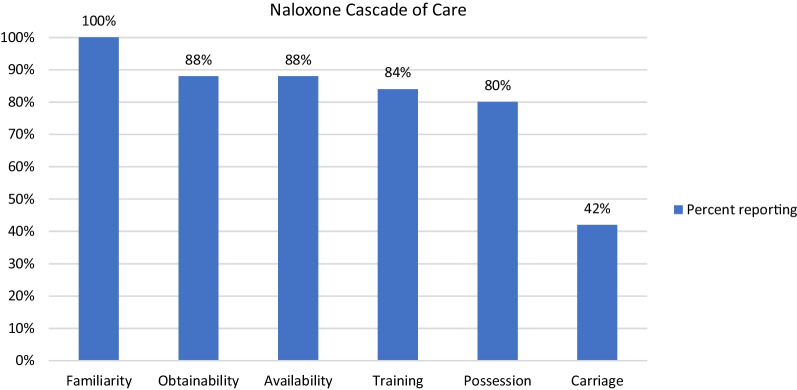
Participants (n = 97) were majority male (59%), with a mean age of 48 (SD = 12), 27% had college education or higher, 64% indicated injection drug use, and 84% reported past naloxone training. All participants endorsed familiarity with naloxone, but only 42% regularly carried naloxone. The following variables were associated with carrying naloxone: White race (aOR = 2.94, 95% CI 1.02-8.52), college education (aOR = 8.11, 95% CI 1.76-37.47), and total number of self-reported harm reduction behaviors (aOR = 1.45, 95% CI 1.00-2.11).
We found low rates of naloxone carriage among methadone-treated patients. Methadone programs provide opportunities for naloxone interventions and should target racial/ethnic minorities and individuals with lower education. The spectrum of harm reduction behaviors should be encouraged among these populations to enhance naloxone carriage.
尽管纳洛酮广泛可用,但美国阿片类药物过量率仍在继续上升。“护理级联”(CoC)是一种公共卫生方法,可确定实现特定结果的步骤,并且已用于确定阿片类药物使用障碍(OUD)个体携带纳洛酮的差距。我们试图将此框架应用于可能更倾向于采取减少伤害行为的寻求治疗的 OUD 人群。
从城市美沙酮计划中招募患者完成一项调查。我们评估了纳洛酮的熟悉程度、可用性、可获得性、培训和拥有情况,以及纳洛酮携带率、人口统计学和减少伤害行为。多变量逻辑回归检查了纳洛酮携带与个体因素之间的关联。
参与者(n=97)主要为男性(59%),平均年龄为 48 岁(SD=12),27%具有大学学历或更高学历,64%表示使用注射药物,84%报告过去接受过纳洛酮培训。所有参与者都表示熟悉纳洛酮,但只有 42%的人经常携带纳洛酮。以下变量与携带纳洛酮有关:白种人(aOR=2.94,95%CI 1.02-8.52)、大学学历(aOR=8.11,95%CI 1.76-37.47)和自我报告的减少伤害行为总数(aOR=1.45,95%CI 1.00-2.11)。
我们发现美沙酮治疗患者携带纳洛酮的比例较低。美沙酮计划为纳洛酮干预提供了机会,应针对少数民族和教育程度较低的人群。应鼓励这些人群采取各种减少伤害行为,以增强纳洛酮的携带。