Kim Hack-Lyoung, Lee Eun Mi, Ahn Shin Young, Kim Kwang-Il, Kim Hyeon Chang, Kim Ju Han, Lee Hae-Young, Lee Jang Hoon, Park Jong-Moo, Cho Eun Joo, Park Sungha, Shin Jinho, Kim Young-Kwon
Department of Internal Medicine, Seoul Metropolitan Government Seoul National University Boramae Medical Center, Seoul National University College of Medicine, Seoul, Republic of Korea.
Department of Internal Medicine, Wonkwang University Sanbon Hospital, Wonkwang University School of Medicine, Gunpo, Republic of Korea.
Clin Hypertens. 2023 Feb 15;29(1):11. doi: 10.1186/s40885-023-00234-9.
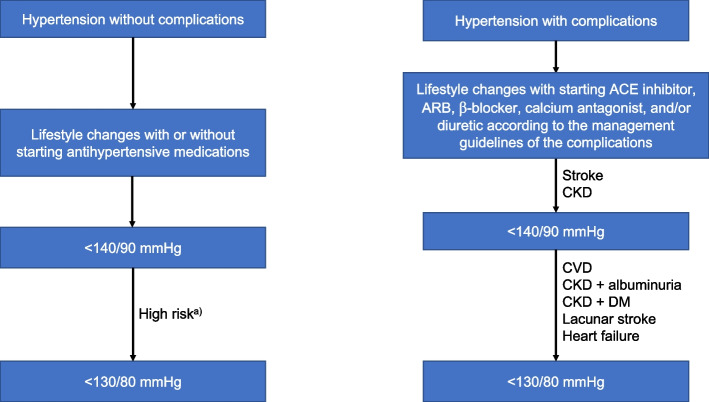
Hypertension is the leading cause of death in human being, which shows high prevalence and associated complications that increase the mortality and morbidity. Controlling blood pressure (BP) is very important because it is well known that lowering high BP effectively improves patients' prognosis. This review aims to provide a focused update of the 2018 Korean Hypertension Society Guidelines for the management of hypertension. The importance of ambulatory BP and home BP monitoring was further emphasized not only for the diagnosis but also for treatment target. By adopting corresponding BPs, the updated guideline recommended out-of-office BP targets for both standard and intensive treatment. Based on the consensus on corresponding BPs and Systolic Blood Pressure Intervention Trial (SPRINT) revisit, the updated guidelines recommended target BP in high-risk patients below 130/80 mmHg and it applies to hypertensive patients with three or more additional cardiovascular risk factors, one or more risk factors with diabetes, or hypertensive patients with subclinical organ damages, coronary or vascular diseases, heart failure, chronic kidney disease with proteinuria, and cerebral lacunar infarction. Cerebral infarction and chronic kidney disease are also high-risk factors for cardiovascular disease. However, due to lack of evidence, the target BP was generally determined at < 140/90 mmHg in patients with those conditions as well as in the elderly. Updated contents regarding the management of hypertension in special situations are also discussed.
高血压是人类死亡的主要原因,其患病率高且伴有并发症,会增加死亡率和发病率。控制血压非常重要,因为众所周知,有效降低高血压可改善患者预后。本综述旨在重点更新2018年韩国高血压学会高血压管理指南。动态血压和家庭血压监测的重要性不仅在诊断方面,而且在治疗目标方面都得到了进一步强调。通过采用相应的血压标准,更新后的指南推荐了标准治疗和强化治疗的诊室外血压目标。基于对相应血压标准的共识以及收缩压干预试验(SPRINT)的重新审视,更新后的指南推荐高危患者的血压目标低于130/80 mmHg,这适用于具有三个或更多其他心血管危险因素、一个或多个糖尿病危险因素的高血压患者,或患有亚临床器官损害、冠状动脉或血管疾病、心力衰竭、伴有蛋白尿的慢性肾脏病以及脑腔隙性梗死的高血压患者。脑梗死和慢性肾脏病也是心血管疾病的高危因素。然而,由于缺乏证据,对于患有这些疾病的患者以及老年人,血压目标通常确定为<140/90 mmHg。还讨论了特殊情况下高血压管理的更新内容。