Institute of Evolutionary Medicine, University of Zurich, Zurich, Switzerland.
Am J Biol Anthropol. 2022 Oct;179(2):307-313. doi: 10.1002/ajpa.24600. Epub 2022 Aug 5.
Ancient Egyptian remains have been of interest for anthropological research for decades. Despite many investigations, the ritual vessels for the internal organs removed during body preparation-liver, lungs, stomach, and intestines, of Egyptian mummies are rarely used for palaeopathological or medical investigations. These artifacts, commonly referred to as canopic jars, are the perfect combination of cultural and biological material and present an untapped resource for both Egyptological and medical fields. Nevertheless, technical challenges associated with this archeological material have prevented the application of current ancient DNA techniques for both the characterization of human and pathogenic DNA. We present shotgun-sequenced metagenomic profiles and ancient DNA degradation patterns from multiple canopic jars sampled from several European museum collections and enumerate current limitations and possible solutions for the future analysis of similar material. This is the first-ever recorded evidence of ancient human DNA found in Ancient Egyptian canopic jars and the first associated metagenomic description of bacterial taxa in these funerary artifacts.
In this study, our objectives were to characterize the metagenomic profile of the Ancient Egyptian funerary vessels known as canopic jars to retrieve endogenous ancient human DNA, reconstruct ancient microbial communities, and identify possible pathogens that could shed light on disease states of individuals from the past.
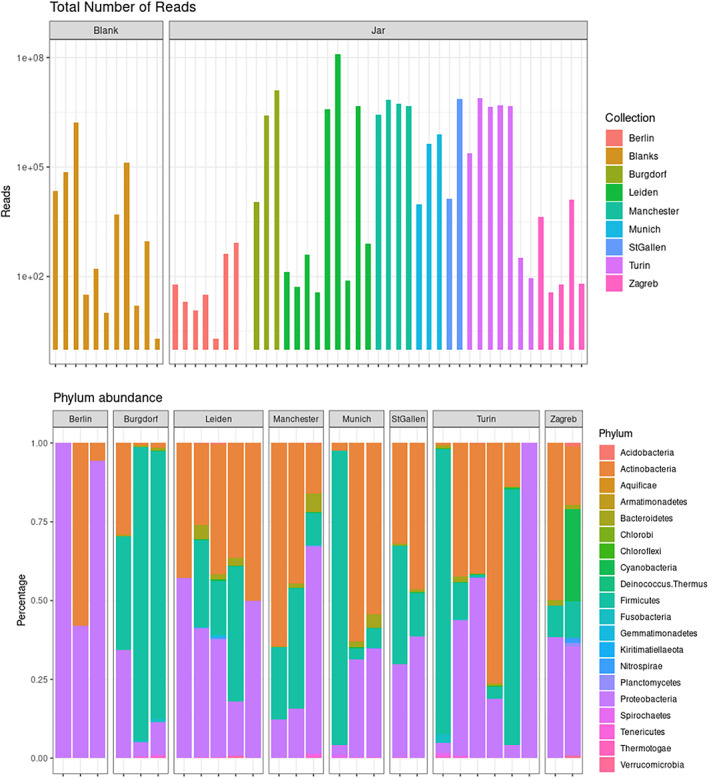
We applied ancient DNA techniques on 140 canopic jars to extract DNA and generate whole-genome sequencing libraries for the analysis of both human and bacterial DNA. The samples were obtained from museum collections in Berlin (DE), Burgdorf (DE), Leiden (NE), Manchester (UK), Munich (DE), St. Gallen (CH), Turin (IT), and Zagreb (HR).
Here we describe the first isolated DNA from the Egyptian artifacts that hold human viscera. No previous work was ever conducted on such material, which led to the first characterization of human DNA from Ancient Egyptian canopic jars and the profiling of the complex bacterial composition of this highly degraded, challenging, organic material. However, the DNA recovered was not of enough quality to confidently characterize bacterial taxa associated with infectious diseases, nor exclusive bacterial members of the human microbiome.
In summary, we present the first genomic survey of the visceral content of Ancient Egyptian funerary artifacts and demonstrate the limitations of current molecular methods to analyze canopic jars, such as the incomplete history of the objects or the presence of uncharacterized compounds that can hamper the recovery of DNA. Our work highlights the main challenges and caveats when working with such complicated archeological material - and offers sampling recommendations for similarly complex future studies, such as incrementing the amount of starting material and sampling from the less exposed parts of the jar content. This is the first-ever recorded evidence of ancient human DNA found in Ancient Egyptian canopic jars, and our results open new avenues in the study of neglected archeological artifacts.
古埃及文物几十年来一直是人类学研究的对象。尽管进行了许多调查,但在尸体准备过程中去除的内部器官(肝脏、肺、胃和肠)的仪式容器——埃及木乃伊的容器很少用于古病理学或医学研究。这些被称为卡诺皮克罐的文物是文化和生物材料的完美结合,为埃及学和医学领域提供了尚未开发的资源。然而,与这种考古材料相关的技术挑战阻止了当前古代 DNA 技术的应用,无法对人类和致病 DNA 进行特征描述。我们从几个欧洲博物馆收藏的多个卡诺皮克罐中提供了高通量测序的宏基因组图谱和古代 DNA 降解模式,并列举了当前分析类似材料的局限性和可能的解决方案。这是首次在古埃及卡诺皮克罐中发现古代人类 DNA 的记录证据,也是首次对这些丧葬文物中细菌分类群进行相关的宏基因组描述。
在这项研究中,我们的目标是描述已知的古埃及丧葬容器(卡诺皮克罐)的宏基因组图谱,以提取内源性古人类 DNA,重建古代微生物群落,并识别可能揭示过去个体疾病状态的病原体。
我们对来自柏林(德国)、布尔格多夫(德国)、莱顿(荷兰)、曼彻斯特(英国)、慕尼黑(德国)、圣加仑(瑞士)、都灵(意大利)和萨格勒布(克罗地亚)的博物馆藏品中的 140 个卡诺皮克罐应用了古代 DNA 技术,以提取 DNA 并生成全基因组测序文库,用于分析人类和细菌 DNA。
在这里,我们描述了首次从埃及文物中分离出的人类内脏 DNA。以前从未对这种材料进行过研究,这导致了首次从古埃及卡诺皮克罐中鉴定出人类 DNA,并对这种高度降解的复杂有机材料的复杂细菌组成进行了分析。然而,回收的 DNA 质量不够,无法对与传染病相关的细菌分类群进行有把握的特征描述,也无法确定人类微生物组中独特的细菌成员。
总之,我们首次对古埃及丧葬文物的内脏内容进行了基因组调查,并展示了当前分子方法分析卡诺皮克罐的局限性,例如物体的不完整历史或存在未被识别的化合物,这些化合物可能会阻碍 DNA 的回收。我们的工作突出了处理此类复杂考古材料时的主要挑战和注意事项,并为类似复杂的未来研究提供了采样建议,例如增加起始材料的数量,并从罐子内容物的暴露较少的部分进行采样。这是首次在古埃及卡诺皮克罐中发现古代人类 DNA 的记录证据,我们的结果为研究被忽视的考古文物开辟了新途径。