Carrozza Maria-Luisa, Niewiadomska Anna-Maria, Mazzei Maurizio, Abi-Said Mounir R, Hué Stéphane, Hughes Joseph, Gatseva Anna, Gifford Robert J
Scuola Normale Superiore, Piazza dei Cavalieri 7, Pisa 56126, Italy.
Virus Pathogen Resource, J. Craig Venter Institute, 9605 Medical Center Drive, Suite 150, Rockville, MD 20850, USA.
Virus Evol. 2023 Jan 18;9(1):vead005. doi: 10.1093/ve/vead005. eCollection 2023.
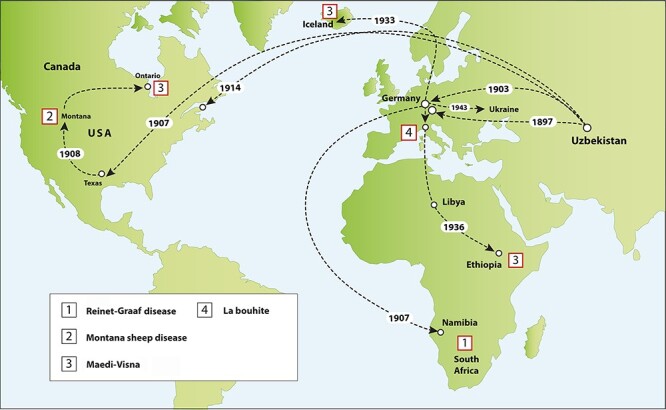
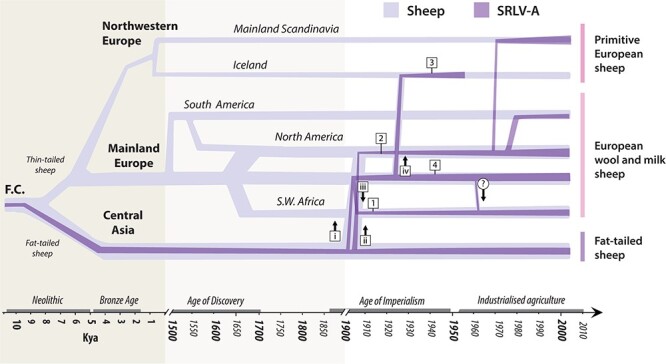
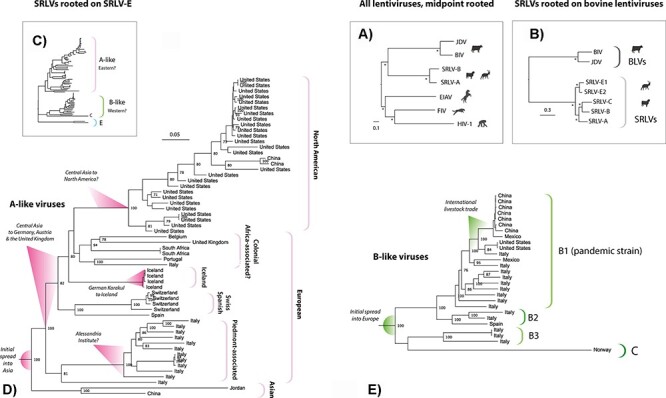
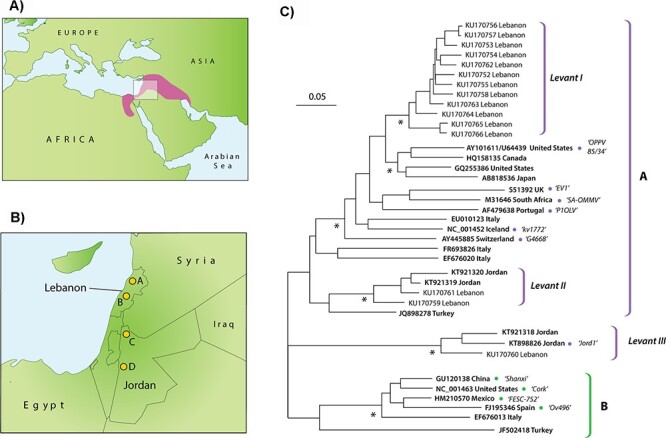
Small ruminant lentiviruses (SRLVs) cause chronic, persistent infections in populations of domestic sheep () and goats () worldwide. The vast majority of SRLV infections involve two genotypes (A and B) that spread in association with the emergence of global livestock trade. However, SRLVs have likely been present in Eurasian ruminant populations since at least the early Neolithic period. Here, we use phylogenetic and phylogeographic approaches to reconstruct the origin of pandemic SRLV strains and infer their historical pattern of global spread. We constructed an open computational resource ('Lentivirus-GLUE') via which an up-to-date database of published SRLV sequences, multiple sequence alignments (MSAs), and sequence-associated metadata can be maintained. We used data collated in Lentivirus-GLUE to perform a comprehensive phylogenetic investigation of global SRLV diversity. Phylogenies reconstructed from genome-length alignments reveal that the deep divisions in the SRLV phylogeny are consistent with an ancient split into Eastern (A-like) and Western (B-like) lineages as agricultural systems disseminated out of domestication centres during the Neolithic period. These findings are also consistent with historical and phylogeographic evidence linking the early 20 century emergence of SRLV-A to the international export of Central Asian Karakul sheep. Investigating the global diversity of SRLVs can help reveal how anthropogenic factors have impacted the ecology and evolution of livestock diseases. The open resources generated in our study can expedite these studies and can also serve more broadly to facilitate the use of genomic data in SRLV diagnostics and research.
小反刍兽慢病毒(SRLV)在全球范围内的家养绵羊( )和山羊( )群体中引起慢性持续性感染。绝大多数SRLV感染涉及两种基因型(A和B),它们随着全球牲畜贸易的出现而传播。然而,至少自新石器时代早期以来,SRLV可能就已存在于欧亚反刍动物群体中。在这里,我们使用系统发育和系统地理学方法来重建大流行SRLV毒株的起源,并推断它们在全球传播的历史模式。我们构建了一个开放的计算资源(“慢病毒 - GLUE”),通过它可以维护已发表的SRLV序列、多序列比对(MSA)和序列相关元数据的最新数据库。我们使用在慢病毒 - GLUE中整理的数据对全球SRLV多样性进行了全面的系统发育研究。从基因组长度比对重建的系统发育表明,SRLV系统发育中的深度分化与新石器时代农业系统从驯化中心传播出去时古老地分裂为东部(A类)和西部(B类)谱系一致。这些发现也与将SRLV - A在20世纪初的出现与中亚卡拉库尔羊的国际出口联系起来的历史和系统地理学证据一致。研究SRLV的全球多样性有助于揭示人为因素如何影响家畜疾病的生态和进化。我们研究中产生的开放资源可以加快这些研究,也可以更广泛地用于促进基因组数据在SRLV诊断和研究中的应用。