Faculté des Sciences de Tunis, LR03ES03 Laboratoire de Microbiologie et Biomolécules Actives, Université Tunis El Manar, 2092, Tunis, Tunisie.
Department of Microbiology and Molecular Genetics, Oklahoma State University, Stillwater, OK, USA.
Genetica. 2023 Apr;151(2):133-152. doi: 10.1007/s10709-023-00182-0. Epub 2023 Feb 16.
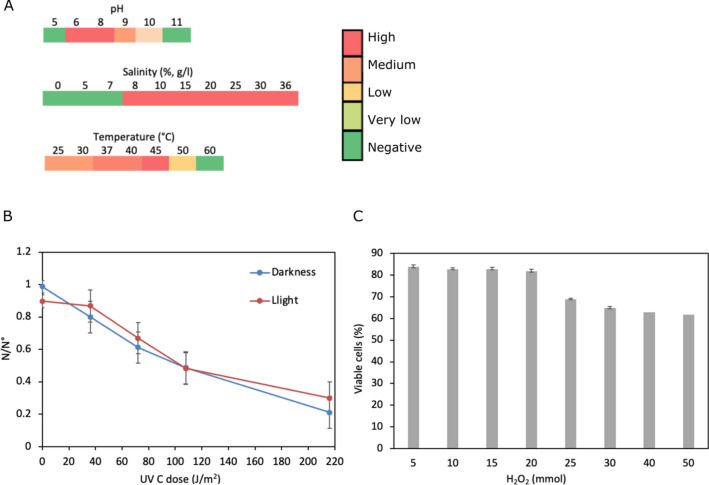
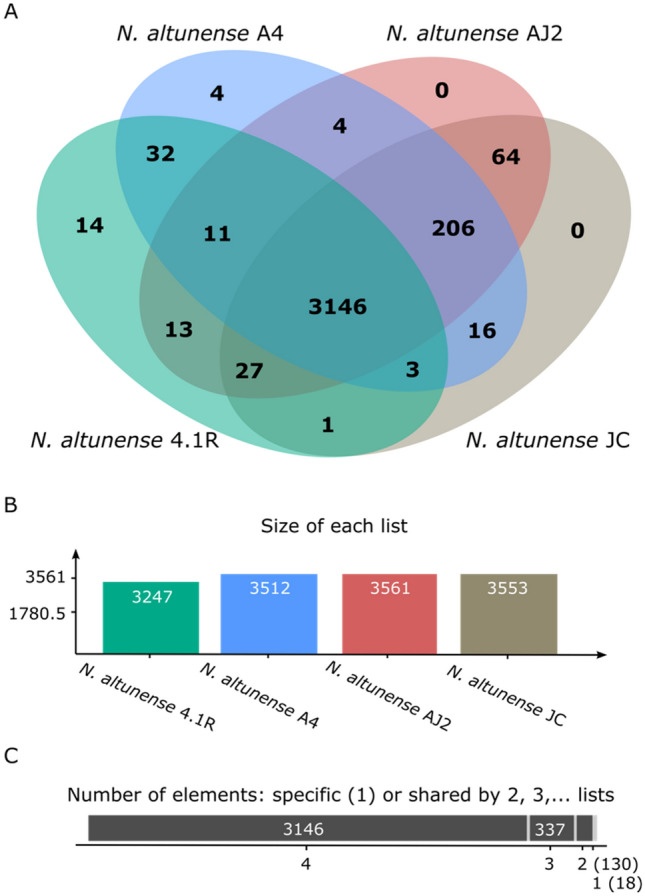
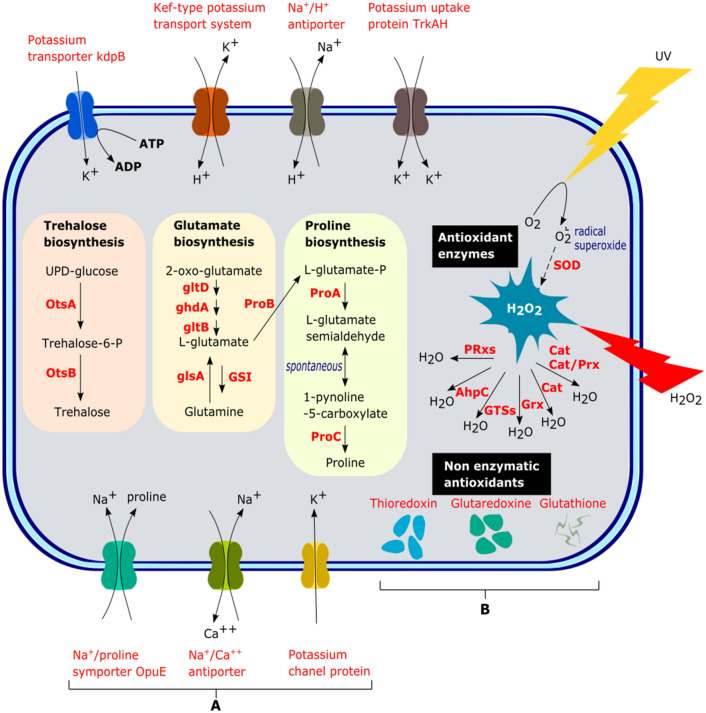
Halophilic archaea are polyextremophiles with the ability to withstand fluctuations in salinity, high levels of ultraviolet radiation, and oxidative stress, allowing them to survive in a wide range of environments and making them an excellent model for astrobiological research. Natrinema altunense 4.1R is a halophilic archaeon isolated from the endorheic saline lake systems, Sebkhas, located in arid and semi-arid regions of Tunisia. It is an ecosystem characterized by periodic flooding from subsurface groundwater and fluctuating salinities. Here, we assess the physiological responses and genomic characterization of N. altunense 4.1R to UV-C radiation, as well as osmotic and oxidative stresses. Results showed that the 4.1R strain is able to survive up to 36% of salinity, up to 180 J/m to UV-C radiation, and at 50 mM of HO, a resistance profile similar to Halobacterium salinarum, a strain often used as UV-C resistant model. In order to understand the genetic determinants of N. altunense 4.1R survival strategy, we sequenced and analyzed its genome. Results showed multiple gene copies of osmotic stress, oxidative stress, and DNA repair response mechanisms supporting its survivability at extreme salinities and radiations. Indeed, the 3D molecular structures of seven proteins related to responses to UV-C radiation (excinucleases UvrA, UvrB, and UvrC, and photolyase), saline stress (trehalose-6-phosphate synthase OtsA and trehalose-phosphatase OtsB), and oxidative stress (superoxide dismutase SOD) were constructed by homology modeling. This study extends the abiotic stress range for the species N. altunense and adds to the repertoire of UV and oxidative stress resistance genes generally known from haloarchaeon.
嗜盐古菌是多极端环境生物,能够耐受盐度波动、高强度紫外线辐射和氧化应激,使它们能够在广泛的环境中生存,并成为天体生物学研究的理想模型。Natrinema altunense 4.1R 是一种从位于突尼斯干旱和半干旱地区的内陆盐湖系统 Sebkhas 中分离出来的嗜盐古菌。它是一个以地下地下水周期性泛滥和盐度波动为特征的生态系统。在这里,我们评估了 N. altunense 4.1R 对 UV-C 辐射、渗透压和氧化应激的生理反应和基因组特征。结果表明,该 4.1R 菌株能够在高达 36%的盐度、高达 180 J/m 的 UV-C 辐射以及 50 mM 的 HO 下存活,其抗性谱类似于常被用作 UV-C 抗性模型的盐杆菌。为了了解 N. altunense 4.1R 生存策略的遗传决定因素,我们对其基因组进行了测序和分析。结果表明,渗透压、氧化应激和 DNA 修复反应机制的多个基因拷贝支持其在极端盐度和辐射下的生存能力。事实上,与 UV-C 辐射(外切核酸酶 UvrA、UvrB 和 UvrC 以及光解酶)、盐胁迫(海藻糖-6-磷酸合酶 OtsA 和海藻糖磷酸酶 OtsB)和氧化应激(超氧化物歧化酶 SOD)相关的七种蛋白质的 3D 分子结构通过同源建模构建。本研究扩展了 N. altunense 的非生物胁迫范围,并增加了通常从盐古菌中已知的 UV 和氧化应激抗性基因。