Department of Biology, The Johns Hopkins University, Baltimore, Maryland, USA.
RNA Biol. 2021 Nov;18(11):1867-1881. doi: 10.1080/15476286.2021.1874717. Epub 2021 Jan 31.
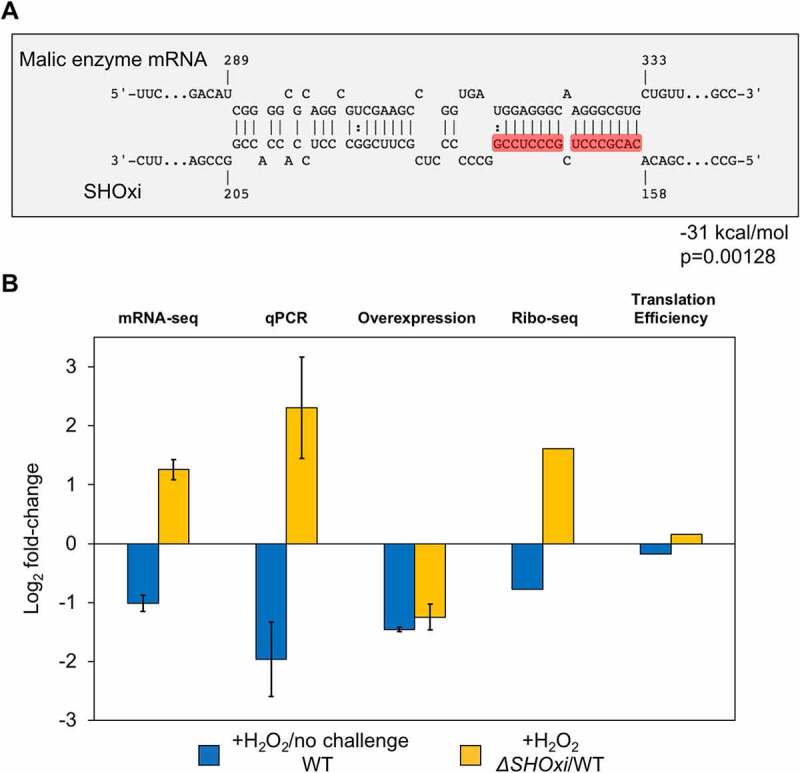
While haloarchaea are highly resistant to oxidative stress, a comprehensive understanding of the processes regulating this remarkable response is lacking. Oxidative stress-responsive small non-coding RNAs (sRNAs) have been reported in the model archaeon, , but targets and mechanisms have not been elucidated. Using a combination of high throughput and reverse molecular genetic approaches, we elucidated the functional role of the most up-regulated intergenic sRNA during oxidative stress in , named mall RNA in aloferax dative Stress (). SHOxi was predicted to form a stable secondary structure with a conserved stem-loop region as the potential binding site for trans-targets. NAD-dependent malic enzyme mRNA, identified as a putative target of SHOxi, interacted directly with a putative 'seed' region within the predicted stem loop of SHOxi. Malic enzyme catalyzes the oxidative decarboxylation of malate into pyruvate using NAD as a cofactor. The destabilization of malic enzyme mRNA, and the decrease in the NAD/NADH ratio, resulting from the direct RNA-RNA interaction between SHOxi and its trans-target was essential for the survival of to oxidative stress. These findings indicate that SHOxi likely regulates redox homoeostasis during oxidative stress by the post-transcriptional destabilization of malic enzyme mRNA. SHOxi-mediated regulation provides evidence that the fine-tuning of metabolic cofactors could be a core strategy to mitigate damage from oxidative stress and confer resistance. This study is the first to establish the regulatory effects of sRNAs on mRNAs during the oxidative stress response in Archaea.
尽管盐杆菌属古菌具有很强的抗氧化应激能力,但对于调节这种显著反应的过程还缺乏全面的了解。在模式古菌 中已经报道了氧化应激响应的小非编码 RNA(sRNA),但目标和机制尚未阐明。我们使用高通量和反向分子遗传学方法的组合,阐明了在 氧化应激中最上调的基因间 sRNA 的功能作用,该 sRNA 名为 在 alloferax 应激下的小 RNA(SHOxi)。SHOxi 被预测形成一个具有保守茎环区域的稳定二级结构,作为潜在的反式靶标结合位点。鉴定为 SHOxi 潜在靶标的 NAD 依赖性苹果酸酶 mRNA,与 SHOxi 预测茎环内的假定“种子”区域直接相互作用。苹果酸酶利用 NAD 作为辅助因子催化苹果酸的氧化脱羧作用生成丙酮酸。SHOxi 与其反式靶标之间的直接 RNA-RNA 相互作用导致苹果酸酶 mRNA 的不稳定性和 NAD/NADH 比值的降低,这对于 在氧化应激下的生存是必不可少的。这些发现表明,SHOxi 可能通过苹果酸酶 mRNA 的转录后失稳来调节氧化应激过程中的氧化还原稳态。SHOxi 介导的调节提供了证据,表明代谢辅助因子的精细调节可能是减轻氧化应激损伤和赋予抗性的核心策略。本研究首次在古菌的氧化应激反应中建立了 sRNA 对 mRNAs 的调节作用。