Gore Katarzyna M, Schiebout Jessen, Peksa Gary D, Hock Sara, Patwari Rahul, Gottlieb Michael
Department of Emergency Medicine, Rush University Medical Center, Chicago, IL, USA.
Clin Exp Emerg Med. 2023 Sep;10(3):306-314. doi: 10.15441/ceem.22.395. Epub 2023 Feb 16.
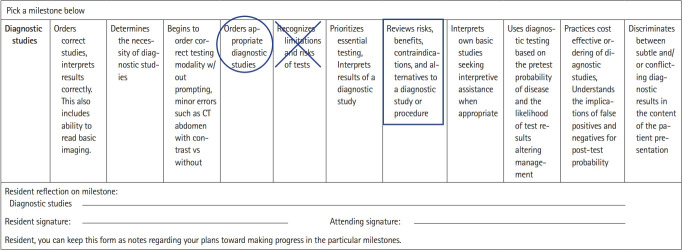
Feedback is critical to the growth of learners. However, feedback quality can be variable in practice. Most feedback tools are generic, with few targeting emergency medicine. We created a feedback tool designed for emergency medicine residents, and this study aimed to evaluate the effectiveness of this tool.
This was a single-center, prospective cohort study comparing feedback quality before and after introducing a novel feedback tool. Residents and faculty completed a survey after each shift assessing feedback quality, feedback time, and the number of feedback episodes. Feedback quality was assessed using a composite score from seven questions, which were each scored 1 to 5 points (minimum total score, 7 points; maximum, 35 points). Preintervention and postintervention data were analyzed using a mixed-effects model that took into account the correlation of random effects between study participants.
Residents completed 182 surveys and faculty members completed 158 surveys. The use of the tool was associated with improved consistency in the summative score of effective feedback attributes as assessed by residents (P=0.040) but not by faculty (P=0.259). However, most of the individual scores for attributes of good feedback did not reach statistical significance. With the tool, residents perceived that faculty spent more time providing feedback (P=0.040) and that the delivery of feedback was more ongoing throughout the shift (P=0.020). Faculty felt that the tool allowed for more ongoing feedback (P=0.002), with no perceived increase in the time spent delivering feedback (P=0.833).
The use of a dedicated tool may help educators provide more meaningful and frequent feedback without impacting the perceived required time needed to provide feedback.
反馈对学习者的成长至关重要。然而,在实际操作中反馈质量可能参差不齐。大多数反馈工具是通用的,针对急诊医学的很少。我们创建了一种专为急诊医学住院医师设计的反馈工具,本研究旨在评估该工具的有效性。
这是一项单中心前瞻性队列研究,比较引入新型反馈工具前后的反馈质量。住院医师和教员在每次轮班后完成一项调查,评估反馈质量、反馈时间和反馈事件的数量。使用七个问题的综合评分来评估反馈质量,每个问题的评分从1到5分(最低总分7分;最高35分)。采用混合效应模型分析干预前和干预后的数据,该模型考虑了研究参与者之间随机效应的相关性。
住院医师完成了182份调查,教员完成了158份调查。使用该工具与住院医师评估的有效反馈属性的总结性评分一致性提高相关(P=0.040),但教员评估的一致性未提高(P=0.259)。然而,良好反馈属性的大多数个体评分未达到统计学意义。使用该工具后,住院医师认为教员花费更多时间提供反馈(P=0.040),并且在整个轮班期间反馈的提供更加持续(P=0.020)。教员认为该工具允许更持续的反馈(P=0.002),且提供反馈所需时间没有明显增加(P=0.833)。
使用专用工具可能有助于教育工作者提供更有意义和频繁的反馈,而不会影响提供反馈所需的时间。