Whitney Laboratory for Marine Bioscience, University of Florida, St. Augustine, FL, USA.
Department of Ecology and Evolutionary Biology, Cornell University, Ithaca, NY, USA.
Nat Commun. 2023 Feb 16;14(1):885. doi: 10.1038/s41467-023-36615-9.
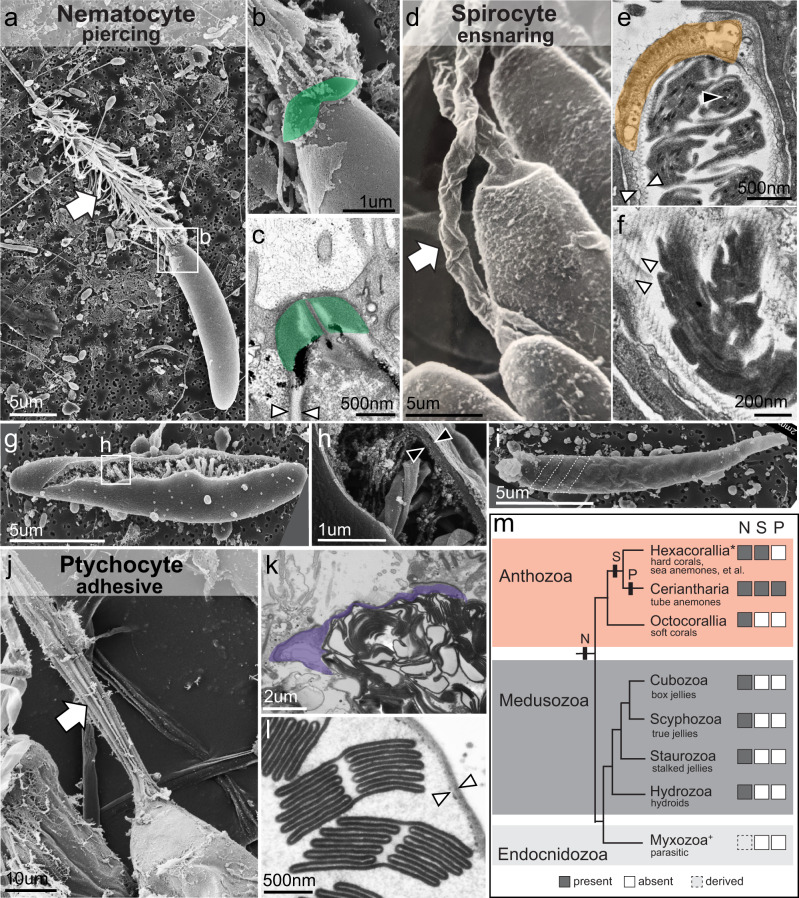
Cnidocytes are the explosive stinging cells unique to cnidarians (corals, jellyfish, etc). Specialized for prey capture and defense, cnidocytes comprise a group of over 30 morphologically and functionally distinct cell types. These unusual cells are iconic examples of biological novelty but the developmental mechanisms driving diversity of the stinging apparatus are poorly characterized, making it challenging to understand the evolutionary history of stinging cells. Using CRISPR/Cas9-mediated genome editing in the sea anemone Nematostella vectensis, we show that a single transcription factor (NvSox2) acts as a binary switch between two alternative stinging cell fates. Knockout of NvSox2 causes a transformation of piercing cells into ensnaring cells, which are common in other species of sea anemone but appear to have been silenced in N. vectensis. These results reveal an unusual case of single-cell atavism and expand our understanding of the diversification of cell type identity.
刺胞动物是具有刺细胞的独特生物(珊瑚、水母等)。刺细胞专门用于猎物捕获和防御,由超过 30 种形态和功能不同的细胞类型组成。这些不寻常的细胞是生物新颖性的标志性例子,但驱动刺细胞多样性的发育机制尚未得到充分描述,这使得理解刺细胞的进化历史具有挑战性。我们使用 CRISPR/Cas9 介导的基因组编辑在海葵 Nematostella vectensis 中进行研究,结果表明单个转录因子(NvSox2)在两种刺细胞命运之间充当二选一的开关。敲除 NvSox2 会导致穿刺细胞转化为缠绕细胞,缠绕细胞在其他海葵物种中很常见,但在 N. vectensis 中似乎被沉默了。这些结果揭示了一个罕见的单细胞返祖现象,并扩展了我们对细胞类型身份多样化的理解。