Institute for Parasitology, Centre for Infection Medicine, University of Veterinary Medicine Hannover, Buenteweg 17, 30559, Hanover, Germany.
Parasit Vectors. 2023 Feb 16;16(1):70. doi: 10.1186/s13071-023-05693-5.
Ticks and tick-borne diseases play a major role in companion animal health. Additionally, the European tick fauna is changing, for instance due to the spread of Dermacentor reticulatus, displaying a higher likelihood of winter activity than Ixodes ricinus. Therefore, we investigated current tick infestations in dogs and cats in Germany and in parts of Austria and the seasonal infestation risk.
Overall, 219 veterinary practices were invited to collect ticks from cats and dogs on a monthly basis. Ticks were morphologically identified and female I. ricinus specimens were measured to estimate attachment duration.
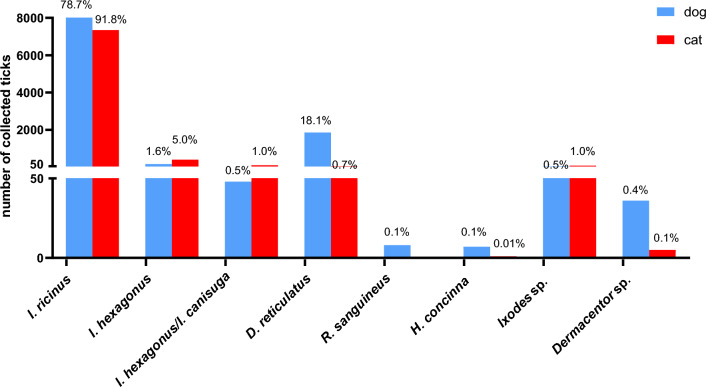
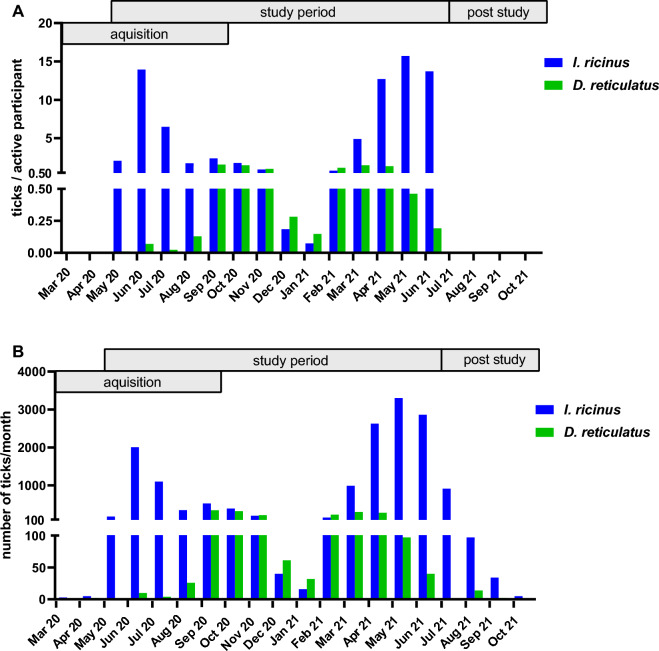
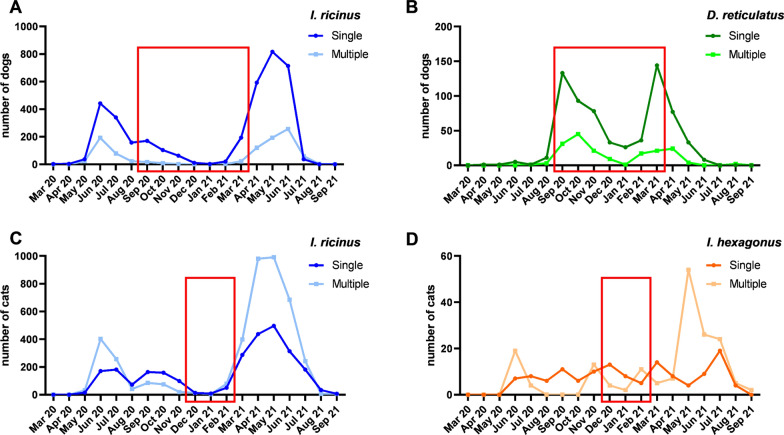
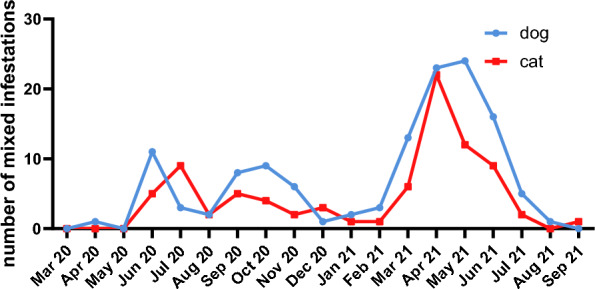
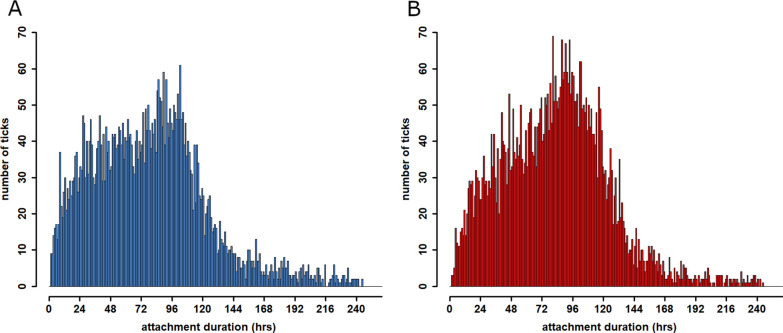
In total, 19,514 ticks, 17,789 (91.2%) from Germany and 1506 (7.7%) from Austria, were received between March 2020 and October 2021, with 10,287 specimens (52.7%) detached from dogs, 8005 from cats (41.0%) and 1222 from other species (6.3%). In Germany, the most common tick species collected from dogs were I. ricinus (78.0%) and D. reticulatus (18.8%), while cats mainly harboured I. ricinus (91.3%) and I. hexagonus (5.5%) and only few D. reticulatus (0.6%). In Austria, collected I. ricinus reached similar proportions in dogs (90.4%) and cats (95.3%), followed by D. reticulatus in both dogs (5.2%) and cats (1.5%), with I. hexagonus (0.9%) collected only marginally from cats. The average infestation intensity amounted to 1.62 ticks/dog and 1.88 ticks/cat. The single to multiple infestation ratio was 79.1% to 20.9% in dogs and 69.0% to 31.0% in cats, with cats being significantly more often multiple infested than dogs, while the proportion of mixed-species infestations was 2.0% for both dogs and cats. The average attachment duration of female I. ricinus specimens amounted to 78.76 h for dogs and 82.73 h for cats. Furthermore, year-round tick exposure was confirmed, with 108 D. reticulatus and 70 I. ricinus received on average per month during December 2020 to February 2021.
The study shows a year-round tick infestation risk, with activity of both D. reticulatus and I. ricinus during winter, and confirms the widespread occurrence of D. reticulatus in Germany. Additionally, long average attachment durations and frequent multiple infestations underline the need for adequate year-round tick control, even during the winter months.
蜱虫和蜱传疾病在伴侣动物健康中起着重要作用。此外,欧洲的蜱类动物群正在发生变化,例如由于硬蜱的传播,其冬季活动的可能性高于蓖子硬蜱。因此,我们调查了德国以及奥地利部分地区目前犬猫的蜱虫感染情况和季节性感染风险。
共有 219 家兽医诊所受邀每月从猫和狗身上采集蜱虫。蜱虫通过形态学鉴定,雌性蓖子硬蜱的标本进行测量以估计附着时间。
2020 年 3 月至 2021 年 10 月期间,共收到 19514 只蜱虫,其中 17789 只(91.2%)来自德国,1506 只(7.7%)来自奥地利,其中 10287 只(52.7%)从狗身上脱落,8005 只(41.0%)从猫身上脱落,1222 只(6.3%)从其他物种脱落。在德国,从狗身上采集到的最常见的蜱种是蓖子硬蜱(78.0%)和硬蜱(18.8%),而猫主要携带蓖子硬蜱(91.3%)和六沟硬蜱(5.5%),只有少量硬蜱(0.6%)。在奥地利,从狗和猫身上采集到的蓖子硬蜱比例相似,分别为 90.4%和 95.3%,其次是硬蜱,在狗和猫身上的比例分别为 5.2%和 1.5%,六沟硬蜱的比例仅为 0.9%。平均感染强度为每只狗 1.62 只蜱,每只猫 1.88 只蜱。狗的单只和多只感染比例为 79.1%和 20.9%,猫的单只和多只感染比例为 69.0%和 31.0%,猫的多只感染比例明显高于狗,而混合物种感染的比例为 2.0%,狗和猫的比例相同。雌性蓖子硬蜱标本的平均附着时间为狗 78.76 小时,猫 82.73 小时。此外,还证实了全年都有蜱虫暴露,2020 年 12 月至 2021 年 2 月期间,平均每月收到 108 只硬蜱和 70 只蓖子硬蜱。
该研究表明存在全年的蜱虫感染风险,硬蜱和蓖子硬蜱在冬季都有活动,并证实了硬蜱在德国的广泛存在。此外,较长的平均附着时间和频繁的多次感染强调了即使在冬季也需要进行适当的全年蜱虫控制。