Maccabi Healthcare Services, Haifa, Israel.
The Azrieli Faculty of Medicine, Bar-Ilan University, Safed, Israel.
Front Endocrinol (Lausanne). 2023 Jan 30;14:1108618. doi: 10.3389/fendo.2023.1108618. eCollection 2023.
Severe childhood obesity is associated with increased prevalence of cardiometabolic risk factors (CMRFs). Among children with Class 1 obesity, higher BMI may indicate greater cardiometabolic risk. Class 1 obesity reflects a wide spectrum of BMI values. Each 10% increase in BMI above the 95th percentile is equivalent to an average increase of 2.15 kg/m2 and 2.75 kg/m2 in BMI among children and adolescents, respectively. Such increments may be of clinical importance.
The study aimed to determine the prevalence and clustering of CMRFs in children and adolescents with BMI 110%-119% of the 95th BMI percentile.
A cross-sectional analysis of data, from an Israeli health maintenance organization, of children and adolescents (5-17 years) with overweight or Class 1 obesity, and at least one measurement of lipid profile during Jan/2020-May/2021. CMRFs were defined as abnormal lipid profile, elevated alanine aminotransferase, hypertension, and prediabetes or diabetes. Study groups included overweight and Class 1 Obesity-A (BMI < 110%) and Obesity-B (BMI ≥ 110%) of the 95th BMI percentile.
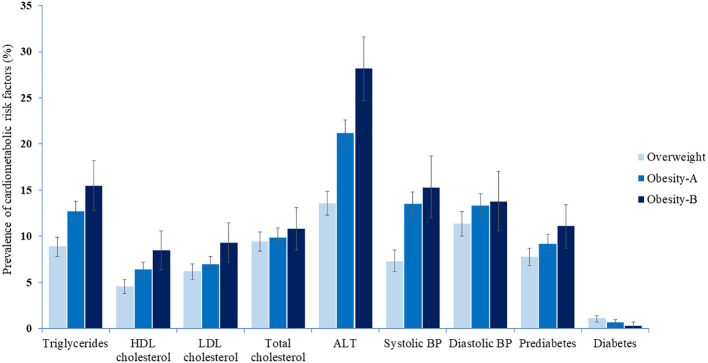
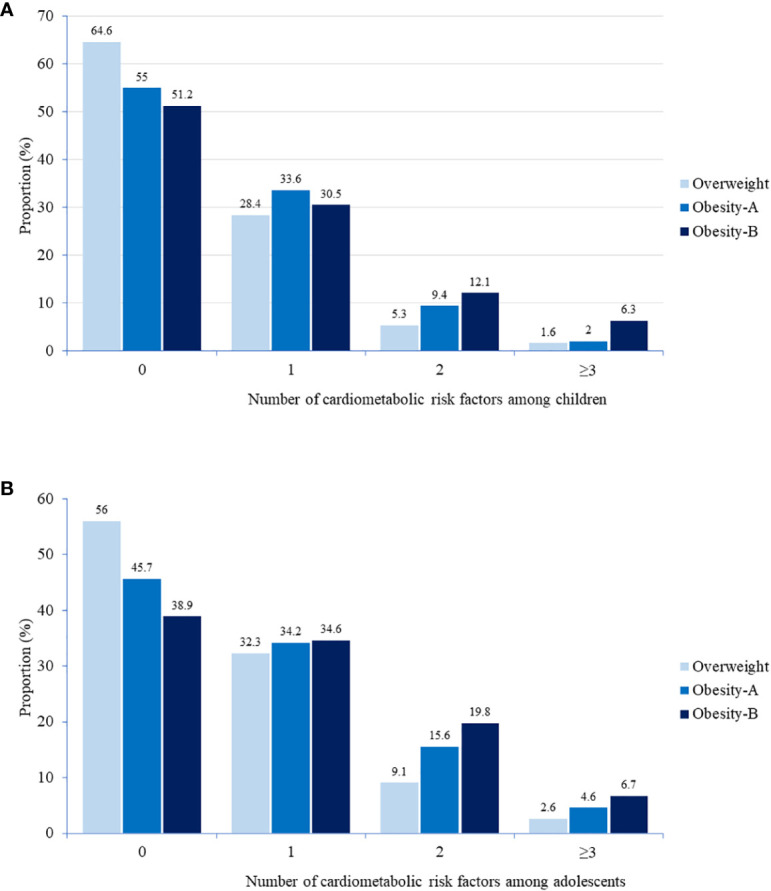
Of 7211 subjects included, 40.2% were overweight, 50.3% obesity-A, and 9.5% obesity-B. Multivariable analyses showed that children and adolescents from the Obesity-B group had increased odds for higher triglycerides, LDL cholesterol, and ALT levels; and lower HDL cholesterol levels, as compared to Obesity-A. The odds of prediabetes (insignificant) tended to be higher in the Obesity-B group, which was associated with increased CMRFs clustering.
Among children and adolescents with Class 1 obesity, BMI ≥ 110% of the 95th percentile was associated with higher prevalence and clustering of CMRFs.
严重的儿童肥胖与心血管代谢危险因素(CMRFs)的患病率增加有关。在一类肥胖的儿童中,较高的 BMI 可能意味着更高的心血管代谢风险。一类肥胖反映了 BMI 值的广泛范围。BMI 高于第 95 百分位的每增加 10%,相当于儿童和青少年的 BMI 平均增加 2.15kg/m2 和 2.75kg/m2。这种增量可能具有临床意义。
本研究旨在确定 BMI 在第 95 百分位的 110%-119%之间的儿童和青少年中 CMRFs 的患病率和聚类情况。
对以色列健康维护组织的数据进行横断面分析,这些数据来自超重或一类肥胖的儿童和青少年(5-17 岁),并在 2020 年 1 月至 2021 年 5 月期间至少有一次血脂谱测量。CMRFs 定义为异常血脂谱、丙氨酸氨基转移酶升高、高血压、糖尿病前期或糖尿病。研究组包括超重和一类肥胖 A(BMI<110%)和一类肥胖 B(BMI≥110%)。
在 7211 名受试者中,40.2%为超重,50.3%为肥胖 A,9.5%为肥胖 B。多变量分析显示,肥胖 B 组的儿童和青少年患高三酰甘油、低密度脂蛋白胆固醇和丙氨酸氨基转移酶水平升高、高密度脂蛋白胆固醇水平降低的几率更高;与肥胖 A 相比,糖尿病前期(无统计学意义)的几率也更高,这与 CMRFs 聚类增加有关。
在一类肥胖的儿童和青少年中,BMI 高于第 95 百分位的 110%与 CMRFs 的患病率和聚类增加有关。