Clinical Research Laboratory, ICMR-National Institute for Research in Reproductive and Child Health (NIRRCH), Mumbai, Maharashtra, India.
Molecular Immunology and Microbiology Laboratory, ICMR-National Institute for Research in Reproductive and Child Health (NIRRCH), Mumbai, Maharashtra, India.
PLoS One. 2023 Feb 17;18(2):e0281809. doi: 10.1371/journal.pone.0281809. eCollection 2023.
Snakebite envenoming (SBE) is an acute, life-threatening emergency in tropical and subtropical countries. It is an occupational hazard and a major socioeconomic determinant. Limited awareness, superstitions, lack of trained health providers, poor utilization of anti-venom results in high mortality and morbidity. India is the snakebite capital of the world. Yet, information on awareness, knowledge, and perceptions about snakebite is limited. Data on capacity building of health systems and its potential impact is lacking. Recommended by the National Task Force on snakebite research in India, this protocol describes the National Snakebite Project aiming for capacity building of health systems on prevention and management of snakebite envenomation in Maharashtra and Odisha states.
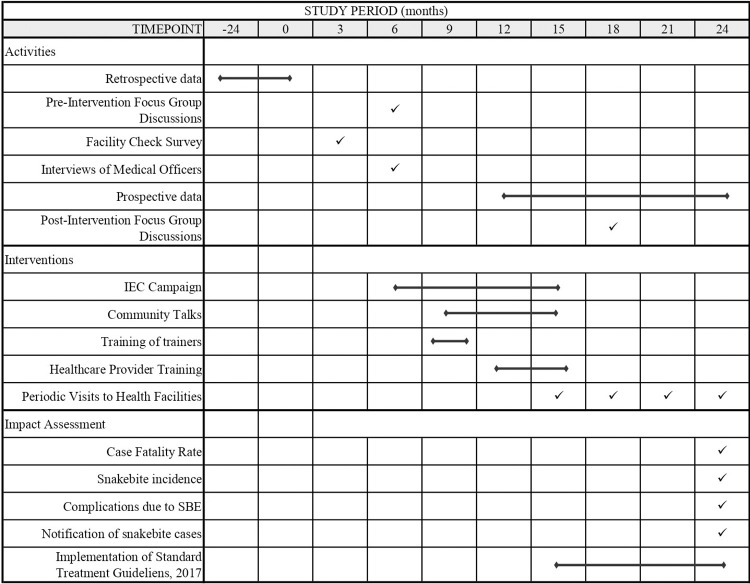
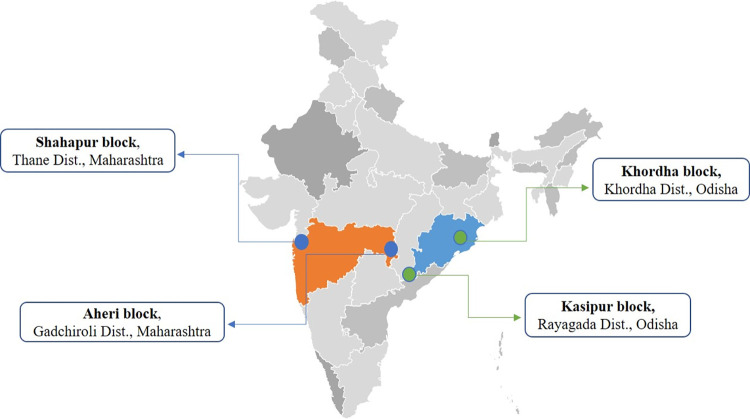
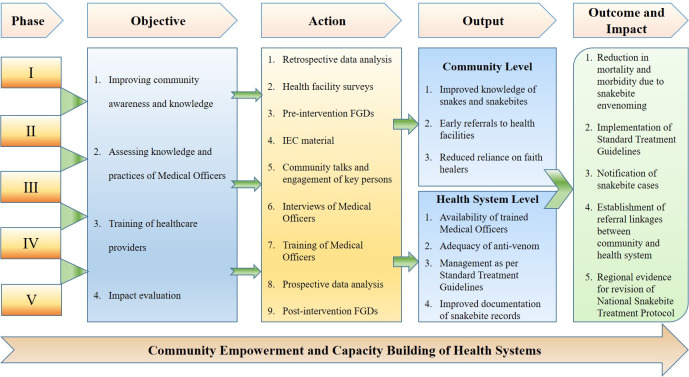
A cross-sectional, multi-centric study will be carried out in Shahapur, Aheri blocks of Maharashtra, and Khordha, Kasipur blocks of Odisha. The study has five phases: Phase I involves the collection of retrospective baseline data of snakebites, facility surveys, and community focus group discussions (FGDs). Phase II involves developing and implementing educational intervention programs for the community. Phase III will assess the knowledge and practices of the healthcare providers on snakebite management followed by their training in Phase IV. Phase V will evaluate the impact of the interventions on the community and healthcare system through FGDs and comparison of prospective and baseline data.
The National Snakebite Project will use a multi-sectoral approach to reduce the burden of SBE. It intends to contribute to community empowerment and capacity building of the public healthcare system on the prevention and management of SBE. The results could be useful for upscaling to other Indian states, South Asia and other tropical countries. The findings of the study will provide critical regional inputs for the revision of the National Snakebite Treatment protocol.
Registered under the Clinical Trials Registry India no. CTRI/2021/11/038137.
蛇伤(SBE)是热带和亚热带国家的一种急性、危及生命的紧急情况。它是一种职业危害,也是主要的社会经济决定因素。由于意识有限、迷信、缺乏训练有素的卫生提供者、抗蛇毒利用不足,导致死亡率和发病率居高不下。印度是世界上的蛇伤之都。然而,关于蛇伤的意识、知识和看法的信息有限。缺乏关于卫生系统能力建设及其潜在影响的数据。本方案由印度国家蛇伤研究工作组推荐,旨在加强马哈拉施特拉邦和奥里萨邦卫生系统预防和管理蛇伤的能力。
将在马哈拉施特拉邦的沙哈普尔和阿赫里区块以及奥里萨邦的科达哈、卡希普尔区块进行一项横断面、多中心研究。该研究有五个阶段:第一阶段涉及收集蛇伤的回顾性基线数据、设施调查和社区焦点小组讨论(FGD)。第二阶段涉及为社区制定和实施教育干预计划。第三阶段将评估医疗保健提供者在蛇伤管理方面的知识和实践,然后在第四阶段对其进行培训。第五阶段将通过 FGD 评估干预对社区和卫生系统的影响,并通过比较前瞻性和基线数据进行评估。
国家蛇伤项目将采用多部门方法来减轻 SBE 的负担。它旨在促进社区赋权和公共卫生系统在预防和管理 SBE 方面的能力建设。研究结果可用于印度其他邦、南亚和其他热带国家的推广。该研究的结果将为修订国家蛇伤治疗方案提供重要的区域投入。
在印度临床试验注册处注册,编号为 CTRI/2021/11/038137。