The Migrant Health Research Group, Institute for Infection and Immunity, St George's University of London, London, UK.
Population Health Research Institute, St George's University of London, London, UK.
BMJ Open. 2022 Nov 17;12(11):e061896. doi: 10.1136/bmjopen-2022-061896.
Migrants and ethnic minority groups have been disproportionately impacted by COVID-19 and have lower levels of vaccine uptake in some contexts. We aimed to determine the extent and nature of social media use in migrant and ethnic minority communities for COVID-19 information, and implications for preventative health measures including vaccination intent and uptake.
A systematic review of published and grey literature following the Preferred Reporting Items for Systematic Reviews and Meta-Analyses guidelines. We searched databases including Embase, Web of Science, PubMed NIH, CINAHL, facilitated through the WHO Global Research on COVID-19 database from 31 December 2019 to 9 June 2021.
Research reporting the use of social media by migrants and/or ethnic minority groups in relation to COVID-19.
We extracted data on key outcomes, study design, country, population under study and sample size.
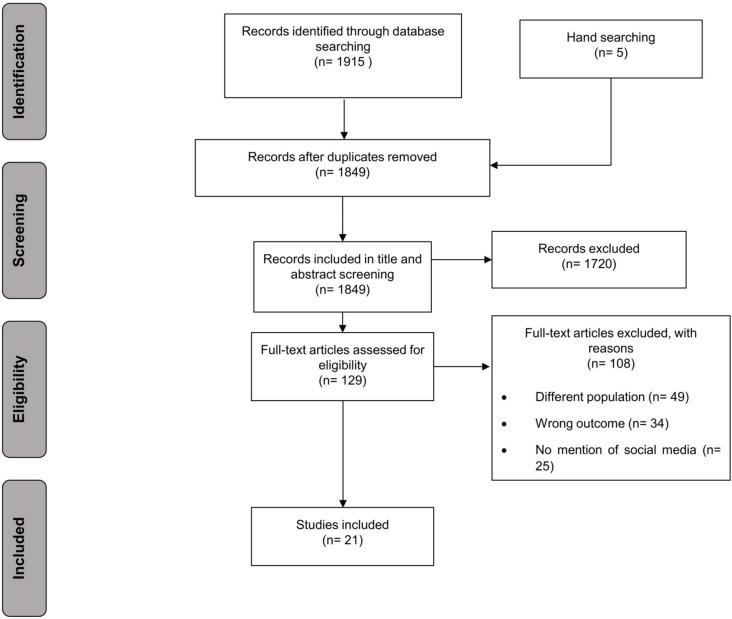
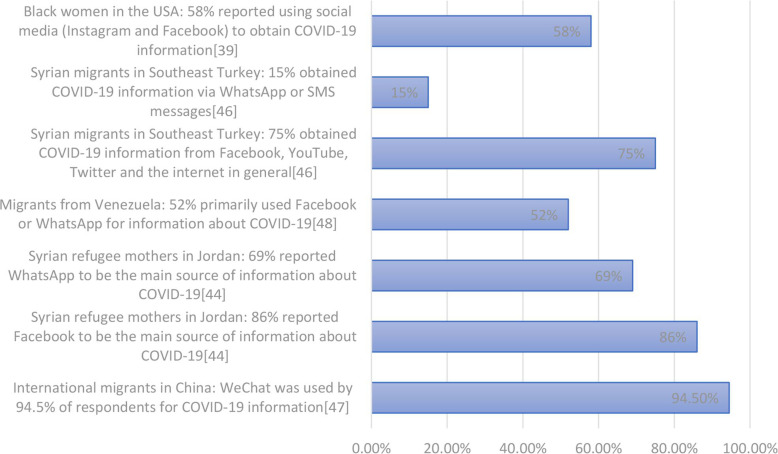
1849 unique records were screened, and 21 data sources were included, including populations in the UK, USA, China, Jordan, Qatar and Turkey. We found evidence of consistent use of a range of social media platforms for COVID-19 information in some migrant and ethnic minority populations (including WeChat, Facebook, WhatsApp, Instagram, Twitter, YouTube), which may stem from difficulty in accessing COVID-19 information in their native languages or from trusted sources. Some evidence suggested circulating misinformation and social media use may be associated with lower participation in preventative health measures, including vaccine intent and uptake, findings which are likely relevant to multiple population groups.
Social media platforms are an important source of information about COVID-19 for some migrant and ethnic minority populations. Urgent actions and further research are now needed to better understand effective approaches to tackling circulating misinformation, and to seize on opportunities to better use social media platforms to support public health communication and improve vaccine uptake.
This study has been registered with PROSPERO (CRD42021259190).
移民和少数族裔群体受到 COVID-19 的不成比例影响,并且在某些情况下疫苗接种率较低。我们旨在确定移民和少数族裔社区在 COVID-19 信息方面使用社交媒体的程度和性质,以及这些信息对预防保健措施(包括接种意愿和接种率)的影响。
按照系统评价和荟萃分析的首选报告项目的指南进行已发表和灰色文献的系统评价。我们在数据库中进行了搜索,包括 Embase、Web of Science、PubMed NIH、CINAHL,这些数据库通过世界卫生组织全球 COVID-19 数据库获得,时间从 2019 年 12 月 31 日至 2021 年 6 月 9 日。
研究报告移民和/或少数族裔群体在与 COVID-19 相关方面使用社交媒体的情况。
我们提取了关于关键结果、研究设计、国家、研究人群和样本量的数据。
筛选出 1849 条独特记录,纳入了 21 条资料来源,包括英国、美国、中国、约旦、卡塔尔和土耳其的人群。我们发现一些移民和少数族裔人群中存在使用一系列社交媒体平台获取 COVID-19 信息的证据(包括微信、脸书、WhatsApp、Instagram、推特、YouTube),这可能是因为他们难以用母语或可信来源获取 COVID-19 信息。有一些证据表明,传播错误信息和使用社交媒体可能与预防保健措施的参与度较低有关,包括接种意愿和接种率,这些发现可能与多个人群群体有关。
社交媒体平台是一些移民和少数族裔人群获取 COVID-19 信息的重要来源。现在需要采取紧急行动和进一步研究,以更好地了解应对错误信息的有效方法,并抓住机会更好地利用社交媒体平台,支持公共卫生宣传,提高疫苗接种率。
本研究已在 PROSPERO(CRD42021259190)上注册。