Division of Cardiology, Department of Internal Medicine, Korea University College of Medicine and Korea University Anam Hospital, Seoul, Republic of Korea, 73 Goryeodae-Ro, Seongbuk-Gu, 02841.
Department of Statistics and Actuarial Science, Soongsil University, Seoul, Republic of Korea.
Cardiovasc Diabetol. 2023 Feb 20;22(1):36. doi: 10.1186/s12933-023-01769-9.
Dyslipidemia measured as low-density lipoprotein (LDL)-cholesterol is an established risk factor of cardiovascular disease, which is more pronounced in diabetes population. Less is known about the association of LDL-cholesterol level and sudden cardiac arrest (SCA) risk in diabetes mellitus patients. This study investigated the association of LDL-cholesterol level and SCA risk in diabetes population.
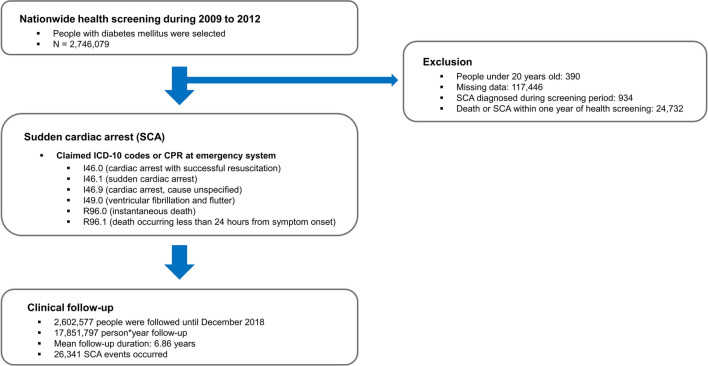
This study was based on Korean National Health Insurance Service database. Patients who received general examination from 2009 to 2012 and diagnosed as type 2 diabetes mellitus were analyzed. Primary outcome was defined as SCA event identified with International Classification of Disease code.
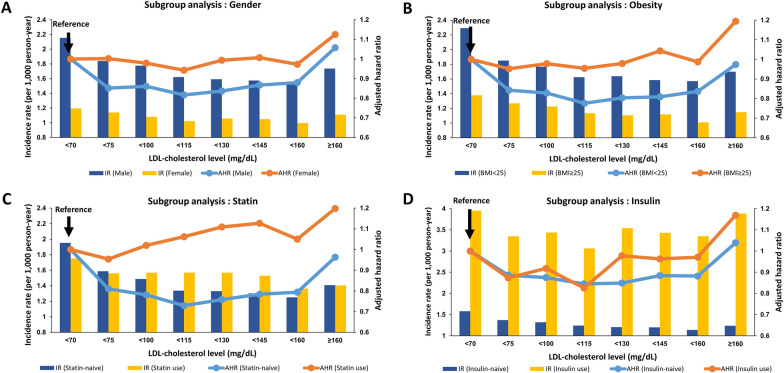
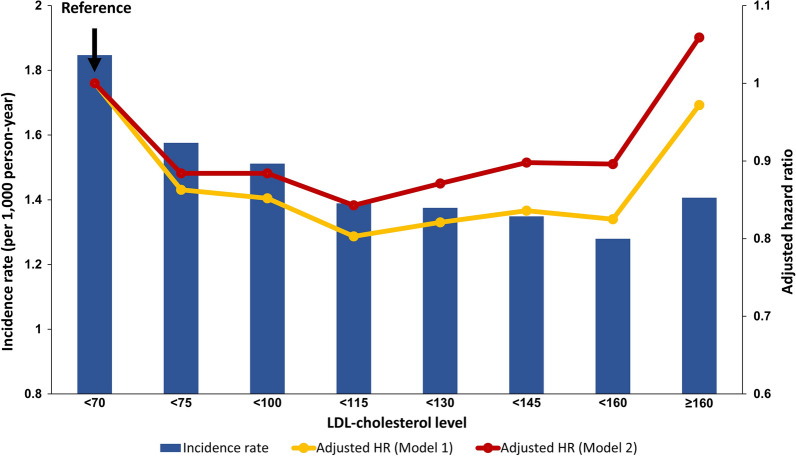
A total of 2,602,577 patients were included, with total follow-up duration of 17,851,797 person * year. Mean follow-up duration was 6.86 years, and 26,341 SCA cases were identified. Overall incidence of SCA was highest in the lowest LDL-cholesterol group (< 70 mg/dL) and decreased in a linear manner as LDL-cholesterol rises, till 160 mg/dL. Adjustment of covariates resulted in U-shape association, with highest risk of SCA in the highest LDL-cholesterol group (≥ 160 mg/dL) followed by lowest LDL-cholesterol group (< 70 mg/dL). In subgroup analysis, U-shape association between SCA risk and LDL-cholesterol was more pronounced in male, non-obese people, and those who did not use statins.
In people with diabetes, the association between SCA and LDL-cholesterol level was U-shaped with highest and lowest LDL-cholesterol group having higher risk of SCA than others. Low LDL-cholesterol level can be a surrogate marker for increased risk of SCA in people with diabetes mellitus and this paradoxical association should be recognized and extended to clinical preventive measures.
作为心血管疾病既定风险因素的血脂异常(即低密度脂蛋白胆固醇)在糖尿病患者中更为明显。然而,在糖尿病患者中,低密度脂蛋白胆固醇水平与心搏骤停(SCA)风险之间的关联知之甚少。本研究旨在调查糖尿病患者中低密度脂蛋白胆固醇水平与 SCA 风险之间的关联。
本研究基于韩国国家健康保险服务数据库。分析了 2009 年至 2012 年接受一般检查并被诊断为 2 型糖尿病的患者。主要结局定义为国际疾病分类代码识别的 SCA 事件。
共纳入 2602577 例患者,总随访时间为 17851797 人年。平均随访时间为 6.86 年,共发现 26341 例 SCA 病例。SCA 的总体发生率在最低低密度脂蛋白胆固醇组(<70mg/dL)最高,随着低密度脂蛋白胆固醇的升高呈线性下降,直至 160mg/dL。调整协变量后呈 U 形关联,最高 SCA 风险出现在最高低密度脂蛋白胆固醇组(≥160mg/dL),其次是最低低密度脂蛋白胆固醇组(<70mg/dL)。亚组分析显示,在男性、非肥胖人群和未使用他汀类药物的人群中,SCA 风险与 LDL 胆固醇之间的 U 形关联更为明显。
在糖尿病患者中,SCA 与 LDL 胆固醇水平之间呈 U 形关联,最低和最高 LDL 胆固醇组的 SCA 风险高于其他组。低 LDL 胆固醇水平可能是糖尿病患者 SCA 风险增加的替代标志物,这种矛盾的关联应得到认识,并推广到临床预防措施中。