He Wanying, Cai Ruining, Xi Shichuan, Yin Ziyu, Du Zengfeng, Luan Zhendong, Sun Chaomin, Zhang Xin
CAS Key Laboratory of Marine Geology and Environment & Center of Deep Sea Research, Institute of Oceanology, Chinese Academy of Sciences, Qingdao, China.
Laboratory for Marine Geology, Pilot Laboratory for Marine Science and Technology, Qingdao, China.
Microbiol Spectr. 2023 Feb 21;11(2):e0367822. doi: 10.1128/spectrum.03678-22.
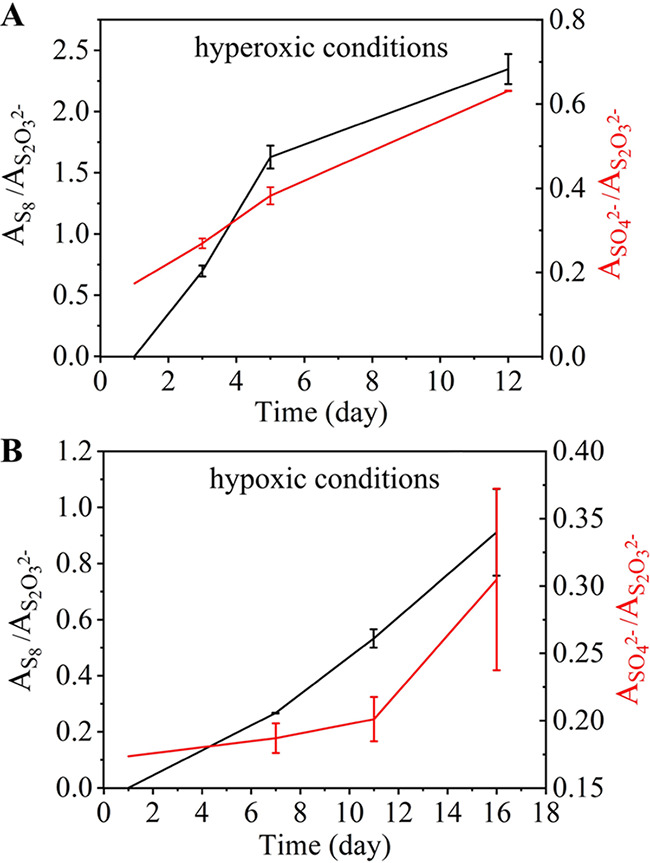
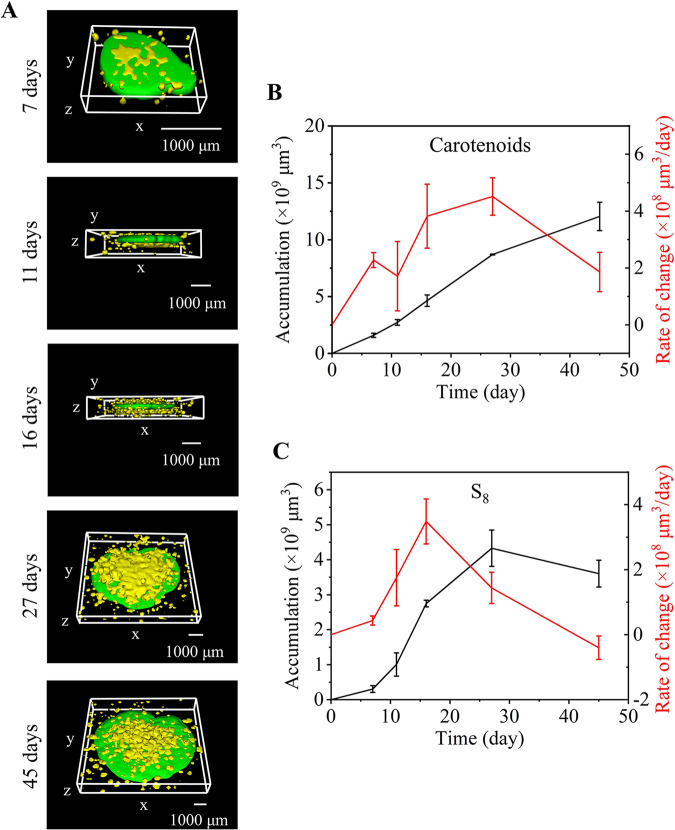
As microbial sulfur metabolism significantly contributes to the formation and cycling of deep-sea sulfur, studying their sulfur metabolism is important for understanding the deep-sea sulfur cycle. However, conventional methods are limited in near real-time studies of bacterial metabolism. Recently, Raman spectroscopy has been widely used in studies on biological metabolism due to its low-cost, rapid, label-free, and nondestructive features, providing us with new approaches to solve the above limitation. Here, we used the confocal Raman quantitative 3D imaging method to nondestructively detect the growth and metabolism of Erythrobacter flavus 21-3 in the long term and near real time, which possessed a pathway mediating the formation of elemental sulfur in the deep sea, but the dynamic process was unknown. In this study, its dynamic sulfur metabolism was visualized and quantitatively assessed in near real time using 3D imaging and related calculations. Based on 3D imaging, the growth and metabolism of microbial colonies growing under both hyperoxic and hypoxic conditions were quantified by volume calculation and ratio analysis. Additionally, unprecedented details of growth and metabolism were uncovered by this method. Due to this successful application, this method is potentially significant for analyzing the biological processes of microorganisms in the future. Microorganisms contribute significantly to the formation of deep-sea elemental sulfur, so studies on their growth and dynamic sulfur metabolism are important to understand the deep-sea sulfur cycle. However, near real-time nondestructive metabolic studies of microorganisms remain a great challenge due to the limitations of existing methods. We thus used an imaging-related workflow by confocal Raman microscopy. More detailed descriptions of the sulfur metabolism of 21-3 were disclosed, which perfectly complemented previous research results. Therefore, this method is potentially significant for analyzing the biological processes of microorganisms in the future. To our knowledge, this is the first label-free and nondestructive technique that can provide temporally persistent 3D visualization and quantitative information about bacteria.
由于微生物硫代谢对深海硫的形成和循环有重要贡献,研究其硫代谢对于理解深海硫循环至关重要。然而,传统方法在细菌代谢的近实时研究中存在局限性。近年来,拉曼光谱因其低成本、快速、无标记和非破坏性的特点,在生物代谢研究中得到广泛应用,为解决上述局限性提供了新途径。在此,我们使用共聚焦拉曼定量三维成像方法,对具有介导深海元素硫形成途径但动态过程未知的黄杆菌21-3的生长和代谢进行长期且近实时的无损检测。在本研究中,利用三维成像和相关计算对其动态硫代谢进行了近实时的可视化和定量评估。基于三维成像,通过体积计算和比率分析对在高氧和低氧条件下生长的微生物菌落的生长和代谢进行了量化。此外,该方法还揭示了生长和代谢前所未有的细节。由于这一成功应用,该方法在未来分析微生物的生物学过程方面可能具有重要意义。微生物对深海元素硫的形成有重要贡献,因此研究它们的生长和动态硫代谢对于理解深海硫循环很重要。然而,由于现有方法的局限性,微生物的近实时无损代谢研究仍然是一个巨大挑战。因此,我们使用了共聚焦拉曼显微镜的成像相关工作流程。对21-3的硫代谢进行了更详细的描述,完美补充了先前的研究结果。因此,该方法在未来分析微生物的生物学过程方面可能具有重要意义。据我们所知,这是第一种能够提供细菌的时间上持续的三维可视化和定量信息的无标记和非破坏性技术。