CAS Key Laboratory of Experimental Marine Biology & Center of Deep Sea Research, Institute of Oceanology, Chinese Academy of Sciences, Qingdao, China.
Laboratory for Marine Biology and Biotechnology, Qingdao National Laboratory for Marine Science and Technology, Qingdao, China.
ISME J. 2020 Sep;14(9):2261-2274. doi: 10.1038/s41396-020-0684-5. Epub 2020 May 26.
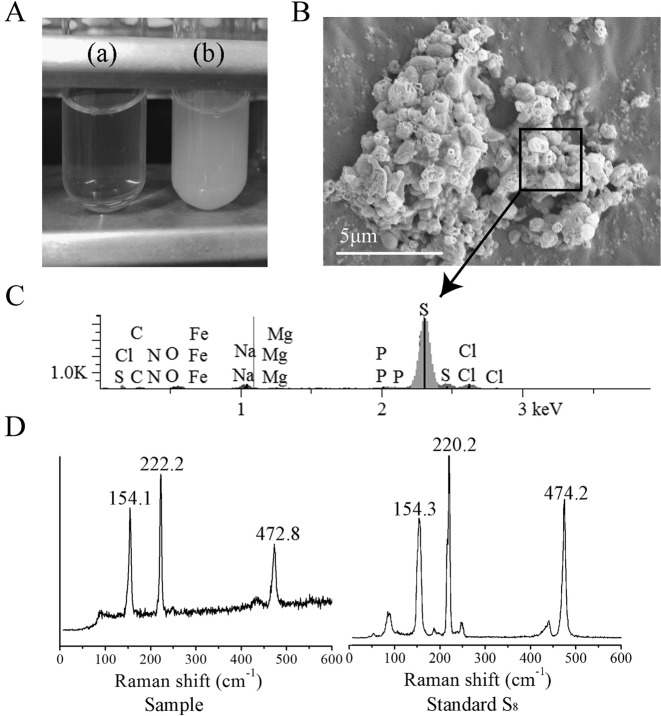
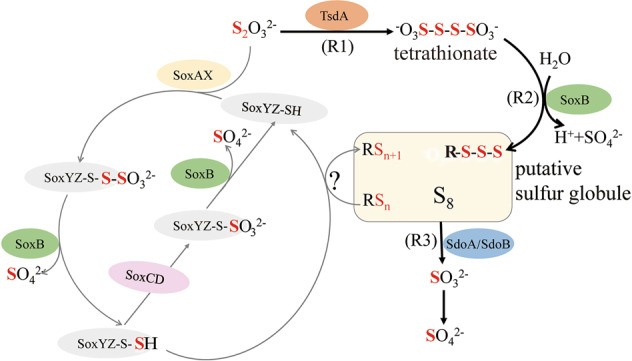
Zero-valent sulfur (ZVS) has been shown to be a major sulfur intermediate in the deep-sea cold seep of the South China Sea based on our previous work, however, the microbial contribution to the formation of ZVS in cold seep has remained unclear. Here, we describe a novel thiosulfate oxidation pathway discovered in the deep-sea cold seep bacterium Erythrobacter flavus 21-3, which provides a new clue about the formation of ZVS. Electronic microscopy, energy-dispersive, and Raman spectra were used to confirm that E. flavus 21-3 effectively converts thiosulfate to ZVS. We next used a combined proteomic and genetic method to identify thiosulfate dehydrogenase (TsdA) and thiosulfohydrolase (SoxB) playing key roles in the conversion of thiosulfate to ZVS. Stoichiometric results of different sulfur intermediates further clarify the function of TsdA in converting thiosulfate to tetrathionate (OS-S-S-SO), SoxB in liberating sulfone from tetrathionate to form ZVS and sulfur dioxygenases (SdoA/SdoB) in oxidizing ZVS to sulfite under some conditions. Notably, homologs of TsdA, SoxB, and SdoA/SdoB widely exist across the bacteria including in Erythrobacter species derived from different environments. This strongly indicates that this novel thiosulfate oxidation pathway might be frequently used by microbes and plays an important role in the biogeochemical sulfur cycle in nature.
基于我们之前的工作,零价硫 (ZVS) 已被证明是南海深海冷泉中的一种主要硫中间体,然而,微生物对冷泉中 ZVS 形成的贡献仍不清楚。在这里,我们描述了在深海冷泉细菌 E. flavus 21-3 中发现的一种新的硫代硫酸盐氧化途径,为 ZVS 的形成提供了新的线索。电子显微镜、能量色散和拉曼光谱用于确认 E. flavus 21-3 有效地将硫代硫酸盐转化为 ZVS。接下来,我们使用组合蛋白质组学和遗传方法来鉴定在将硫代硫酸盐转化为 ZVS 中起关键作用的硫代硫酸盐脱氢酶 (TsdA) 和硫代磺酸盐水解酶 (SoxB)。不同硫中间体的化学计量结果进一步阐明了 TsdA 在将硫代硫酸盐转化为连四硫酸盐 (OS-S-S-SO)、SoxB 在从连四硫酸盐释放亚砜以形成 ZVS 和硫双加氧酶 (SdoA/SdoB) 的作用下在某些条件下将 ZVS 氧化为亚硫酸盐。值得注意的是,TsdA、SoxB 和 SdoA/SdoB 的同源物广泛存在于包括来自不同环境的 Erythrobacter 属在内的细菌中。这强烈表明,这种新的硫代硫酸盐氧化途径可能经常被微生物使用,并在自然界的生物地球化学硫循环中发挥重要作用。