Department of Psychology, University of Waterloo, Ontario, Canada.
DEVCOM U.S. Army Research Laboratory, Austin, TX, USA.
Exp Psychol. 2022 Nov;69(6):295-307. doi: 10.1027/1618-3169/a000567.
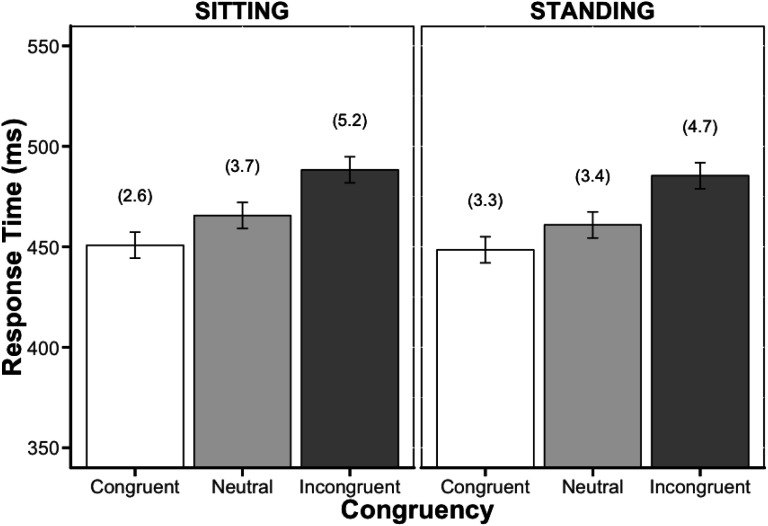
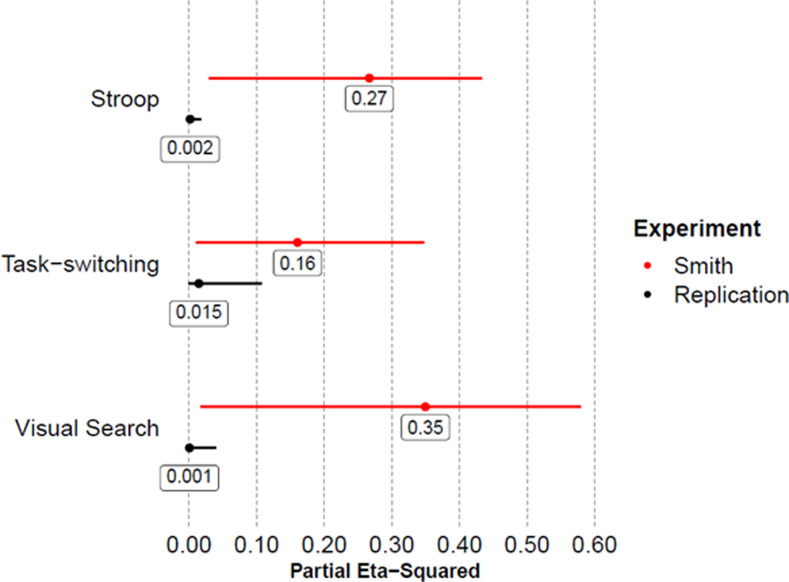
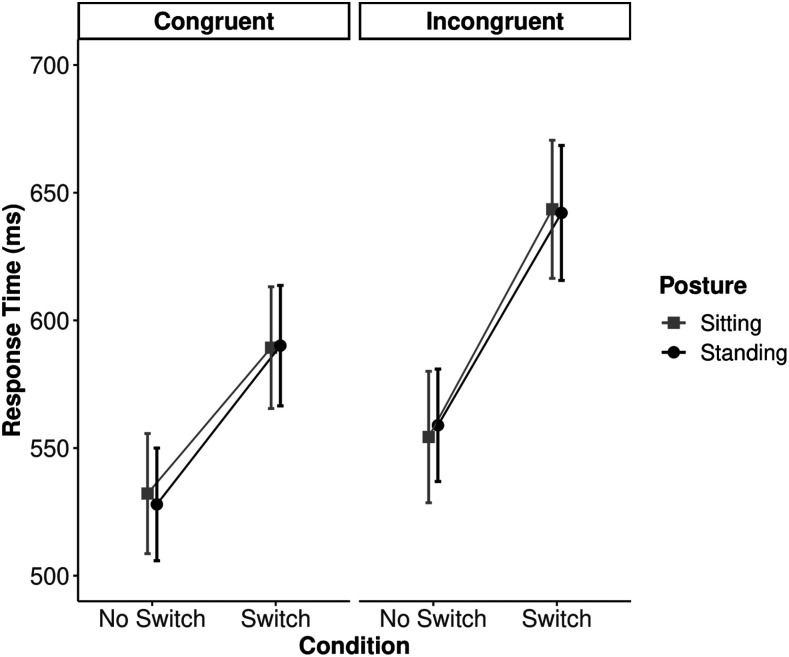
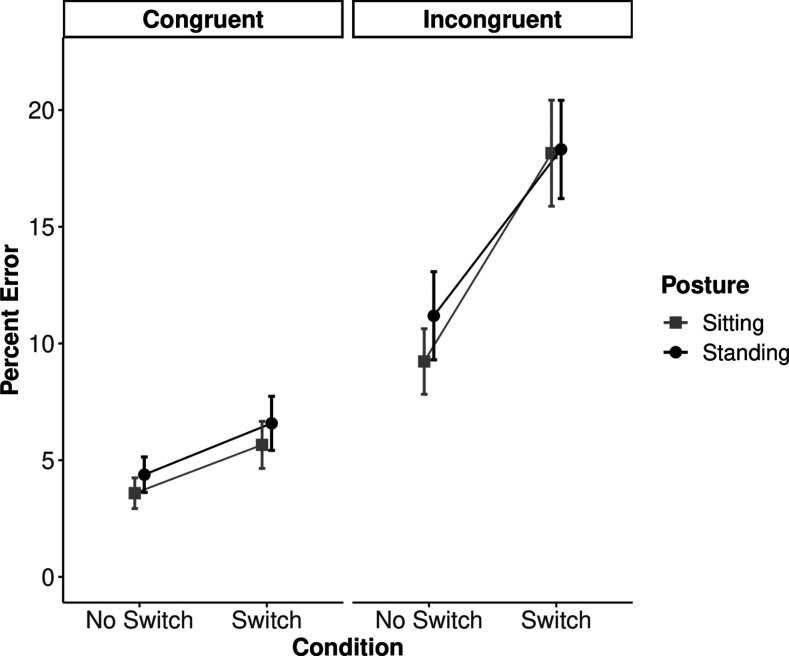
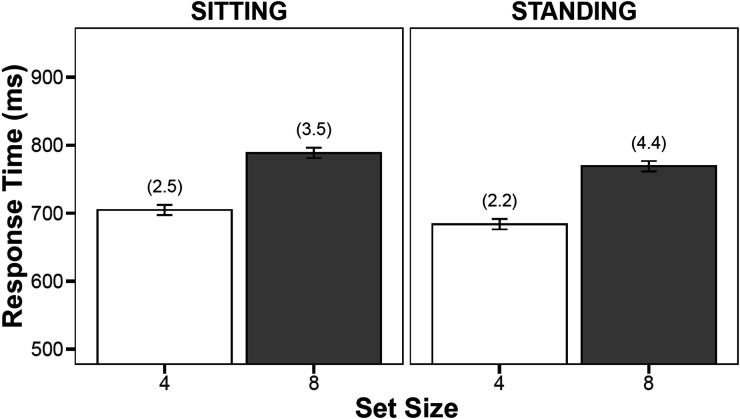
Smith et al. (2019) found standing resulted in better performance than sitting in three different cognitive control paradigms: a Stroop task, a task-switching, and a visual search paradigm. Here, we conducted close replications of the authors' three experiments using larger sample sizes than the original work. Our sample sizes had essentially perfect power to detect the key postural effects reported by Smith et al. The results from our experiments revealed that, in contrast to Smith et al., the postural interactions were quite limited in magnitude in addition to being only a fraction of the size of the original effects. Moreover, our results from Experiment 1 are consistent with two recent replications (Caron et al., 2020; Straub et al., 2022), which reported no meaningful influences of posture on the Stroop effect. In all, the current research provides further converging evidence that postural influences on cognition do not appear to be as robust, as was initially reported in prior work.
史密斯等人(2019 年)发现,在三种不同的认知控制范式中,站立比坐姿表现更好:斯特鲁普任务、任务转换和视觉搜索范式。在这里,我们使用比原始研究更大的样本量对作者的三个实验进行了密切复制。我们的样本量实际上具有检测史密斯等人报告的关键姿势效果的完美功效。我们实验的结果表明,与史密斯等人相反,除了原始效果的一小部分外,姿势相互作用的幅度非常有限。此外,我们的实验 1 结果与两项最近的重复研究(Caron 等人,2020 年;Straub 等人,2022 年)一致,该研究报告称,姿势对斯特鲁普效应没有有意义的影响。总的来说,当前的研究提供了进一步的证据,表明姿势对认知的影响似乎不像之前的研究最初报告的那样稳健。