Marks David F
Independent Researcher, Provence-Alpes-Côte d'Azur, 13200 Arles, France.
Vision (Basel). 2023 Feb 14;7(1):12. doi: 10.3390/vision7010012.
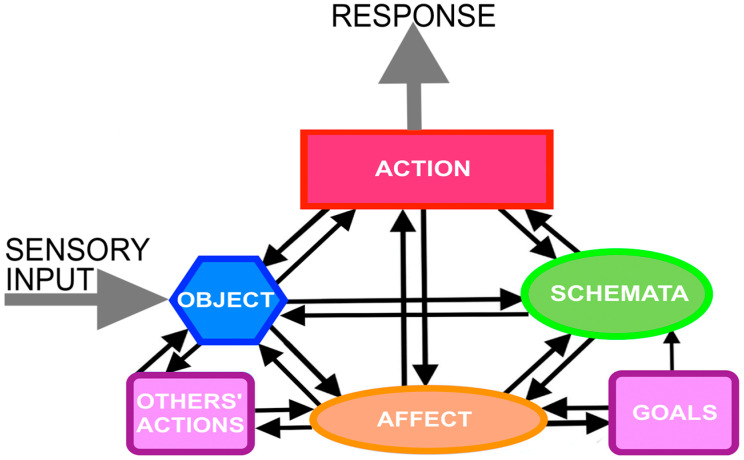
The Action Cycle Theory (ACT) is an enactive theory of the perception and a mental imagery system that is comprised of six modules: Schemata, Objects, Actions, Affect, Goals and Others' Behavior. The evidence supporting these six connected modules is reviewed in light of research on mental imagery vividness. The six modules and their interconnections receive empirical support from a wide range of studies. All six modules of perception and mental imagery are influenced by individual differences in vividness. Real-world applications of ACT show interesting potential to improve human wellbeing in both healthy people and patients. Mental imagery can be applied in creative ways to make new collective goals and actions for change that are necessary to maximize the future prospects of the planet.
行动循环理论(ACT)是一种关于感知和心理意象系统的具身认知理论,它由六个模块组成:图式、客体、行动、情感、目标和他人行为。结合心理意象生动性的研究,对支持这六个相互关联模块的证据进行了综述。这六个模块及其相互联系得到了广泛研究的实证支持。感知和心理意象的所有六个模块都受到生动性个体差异的影响。ACT在现实世界中的应用显示出改善健康人和患者福祉的有趣潜力。心理意象可以以创造性的方式应用,以制定新的集体目标和变革行动,这对于最大化地球的未来前景至关重要。