Department of Nutrition, University of California, Davis, Davis, CA.
Department of Molecular and Cellular Biology, University of California, Davis, Davis, CA.
Am J Clin Nutr. 2023 Feb;117(2):286-297. doi: 10.1016/j.ajcnut.2022.10.015. Epub 2022 Dec 20.
Periodic prolonged fasting (PF) extends lifespan in model organisms and ameliorates multiple disease states both clinically and experimentally owing, in part, to its ability to modulate the immune system. However, the relationship between metabolic factors, immunity, and longevity during PF remains poorly characterized especially in humans.
This study aimed to observe the effects of PF in human subjects on the clinical and experimental markers of metabolic and immune health and uncover underlying plasma-borne factors that may be responsible for these effects.
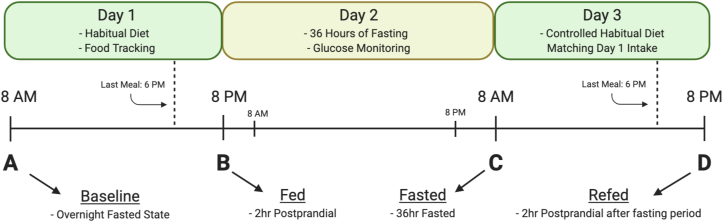
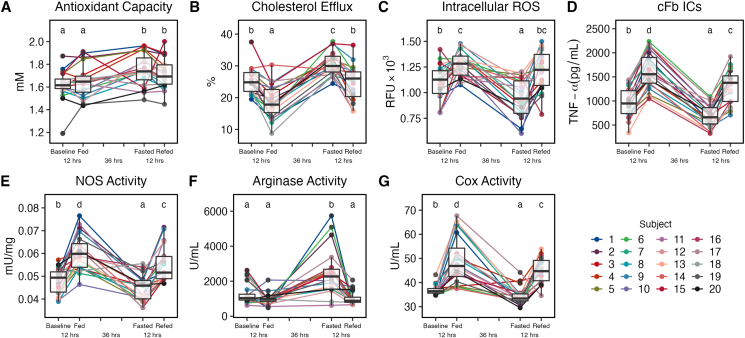
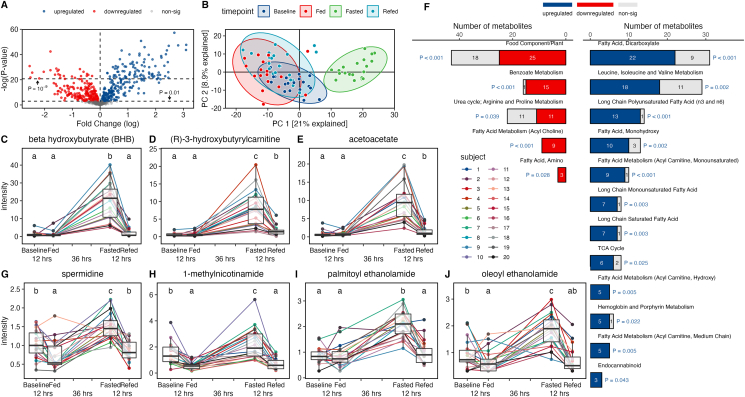
In this rigorously controlled pilot study (ClinicalTrial.gov identifier, NCT03487679), 20 young males and females participated in a 3-d study protocol including assessments of 4 distinct metabolic states: 1) overnight fasted baseline state, 2) 2-h postprandial fed state, 3) 36-h fasted state, and 4) final 2-h postprandial re-fed state 12 h after the 36-h fasting period. Clinical and experimental markers of immune and metabolic health were assessed for each state along with comprehensive metabolomic profiling of participant plasma. Bioactive metabolites identified to be upregulated in circulation after 36 h of fasting were then assessed for their ability to mimic the effects of fasting in isolated human macrophage as well as the ability to extend lifespan in Caenorhabditis elegans.
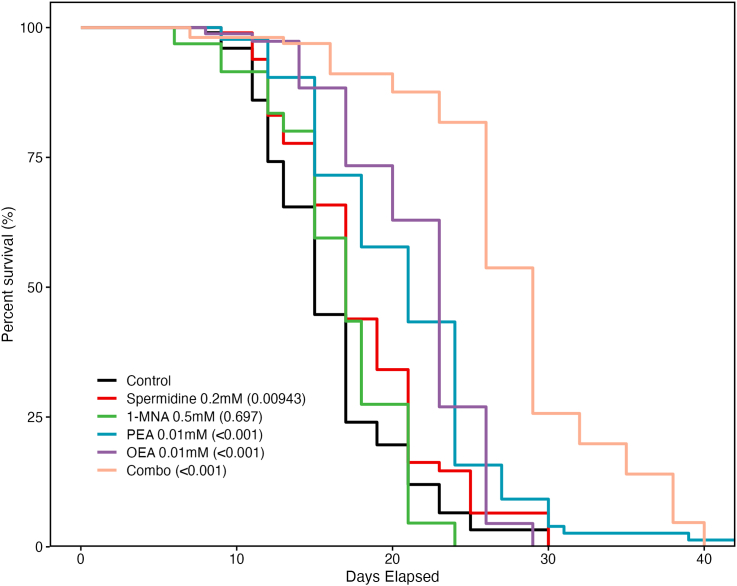
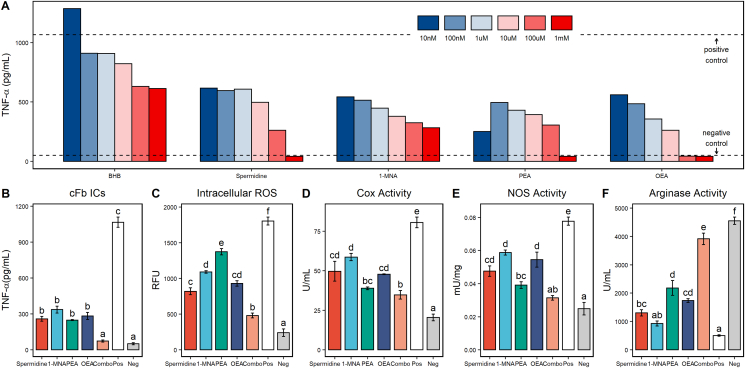
We showed that PF robustly altered the plasma metabolome and conferred beneficial immunomodulatory effects on human macrophages. We also identified 4 bioactive metabolites that were upregulated during PF (spermidine, 1-methylnicotinamide, palmitoylethanolamide, and oleoylethanolamide) that could replicate these immunomodulatory effects. Furthermore, we found that these metabolites and their combination significantly extended the median lifespan of C. elegans by as much as 96%.
The results of this study reveal multiple functionalities and immunological pathways affected by PF in humans, identify candidates for the development of fasting mimetic compounds, and uncover targets for investigation in longevity research.
周期性长时间禁食(PF)可延长模型生物的寿命,并在临床和实验中改善多种疾病状态,部分原因是其能够调节免疫系统。然而,PF 期间代谢因素、免疫和长寿之间的关系在人类中仍未得到很好的描述。
本研究旨在观察 PF 对人体临床和实验代谢及免疫健康标志物的影响,并揭示可能导致这些影响的潜在血浆传播因子。
在这项严格控制的初步研究中(ClinicalTrials.gov 标识符:NCT03487679),20 名年轻男性和女性参加了为期 3 天的研究方案,包括评估 4 种不同的代谢状态:1)夜间禁食的基础状态,2)2 小时餐后进食状态,3)36 小时禁食状态,以及 4)最后 12 小时 36 小时禁食期后 2 小时餐后再进食状态。对每个状态进行了免疫和代谢健康的临床和实验标志物评估,以及参与者血浆的全面代谢组学分析。鉴定出在 36 小时禁食后循环中上调的生物活性代谢物,然后评估其在分离的人巨噬细胞中模拟禁食作用的能力,以及在秀丽隐杆线虫中延长寿命的能力。
我们表明,PF 强烈改变了血浆代谢组,并对人巨噬细胞产生了有益的免疫调节作用。我们还鉴定出 4 种在 PF 期间上调的生物活性代谢物(亚精胺、1-甲基烟酰胺、棕榈酰乙醇酰胺和油酰乙醇酰胺),它们可以复制这些免疫调节作用。此外,我们发现这些代谢物及其组合可使秀丽隐杆线虫的中位寿命延长多达 96%。
这项研究的结果揭示了 PF 在人类中影响的多种功能和免疫途径,确定了开发禁食模拟化合物的候选物,并揭示了长寿研究的调查目标。