Sun Zhiwei, Jiang Xinge, Wu Hua, Liu Feifei
School of Information Science and Electrical Engineering, Shandong Jiaotong University, Jinan, China.
School of Science, Shandong Jianzhu University, Jinan, China.
Front Neurosci. 2023 Feb 6;17:1121902. doi: 10.3389/fnins.2023.1121902. eCollection 2023.
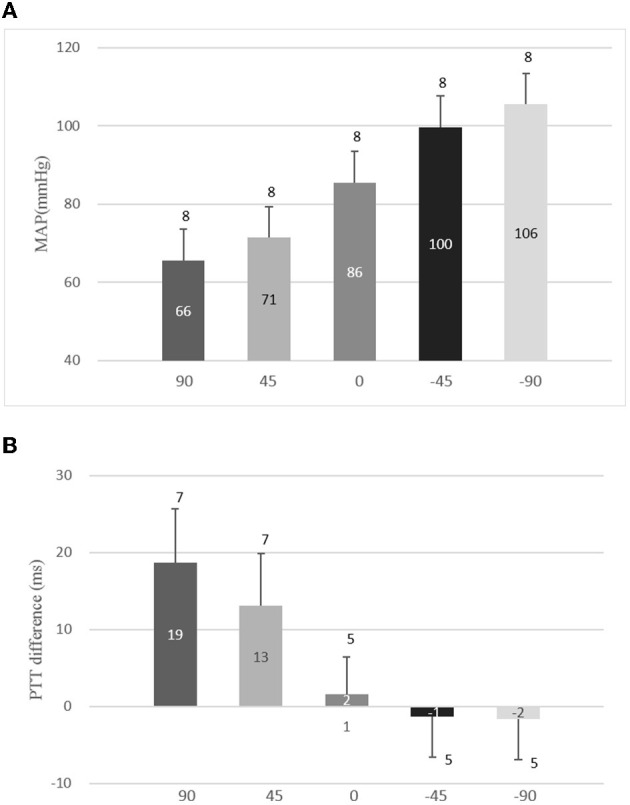
Pulse transit time (PTT) and blood pressure (BP) are widely used to quantify arterial characteristics. Arm position influences arterial BP and peripheral PTT. This study aims to quantify the relationship between PTT changes with internal vascular pressure variations induced by the arm moving. With left arm at horizontal position as reference and the right arm moving from 90 to 45, 0, -45, and -90° respectively, PTT difference was calculated by the difference of the pulse foot between right arm and left arm within the same heartbeat. The change in the BP was calculated from the gravitational effect with the measured arm length. Our results showed that the change in PTT with arm elevating is more obvious than that with arm lowering, indicating the different relationship between PTT changes due to the internal BP changes. This can help in understanding the inherent physiological/pathological mechanism of cardiovascular system.
脉搏传输时间(PTT)和血压(BP)被广泛用于量化动脉特征。手臂位置会影响动脉血压和外周PTT。本研究旨在量化因手臂移动引起的内部血管压力变化导致的PTT变化之间的关系。以左臂处于水平位置为参照,右臂分别从90°移动到45°、0°、-45°和-90°,通过同一心跳周期内右臂和左臂之间的脉搏波峰差来计算PTT差值。血压变化通过测量的手臂长度的重力效应来计算。我们的结果表明,PTT随手臂抬高的变化比随手臂降低的变化更明显,这表明由于内部血压变化导致的PTT变化之间存在不同的关系。这有助于理解心血管系统的内在生理/病理机制。