Liu Chengyu, Zhuang Tao, Zhao Lina, Chang Faliang, Liu Changchun, Wei Shoushui, Li Qiqiang, Zheng Dingchang
School of Control Science and Engineering, Shandong University, Jinan 250061, China ; School of Information Science and Engineering, Shandong University, Jinan 250100, China ; Institute of Cellular Medicine, Newcastle University, Newcastle upon Tyne NE2 4HH, UK.
National Laboratory of Pattern Recognition, Institute of Automation, Chinese Academy of Sciences, Beijing 100190, China.
Biomed Res Int. 2014;2014:923260. doi: 10.1155/2014/923260. Epub 2014 May 20.
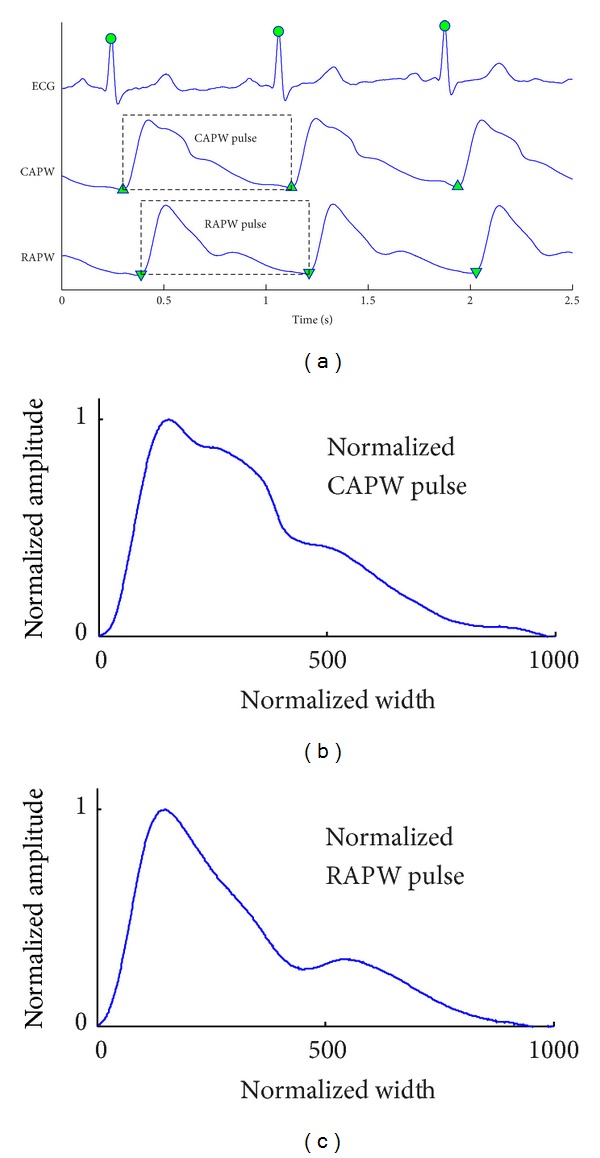
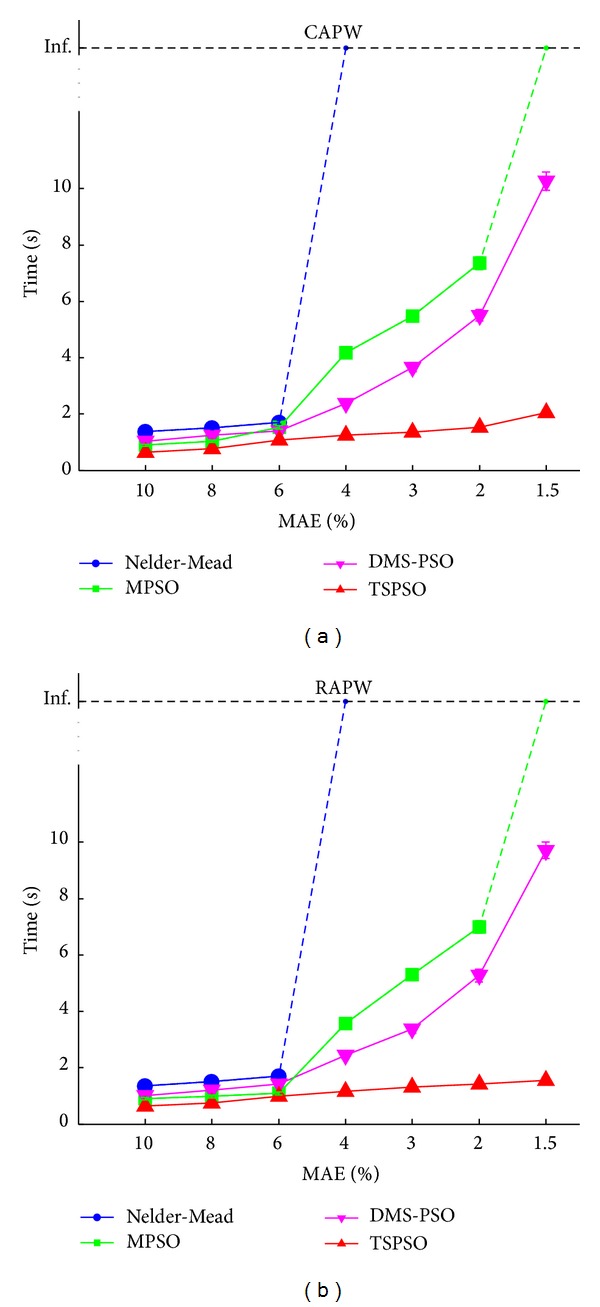
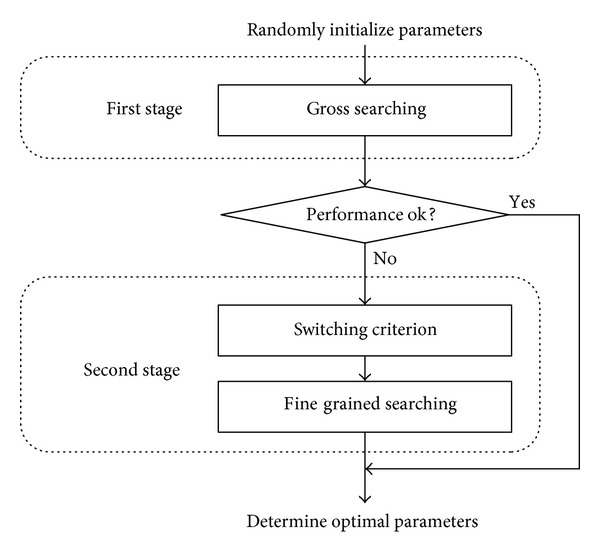
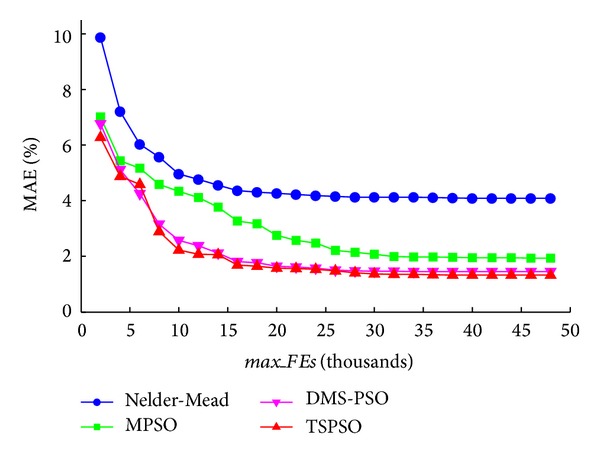
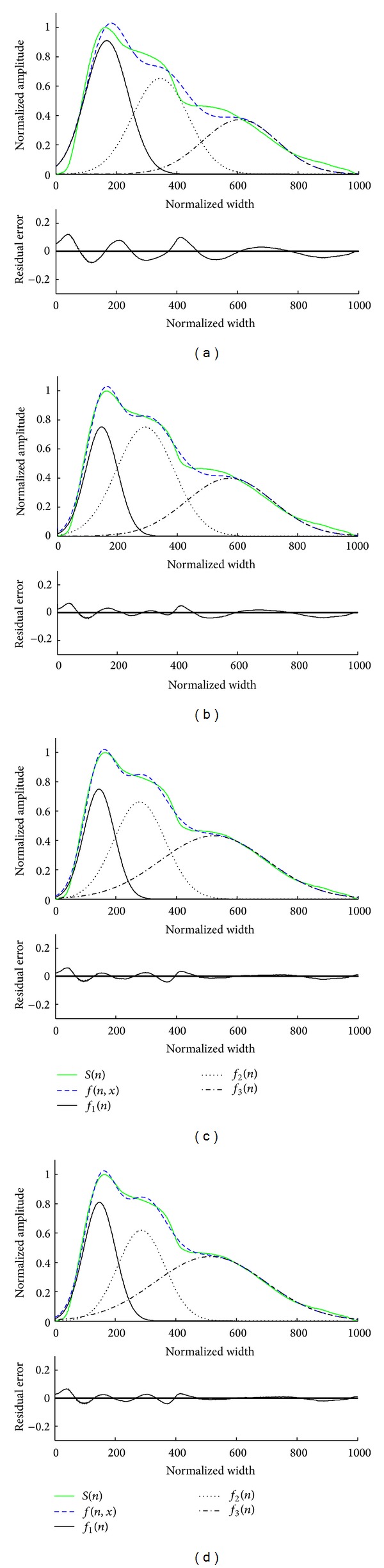
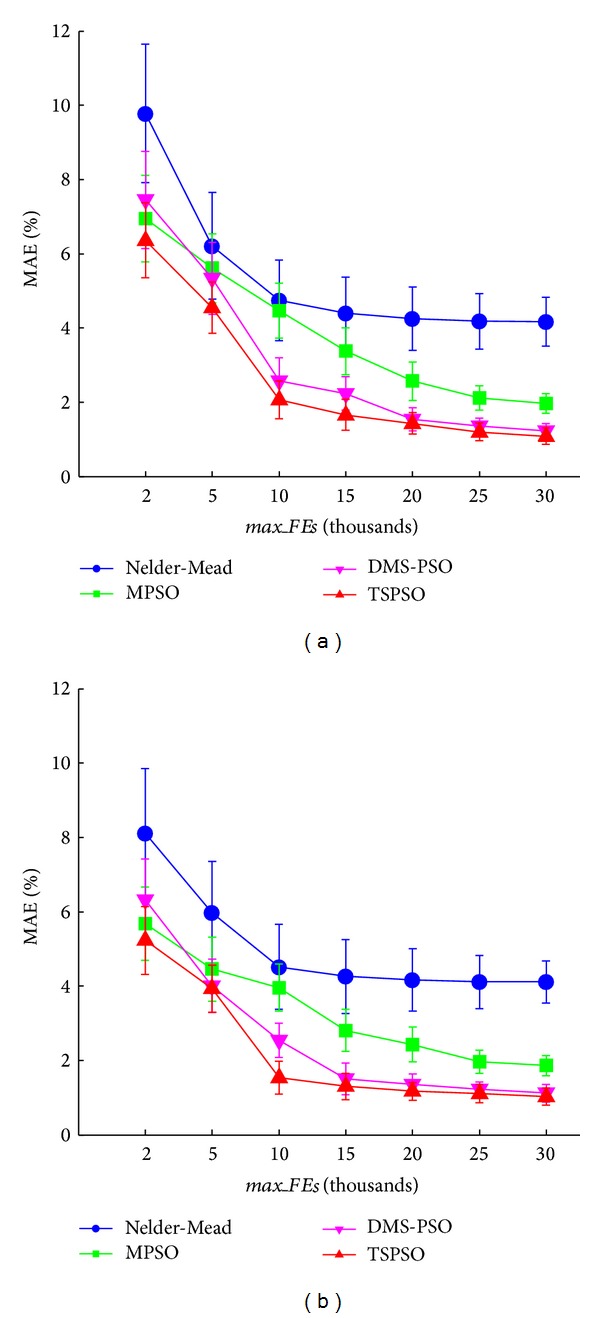
Changes of arterial pressure waveform characteristics have been accepted as risk indicators of cardiovascular diseases. Waveform modelling using Gaussian functions has been used to decompose arterial pressure pulses into different numbers of subwaves and hence quantify waveform characteristics. However, the fitting accuracy and computation efficiency of current modelling approaches need to be improved. This study aimed to develop a novel two-stage particle swarm optimizer (TSPSO) to determine optimal parameters of Gaussian functions. The evaluation was performed on carotid and radial artery pressure waveforms (CAPW and RAPW) which were simultaneously recorded from twenty normal volunteers. The fitting accuracy and calculation efficiency of our TSPSO were compared with three published optimization methods: the Nelder-Mead, the modified PSO (MPSO), and the dynamic multiswarm particle swarm optimizer (DMS-PSO). The results showed that TSPSO achieved the best fitting accuracy with a mean absolute error (MAE) of 1.1% for CAPW and 1.0% for RAPW, in comparison with 4.2% and 4.1% for Nelder-Mead, 2.0% and 1.9% for MPSO, and 1.2% and 1.1% for DMS-PSO. In addition, to achieve target MAE of 2.0%, the computation time of TSPSO was only 1.5 s, which was only 20% and 30% of that for MPSO and DMS-PSO, respectively.
动脉压波形特征的变化已被公认为心血管疾病的风险指标。使用高斯函数进行波形建模已被用于将动脉压脉冲分解为不同数量的子波,从而量化波形特征。然而,当前建模方法的拟合精度和计算效率有待提高。本研究旨在开发一种新型的两阶段粒子群优化器(TSPSO)来确定高斯函数的最优参数。对20名正常志愿者同时记录的颈动脉和桡动脉压力波形(CAPW和RAPW)进行了评估。将我们的TSPSO的拟合精度和计算效率与三种已发表的优化方法进行了比较:Nelder-Mead方法、改进的粒子群优化器(MPSO)和动态多群粒子群优化器(DMS-PSO)。结果表明,TSPSO实现了最佳的拟合精度,CAPW的平均绝对误差(MAE)为1.1%,RAPW的平均绝对误差为1.0%,相比之下,Nelder-Mead方法分别为4.2%和4.1%,MPSO为2.0%和1.9%,DMS-PSO为1.2%和1.1%。此外,为了达到2.0%的目标MAE,TSPSO的计算时间仅为1.5秒,分别仅为MPSO和DMS-PSO计算时间的20%和30%。