Johnson Richard J, Sanchez Lozada Laura G, Lanaspa Miguel A, Piani Federica, Borghi Claudio
Department of Medicine, University of Colorado Anschutz Medical Campus, Aurora, Colorado, USA.
Department of Cardio-Renal Physiopathology, Instituto Nacional de Cardiología "Ignacio Chavez," , Mexico City, Mexico.
Kidney Int Rep. 2022 Dec 5;8(2):229-239. doi: 10.1016/j.ekir.2022.11.016. eCollection 2023 Feb.
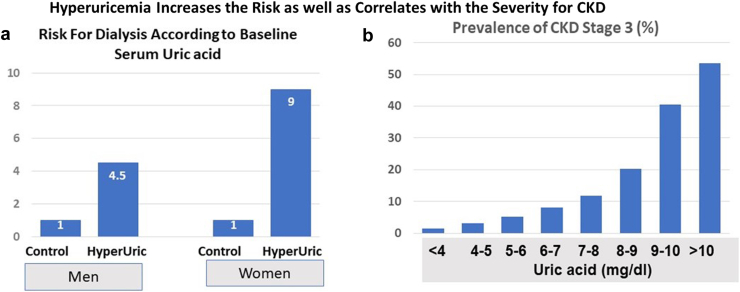
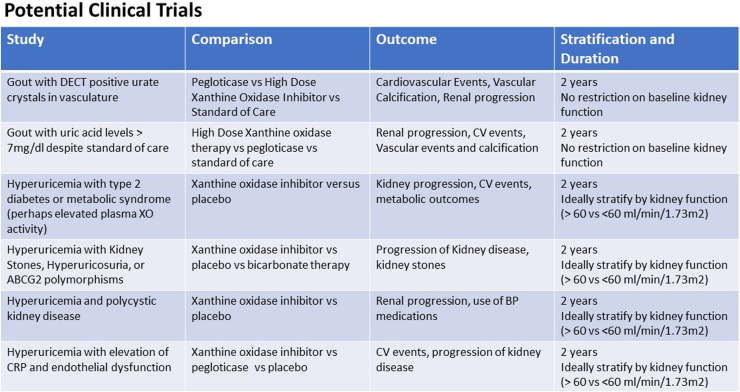
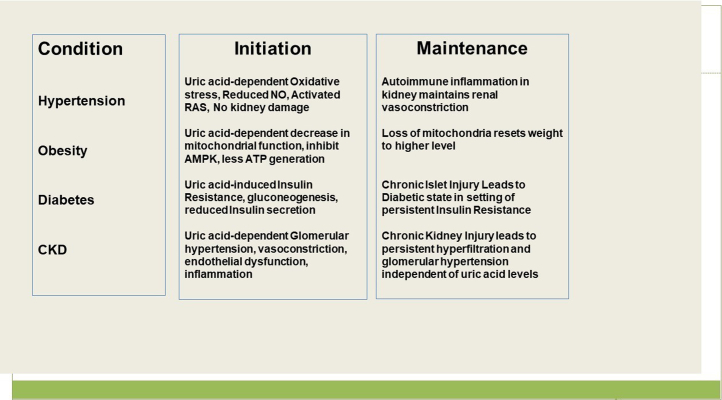
Gout and hyperuricemia are present in 25% and 60% of patients with chronic kidney disease (CKD), respectively. Despite the common association, the role of uric acid in the progression of kidney disease and in metabolic complications remains contested. Some authorities argue that the treatment of asymptomatic hyperuricemia in CKD is not indicated, and some have even suggested hyperuricemia may be beneficial. Here, we review the various arguments both for and against treatment. The weight of the evidence suggests asymptomatic hyperuricemia is likely injurious, but it may primarily relate to subgroups, those who have systemic crystal deposits, those with frequent urinary crystalluria or kidney stones, and those with high intracellular uric acid levels. We recommend carefully designed clinical trials to test if lowering uric acid in hyperuricemic subjects with cardiometabolic complications is protective.
痛风和高尿酸血症分别存在于25%和60%的慢性肾脏病(CKD)患者中。尽管二者关联常见,但尿酸在肾脏疾病进展和代谢并发症中的作用仍存在争议。一些权威人士认为,CKD患者无症状性高尿酸血症无需治疗,甚至有人认为高尿酸血症可能有益。在此,我们回顾支持和反对治疗的各种观点。证据表明,无症状性高尿酸血症可能有害,但可能主要与某些亚组有关,即有全身晶体沉积的患者、频繁出现尿结晶或肾结石的患者以及细胞内尿酸水平高的患者。我们建议开展精心设计的临床试验,以检验降低伴有心脏代谢并发症的高尿酸血症患者的尿酸水平是否具有保护作用。