Amoah John Oti, Addai-Mununkum Theresah, Oduro Georgina Yaa, Odoi Amanda, Ansah John Windie, Takyiakwaa Dorothy, Sakyi-Djan Pearl
Centre for Gender Research, Advocacy and Documentation (CEGRAD), University of Cape Coast, Ghana.
Centre for African and International Studies, University of Cape Coast, Ghana.
Soc Sci Humanit Open. 2023;7(1):100443. doi: 10.1016/j.ssaho.2023.100443. Epub 2023 Feb 10.
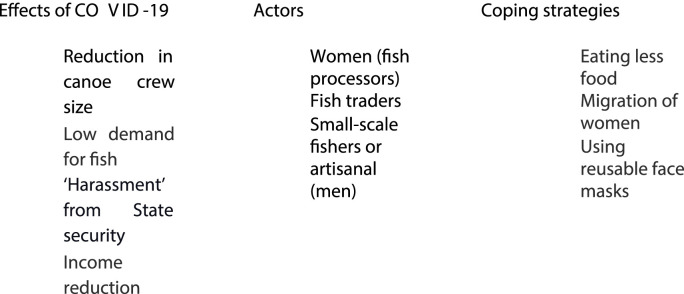
The COVID-19 outbreak effects and related state responses, especially mobility restriction interventions, contributed to disruption in livelihoods in the coastal communities in Ghana. This paper uses an ethnographic approach to analyse the effects of the COVID-19 pandemic and coping strategies adopted by small-scale fishers, fish traders and processors. We argued that focusing solely on the livelihoods of formal sector workers is problematic because it fails to consider the dynamics of informal coastal workers. Findings indicate that fishers, fish traders and processors experienced various effects on food, income, police harassment, and coping strategies, including migration, resorting to reusable face masks and food-compromising practices. Infectious diseases such as COVID-19 impact coastal people and their livelihoods. Therefore, implementing social protection measures to mitigate the effects of pandemics on livelihoods should be better coordinated and well-targeted to reach the most vulnerable. Findings from this study offer pointers to position preparedness and response efforts to future outbreaks in a similar context.
新冠疫情的影响及相关国家应对措施,尤其是流动限制干预措施,导致加纳沿海社区的生计受到干扰。本文采用人种志方法,分析新冠疫情的影响以及小规模渔民、鱼商和加工者所采取的应对策略。我们认为,仅关注正规部门工人的生计存在问题,因为它没有考虑到沿海非正规工人的动态情况。研究结果表明,渔民、鱼商和加工者在食物、收入、警方骚扰以及应对策略等方面都受到了各种影响,这些策略包括迁移、使用可重复使用的口罩以及采取有损食物的做法。像新冠疫情这样的传染病会影响沿海居民及其生计。因此,应更好地协调并精准实施社会保护措施,以减轻疫情对生计的影响,从而惠及最弱势群体。本研究的结果为在类似背景下针对未来疫情的防范和应对工作提供了指导方向。