Hou Yue, Wang Sai-Feng, Zhou Ke, Dai Shi-Xue
Department of Gastroenterology, (Guangdong Provincial Geriatrics Institute), National Key Clinical Specialty, Guangdong Provincial People's Hospital, (Guangdong Academy of Medical Sciences), Southern Medical University, Guangzhou, Guangdong, China.
The Second School of Clinical Medicine, Southern Medical University, Guangzhou, Guangdong, China.
Front Nutr. 2023 Jan 17;9:1066252. doi: 10.3389/fnut.2022.1066252. eCollection 2022.
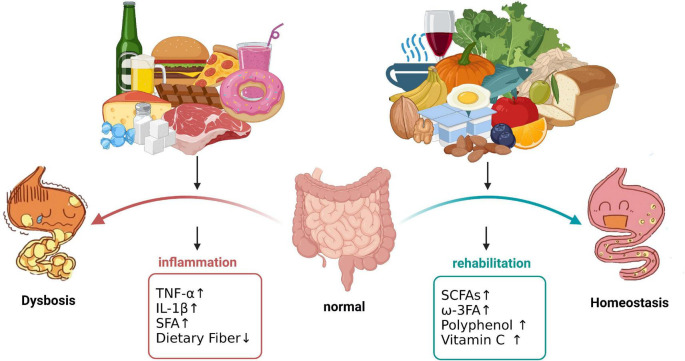
Inflammatory bowel disease (IBD), a non-specific chronic idiopathic inflammatory condition of the digestive system, requires lifelong treatment in which drugs are the mainstay, along with surgery when necessary. In adjuvant therapies, the diet is considered to be an essential, controllable, and economical component. However, the majority of recent nutrition research has focused on the general effects of nutrients on IBD, with little attention given to the advantages and negative aspects of individual foods and dietary combinations. To cover these shortcomings, we surveyed the benefits and drawbacks of typical foods and their chemical compositions on intestinal pathophysiology by comparing nutrients existing in the foods in Eastern and Western countries. Moreover, for Eastern and Western patients with IBD, we innovatively propose a 3-step dietary recommendation based on modified customary eating habits, including lowering the triggering foods, modifying dietary advice to control disease progression, and improving surgery prognosis.
炎症性肠病(IBD)是一种消化系统的非特异性慢性特发性炎症性疾病,需要终身治疗,其中药物是主要治疗手段,必要时还需进行手术。在辅助治疗中,饮食被认为是一个重要、可控且经济的组成部分。然而,最近的大多数营养研究都集中在营养素对IBD的总体影响上,很少关注个别食物和饮食组合的优点和负面影响。为了弥补这些不足,我们通过比较东西方国家食物中存在的营养素,研究了典型食物及其化学成分对肠道病理生理学的利弊。此外,对于东西方的IBD患者,我们创新性地提出了基于改良饮食习惯的三步饮食建议,包括减少触发食物、修改饮食建议以控制疾病进展以及改善手术预后。