The Department of Cardiology, General Hospital of Northern Theater Command, Shenyang, Liaoning, China.
The Department of Cardiology, Xijing Hospital, Air Force Medical University, Xi'an, Shanxi, China.
Front Immunol. 2023 Feb 2;14:1087345. doi: 10.3389/fimmu.2023.1087345. eCollection 2023.
The relationship between the systemic immune inflammatory index (SII) and the prognosis of hypertensive patients is unclear. This study aims to explore the association of SII with all-cause and cause-specific mortality in patients with hypertension.
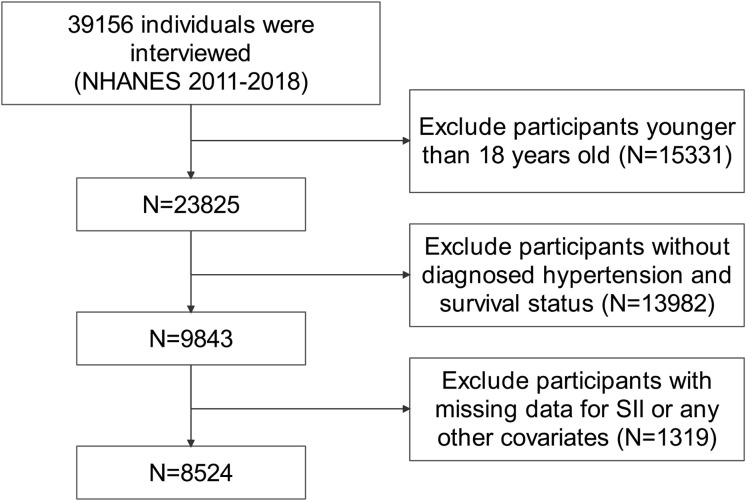
This study included 8524 adults with hypertension from the National Health and Nutritional Examination Surveys (NHANES) 2011-2018, and followed for survival through December 31, 2019. Cox proportional hazards models were used to investigate the associations between SII and mortality from all causes, cardiovascular disease (CVD), and cancer. Restricted cubic spline, piecewise linear regression, subgroup and sensitivity analyses were also used.
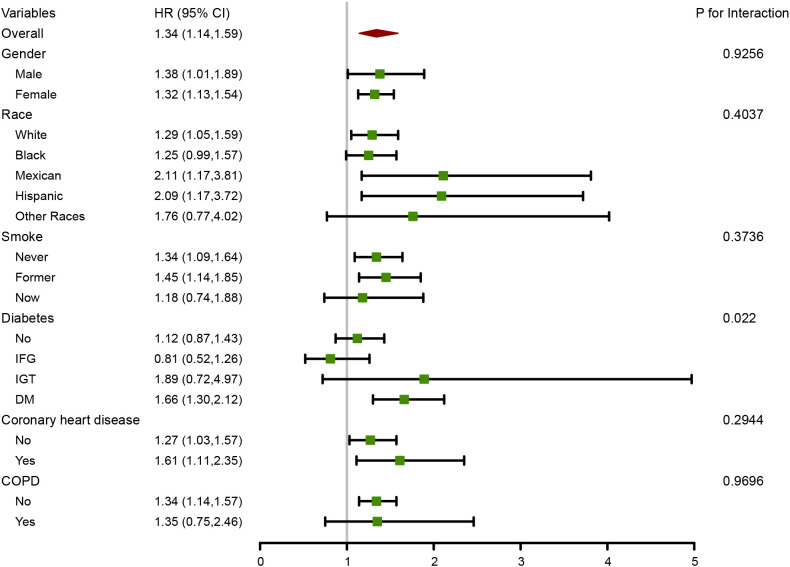
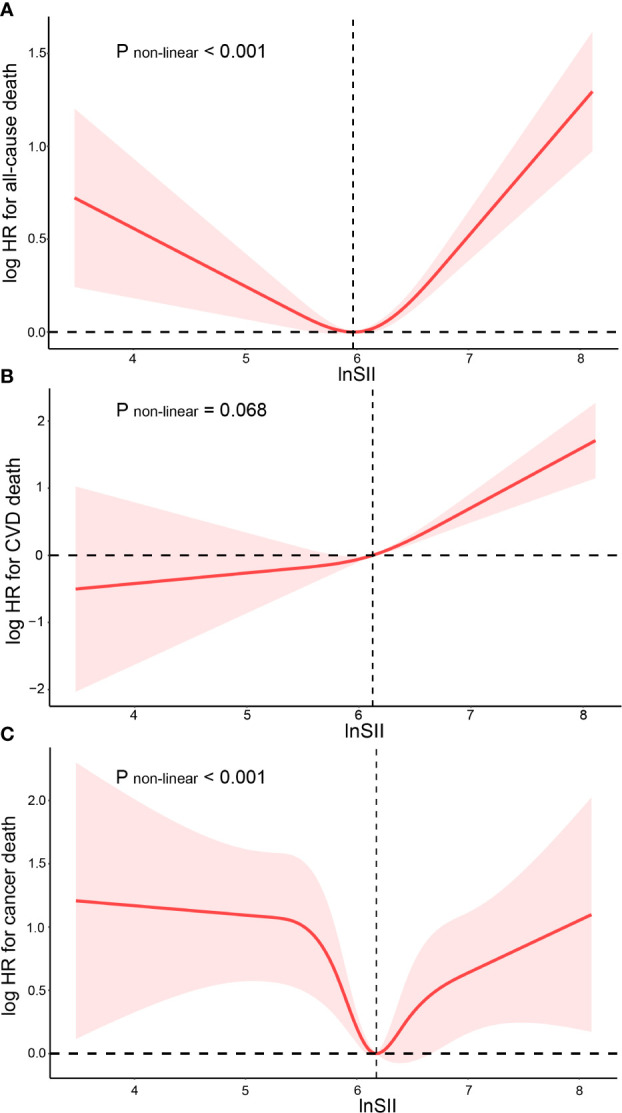
During a median follow-up of 4.58 years, 872 all-cause deaths occurred. After adjusting for covariates, higher SII was significantly associated with an elevated risk of CVD mortality. There was a 102% increased risk of CVD mortality per one-unit increment in natural log-transformed SII (lnSII) (P < 0.001). Consistent results were also observed when SII was examined as categorical variable (quartiles). The associations of SII with all-cause and cancer mortality were detected as U-shaped with threshold values of 5.97 and 6.18 for lnSII respectively. Below thresholds, higher SII was significantly associated with lower all-cause mortality (HR=0.79, 95%CI=0.64-0.97) and cancer mortality (HR=0.73, 95%CI=0.53-1.00). Above thresholds, SII was significantly positive associated with all-cause mortality (HR=1.93, 95%CI=1.55-2.40) and cancer mortality (HR=1.93, 95%CI=1.22-3.05). The results were robust in subgroup and sensitivity analyses.
Higher SII (either as a continuous or categorical variable) were significantly associated with a higher risk of CVD mortality. The U-shaped associations were observed between SII and all-cause and cancer mortality.
系统性免疫炎症指数(SII)与高血压患者预后之间的关系尚不清楚。本研究旨在探讨 SII 与高血压患者全因和特定原因死亡率的关系。
本研究纳入了 2011-2018 年全国健康与营养调查(NHANES)中的 8524 名高血压成年人,并通过 2019 年 12 月 31 日的生存随访。使用 Cox 比例风险模型探讨 SII 与全因、心血管疾病(CVD)和癌症死亡率之间的关系。还使用了受限立方样条、分段线性回归、亚组和敏感性分析。
在中位数为 4.58 年的随访期间,发生了 872 例全因死亡。在调整了协变量后,较高的 SII 与 CVD 死亡率升高显著相关。SII 的自然对数(lnSII)每增加一个单位,CVD 死亡率的风险增加 102%(P<0.001)。当 SII 作为分类变量(四分位数)进行检查时,也观察到了一致的结果。SII 与全因和癌症死亡率的关系呈 U 型,lnSII 的阈值分别为 5.97 和 6.18。在阈值以下,较高的 SII 与全因死亡率降低显著相关(HR=0.79,95%CI=0.64-0.97)和癌症死亡率降低显著相关(HR=0.73,95%CI=0.53-1.00)。在阈值以上,SII 与全因死亡率升高显著相关(HR=1.93,95%CI=1.55-2.40)和癌症死亡率升高显著相关(HR=1.93,95%CI=1.22-3.05)。结果在亚组和敏感性分析中是稳健的。
较高的 SII(无论是作为连续变量还是分类变量)与 CVD 死亡率升高显著相关。SII 与全因和癌症死亡率之间存在 U 型关系。