Medical Affairs and Innovation, Héma-Québec, Québec, Montreal and Québec, Canada
Medical Affairs and Innovation, Héma-Québec, Québec, Montreal and Québec, Canada.
BMJ Open. 2023 Feb 23;13(2):e068803. doi: 10.1136/bmjopen-2022-068803.
The long-term humoral immunity to COVID-19 is not well understood owing to the continuous emergence of new variants of concern, the evolving vaccine-induced and infection-induced immunity, and the limited duration of follow-up in previous studies. As the sole blood service in Québec (Canada), Héma-Québec established a COVID-19-focused biobank ('PlasCoV') in April 2021.
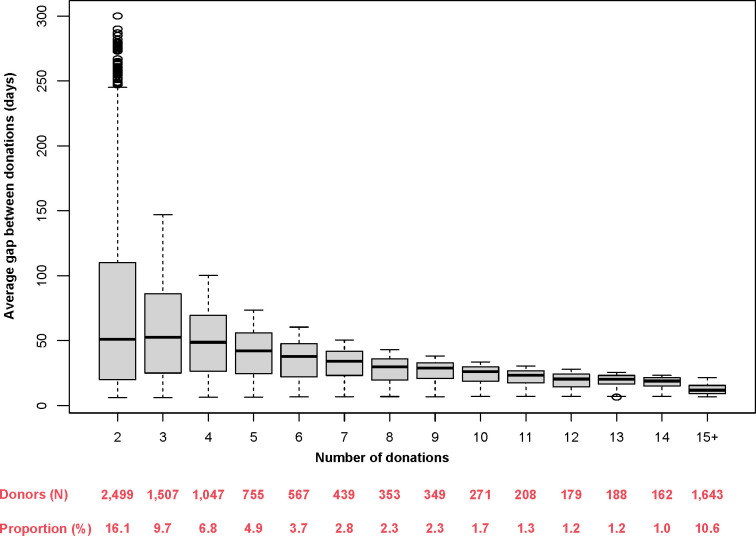
As of January 2022, the biobank included 86 483 plasma samples from 15 502 regular donors (age range=18-84 years, females=49.7%), for an average of 5.6 donations per donor. Nearly two-thirds (65.6%) of biobank donors made at least two donations, with many donors having provided samples prevaccination and postvaccination (3061 (19.7%)) or preinfection and postinfection (131 (0.8%)), thus allowing for longitudinal studies on vaccine-induced and infection-induced immunity.
A study that used PlasCoV samples revealed that previously infected individuals who received a single dose of the BNT162b2 COVID-19 vaccine exhibited the strongest immune response. By contrast, SARS-CoV-2-naïve individuals required two vaccine doses to produce a maximal immune response. Furthermore, the results of a four-phase seroprevalence study indicated that the antinucleocapsid (N) response wanes rapidly, so that up to one-third of previously infected donors were seronegative for anti-N.
Donations from individuals who consented to participate before 1 October 2022 will be collected up until 31 March 2023. This plasma biobank will facilitate the conduct of longitudinal studies on COVID-19 immunity, thus helping to provide valuable insights into the anti-SARS-CoV-2 immune response and its persistence, and the effects of vaccination and variants on the specificity of the anti-SARS-CoV-2 immune response.
由于新出现的关注变异株、不断演变的疫苗诱导和感染诱导免疫以及先前研究中随访时间有限,人们对 COVID-19 的长期体液免疫仍了解甚少。作为加拿大魁北克省唯一的血液服务机构,Héma-Québec 于 2021 年 4 月建立了一个专注于 COVID-19 的生物银行(“PlasCoV”)。
截至 2022 年 1 月,该生物库包括来自 15502 名常规献血者(年龄范围 18-84 岁,女性占 49.7%)的 86483 份血浆样本,每位献血者平均捐献 5.6 份。近三分之二(65.6%)的生物库献血者至少捐献过两次,其中许多献血者在接种疫苗前和接种疫苗后(3061 人(19.7%))或感染前和感染后(131 人(0.8%))提供了样本,从而可以进行疫苗诱导和感染诱导免疫的纵向研究。
一项使用 PlasCoV 样本的研究表明,先前感染过的个体在接种一剂 BNT162b2 COVID-19 疫苗后表现出最强的免疫反应。相比之下,SARS-CoV-2 未感染的个体需要接种两剂疫苗才能产生最大的免疫反应。此外,一项四阶段血清流行率研究的结果表明,核衣壳(N)抗体反应迅速减弱,因此多达三分之一的先前感染过的献血者对 N 呈血清阴性。
将在 2022 年 10 月 1 日前同意参与的个人的捐赠收集至 2023 年 3 月 31 日。这个血浆生物库将有助于开展 COVID-19 免疫的纵向研究,从而为深入了解抗 SARS-CoV-2 免疫反应及其持久性,以及疫苗接种和变异株对 SARS-CoV-2 免疫反应特异性的影响提供有价值的见解。