Department of Pathology, Christian-Albrechts-University, Kiel, Germany.
Department of Pathology, Christian-Albrechts-University, University Hospital Schleswig-Holstein, Arnold-Heller-Str. 3, Haus 14, 24105, Kiel, Germany.
Sci Rep. 2023 Feb 23;13(1):3191. doi: 10.1038/s41598-023-30294-8.
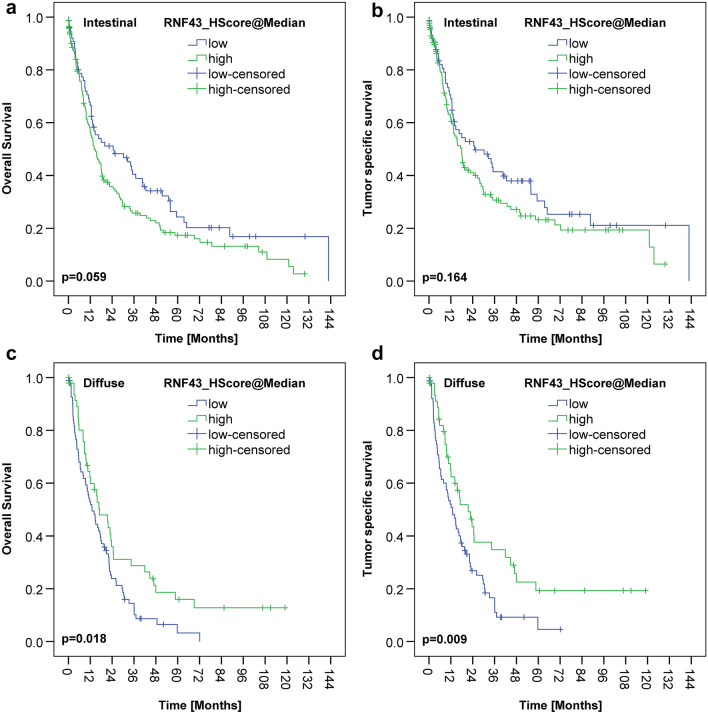
Gastric cancer (GC) is the fifth most common cancer in the world with a poor prognosis. Both RNF43 and LRP1B function as tumor suppressors in the Wnt signaling pathway and have been described to be frequently mutated in GC. In this study of a large and well characterized cohort of 446 GCs we explored the significance of expression of RNF43 and LRP1B and their correlations with clinicopathological patient characteristics. Immunostaining of whole mount tissue sections was documented with the histoscore. Dichotomized at the median, we separated the cohort into a low/negative and a high/positive group of RNF43 and LRP1B expression, respectively. Apart from the entire cohort, we also examined the intestinal and diffuse type GCs separately. Regarding the entire cohort, the expression of RNF43 and LRP1B correlated significantly with the Lauren phenotype and with each other. Interestingly, differences were noted regarding RNF43 between the intestinal and diffuse type GCs. Survival analysis of the intestinal type GCs showed that RNF43 low/negative GCs tended to have a better outcome compared with RNF43 high/positive GCs [24.5 months overall survival (OS) and 25.0 months tumor-specific survival (TSS) vs. 14.1 months OS and 17.9 months TSS, respectively]. To the contrary, diffuse type GCs with RNF43 low/negative had a worse outcome compared with RNF43 high/positive GCs (12.9 months OS and 18.2 months TSS vs. 17.1 months OS and 21.5 months TSS, respectively). On multivariate analysis, RNF43 low/negative versus high/positive was an independent prognosticator of survival in diffuse type GC (hazard ratio 2.393 for OS and 2.398 for TSS). These data support the contention that the expression and biological effect of RNF43 and LRP1B in GC is context-dependent.
胃癌(GC)是全球第五大常见癌症,预后较差。RNF43 和 LRP1B 在 Wnt 信号通路中均作为肿瘤抑制因子发挥作用,并且在 GC 中经常发生突变。在这项对 446 例大型且特征明确的 GC 队列的研究中,我们探讨了 RNF43 和 LRP1B 表达的意义及其与临床病理患者特征的相关性。通过组织学评分记录全组织切片的免疫染色。以中位数为界,我们将队列分为 RNF43 和 LRP1B 表达的低/阴性和高/阳性组。除了整个队列,我们还分别检查了肠型和弥漫型 GC。对于整个队列,RNF43 和 LRP1B 的表达与 Lauren 表型和彼此之间显著相关。有趣的是,在肠型和弥漫型 GC 之间,RNF43 存在差异。肠型 GC 的生存分析显示,RNF43 低/阴性 GC 的总生存期(OS)和肿瘤特异性生存期(TSS)分别为 24.5 个月和 25.0 个月,优于 RNF43 高/阳性 GC(分别为 14.1 个月和 17.9 个月)。相反,RNF43 低/阴性弥漫型 GC 的 OS 和 TSS 分别为 12.9 个月和 18.2 个月,短于 RNF43 高/阳性 GC(分别为 17.1 个月和 21.5 个月)。多变量分析显示,RNF43 低/阴性与弥漫型 GC 的生存是独立的预后因素(OS 的危险比为 2.393,TSS 的危险比为 2.398)。这些数据支持了 RNF43 和 LRP1B 在 GC 中的表达和生物学效应具有上下文依赖性的观点。