Education and Innovation in Health Systems (UCD IRIS Centre), University College Dublin (UCD) Centre for Interdisciplinary Research UCD School of Nursing, Midwifery and Health Systems University College Dublin, Dublin, Ireland.
Improvement Academy, Bradford Institute for Health Research, Bradford Teaching Hospitals NHS Foundation Trust, Duckworth Lane, Bradford, UK.
BMC Health Serv Res. 2023 Feb 24;23(1):195. doi: 10.1186/s12913-023-09190-4.
Recent research, which explored the use of Quality Improvement (QI) methods in the Covid-19 pandemic response, found that Quality Improvement principles were utilised during the crisis management period, albeit without direct intention. Following on from this work, the aim of this paper extends that study by investigating the sustainability and resilience of not only the changes implemented by healthcare staff during Covid-19 in Ireland, but the resilience of the wellbeing of healthcare staff themselves through the various waves of Covid-19.
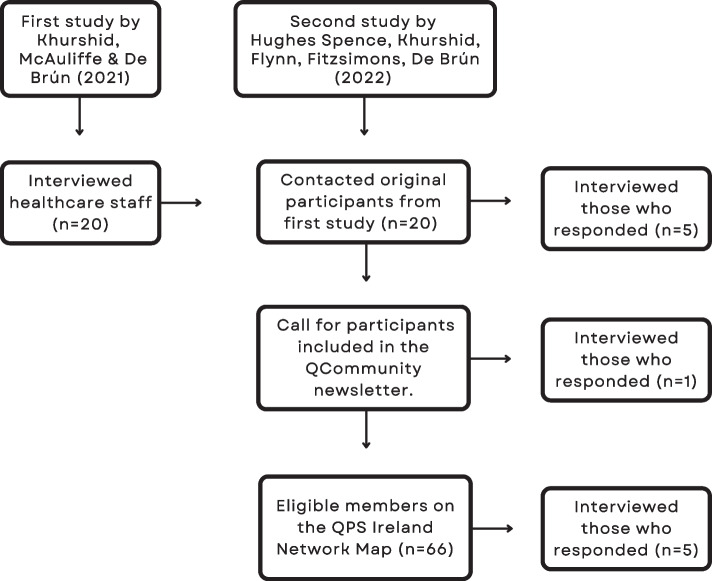
To explore healthcare staffs experience of Quality Improvement and the sustainability and resilience of both Quality Improvement initiatives and healthcare staff, a qualitative design was implemented. Semi-structured interviews took place online over Zoom with 11 healthcare staff members from the Irish healthcare service in the Spring of 2022. An analysis of the narratives was conducted using thematic analysis supported by NVivo12.
Four key themes were evident from the data: (i) From fear to exhaustion; (ii) maintaining person-centred approaches to care; (iii) Covid-19 as a medium for change, and; (iv) staff resilience and appetite for Quality Improvement.
The results of this work identified three key learnings; (i) integrating learning into policies and practice: (ii) the role of collective leadership and devolving/sharing power; and (iii) key drivers/factors that promote sustainability of QI interventions. Despite the challenges in recruitment of research participants experienced during the pandemic, a narrative approach supported the collation of rich and nuanced insights into the experiences of healthcare staff during this time.
A growing body of literature currently exists on how healthcare staff felt during the Covid-19 pandemic. However, as the waves of Covid-19 have declined, it is vital to examine how the feelings of burnout and disillusionment will affect engagement with Quality Improvement in the future. It is also worth noting and examining the feeling of purpose and pride participants expressed from working through the Covid-19 pandemic. This study has helped to address this gap.
最近的研究探索了在新冠疫情应对中使用质量改进(QI)方法的情况,发现尽管并非直接有意为之,但在危机管理期间,质量改进原则得到了应用。在此项工作的基础上,本文旨在通过调查爱尔兰医疗保健人员在新冠疫情期间实施的变革的可持续性和韧性,以及他们在应对多波新冠疫情时的整体幸福感的韧性,进一步延伸该研究。
为了探索医疗保健人员在质量改进方面的经验,以及质量改进举措和医疗保健人员的可持续性和韧性,我们采用了定性设计。2022 年春季,通过在线 Zoom 与爱尔兰医疗服务部门的 11 名医疗保健人员进行了半结构化访谈。采用主题分析对叙事进行分析,并使用 NVivo12 提供支持。
从数据中得出了四个关键主题:(i)从恐惧到疲惫;(ii)保持以人为本的护理方法;(iii)新冠疫情作为变革的媒介;以及(iv)员工的韧性和对质量改进的兴趣。
这项工作的结果确定了三个关键的经验教训:(i)将学习融入政策和实践中;(ii)集体领导和下放/共享权力的作用;以及(iii)促进质量改进干预措施可持续性的关键驱动因素/因素。尽管在疫情期间招募研究参与者遇到了挑战,但叙事方法支持了对医疗保健人员在此期间的经验进行深入细致的分析。
目前关于医疗保健人员在新冠疫情期间的感受的文献越来越多。然而,随着新冠疫情的浪潮逐渐消退,研究人员必须检查倦怠和幻灭感将如何影响他们未来对质量改进的参与度。同样值得注意和研究的是,参与者在应对新冠疫情时所表达的使命感和自豪感。本研究有助于填补这一空白。