Yendewa George A, Sellu Edmond J, Kpaka Rashid A, James Peter B, Yendewa Sahr A, Cummings Peterlyn E, Babawo Lawrence M, Massaquoi Samuel P, Ghazawi Manal, Ocama Ponsiano, Lakoh Sulaiman, Babawo Lawrence S, Salata Robert A
Department of Medicine, Case Western Reserve University School of Medicine, Cleveland, Ohio, USA.
Division of Infectious Diseases and HIV Medicine, University Hospitals Cleveland Medical Center, Cleveland, Ohio, USA.
medRxiv. 2023 Feb 18:2023.02.17.23286086. doi: 10.1101/2023.02.17.23286086.
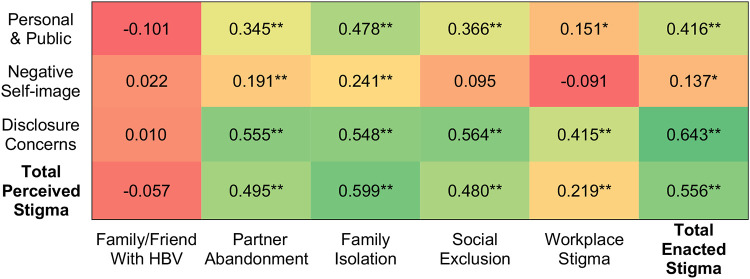
Stigma associated with hepatitis B virus (HBV) is common in endemic countries; however; instruments are lacking to accurately measure HBV-related stigma. We therefore aimed to develop and validate a concise instrument for measuring perceived HBV-related stigma in Sierra Leone. We enrolled 220 people living with HBV (PWHB) aged ≥ 18 years from August to November 2022. The initial Likert-scale instrument entailed 12 items adapted from Berger's HIV Stigma Scale. We included 4 additional items adapted from the USAID indicators for enacted stigma. The proposed scale's psychometric properties were assessed. After item reduction, the final HBV Stigma Scale consisted of 10 items and had good internal consistency (overall Cronbach's α = 0.74), discriminant and construct validity. Exploratory factor analysis produced a 3-dimensional structure accounting for 59.3% of variance: personalized stigma driven by public attitudes (6 items), negative self-image (2 items), and disclosure concerns (2 items). Overall, 72.8% of respondents reported perceived HBV stigma (mean score 29.11 ± 4.14) and a similar a proportion (73.6%) reported at least one instance of enacted stigma. In assessing criterion-related validity, perceived HBV-related stigma correlated strongly with enacted stigma (r = 0.556) and inversely with having family/friends with HBV (r = -0.059). The 10-item HBV Stigma Scale demonstrated good internal consistency and validity and is suitable for screening for HBV-related stigma in Sierra Leone. The psychometric properties of the scale can be optimized with item additions/modifications and confirmatory factor analysis. The scale may help in combating stigma as a barrier to achieving HBV global elimination goals.
在乙肝病毒(HBV)流行国家,与HBV相关的污名化现象很常见;然而,目前缺乏准确衡量HBV相关污名的工具。因此,我们旨在开发并验证一种简洁的工具,用于衡量塞拉利昂民众对HBV相关污名的认知。2022年8月至11月,我们招募了220名年龄≥18岁的HBV感染者(PWHB)。最初的李克特量表工具包含12个项目,改编自伯杰的HIV污名量表。我们又纳入了4个改编自美国国际开发署(USAID)已实施污名指标的项目。对该量表的心理测量学特性进行了评估。经过项目删减,最终的HBV污名量表由10个项目组成,具有良好的内部一致性(总体克朗巴哈α系数 = 0.74)、区分效度和结构效度。探索性因素分析产生了一个三维结构,解释了59.3%的方差:由公众态度驱动的个性化污名(6个项目)、负面自我形象(2个项目)和披露担忧(2个项目)。总体而言,72.8%的受访者表示感受到了HBV污名(平均得分29.11±4.14),类似比例(73.6%)的受访者报告至少有一次已实施污名的情况。在评估效标关联效度时,对HBV相关污名的认知与已实施污名密切相关(r = 0.556),与有感染HBV的家人/朋友呈负相关(r = -0.059)。这个10项的HBV污名量表显示出良好的内部一致性和效度,适用于筛查塞拉利昂HBV相关污名。通过增加/修改项目和验证性因素分析,可以优化该量表的心理测量学特性。该量表可能有助于消除污名,这是实现全球消除HBV目标的一个障碍。