Reinius Maria, Wettergren Lena, Wiklander Maria, Svedhem Veronica, Ekström Anna Mia, Eriksson Lars E
Department of Learning, Informatics, Management and Ethics, Karolinska Institutet, SE-171 77, Stockholm, Sweden.
Department of Neurobiology, Care Sciences and Society, Karolinska Institutet, SE-141 83, Stockholm, Sweden.
Health Qual Life Outcomes. 2017 May 30;15(1):115. doi: 10.1186/s12955-017-0691-z.
Valid and reliable instruments for the measurement of enacted, anticipated and internalised stigma in people living with HIV are crucial for mapping trends in the prevalence of HIV-related stigma and tracking the effectiveness of stigma-reducing interventions. Although longer instruments exist, e.g., the commonly used 40-item HIV Stigma Scale by Berger et al., a shorter instrument would be preferable to facilitate the inclusion of HIV stigma in more and broader surveys. Therefore, the aim of this work was to develop a substantially shorter, but still valid, version of the HIV Stigma Scale.
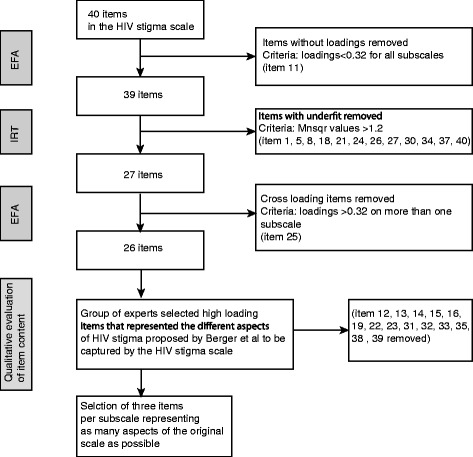
Data from a psychometric evaluation of the Swedish 40-item HIV Stigma Scale were reanalysed to create a short version with 12 items (three from each of the four stigma subscales: personalised stigma, disclosure concerns, concerns with public attitudes and negative self-image). The short version of the HIV stigma scale was then psychometrically tested using data from a national survey investigating stigma and quality of life among people living with HIV in Sweden (n = 880, mean age 47.9 years, 26% female).
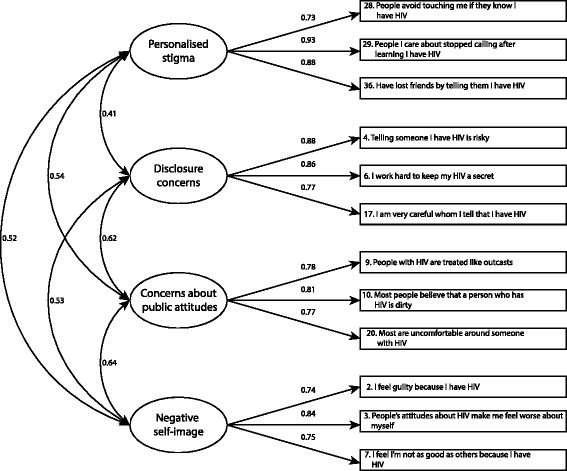
The hypothesized factor structure of the proposed short version was replicated in exploratory factor analysis without cross loadings and confirmatory factor analysis supported construct validity with high standardised effects (>0.7) of items on the intended scales. The χ test was statistically significant (χ = 154.2, df = 48, p < 0.001), but alternate fit measures indicated acceptable fit (comparative fit index: 0.963, Tucker-Lewis index: 0.950 and root mean square error of approximation: 0.071). Corrected item-total correlation coefficients were >0.4 for all items, with a variation indicating that the broadness of the concept of stigma had been captured. All but two aspects of HIV-related stigma that the instrument is intended to cover were captured by the selected items in the short version. The aspects that did not lose any items were judged to have acceptable psychometric properties. The short version of the instrument showed higher floor and ceiling effects than the full-length scale, indicating a loss of sensitivity in the short version. Cronbach's α for the subscales were all >0.7.
Although being less sensitive in measurement, the proposed 12-item short version of the HIV Stigma Scale has comparable psychometric properties to the full-length scale and may be used when a shorter instrument is needed.
对于测量艾滋病毒感染者中表现出的、预期的和内化的耻辱感而言,有效且可靠的工具对于描绘艾滋病毒相关耻辱感的流行趋势以及追踪减少耻辱感干预措施的效果至关重要。尽管存在更长的工具,例如常用的由伯杰等人编制的40项艾滋病毒耻辱感量表,但较短的工具更可取,以便在更多更广泛的调查中纳入艾滋病毒耻辱感相关内容。因此,这项工作的目的是开发一个大幅缩短但仍然有效的艾滋病毒耻辱感量表版本。
对瑞典40项艾滋病毒耻辱感量表的心理测量评估数据进行重新分析,以创建一个包含12个条目的简短版本(从四个耻辱感子量表中的每个子量表选取三个条目:个性化耻辱感、披露担忧、对公众态度的担忧和负面自我形象)。然后,使用来自一项全国性调查的数据对艾滋病毒耻辱感量表的简短版本进行心理测量测试,该调查研究了瑞典艾滋病毒感染者的耻辱感和生活质量(n = 880,平均年龄47.9岁,26%为女性)。
在探索性因素分析中复制了所提议简短版本的假设因素结构,不存在交叉负荷,验证性因素分析支持结构效度,各条目在预期量表上具有较高的标准化效应(>0.7)。χ检验具有统计学意义(χ = 154.2,自由度 = 48,p < 0.001),但替代拟合指标表明拟合度可接受(比较拟合指数:0.963,塔克 - 刘易斯指数:0.950,近似均方根误差:0.071)。所有条目的校正后的项目 - 总分相关系数均>0.4,其变化表明耻辱感概念的广度已被涵盖。简短版本中所选条目涵盖了该工具旨在涵盖的除两个方面之外的所有艾滋病毒相关耻辱感方面。未丢失任何条目的方面被判定具有可接受的心理测量属性。该工具的简短版本比全长量表显示出更高的地板效应和天花板效应,表明简短版本在敏感性上有所损失。各子量表的克朗巴哈α系数均>0.7。
尽管在测量上敏感性较低,但所提议的12项简短版本的艾滋病毒耻辱感量表具有与全长量表相当的心理测量属性,并且在需要较短工具时可以使用。