McClory Susan E, Bardhan Oishi, Rome Kelly S, Giles Josephine R, Baxter Amy E, Xu Lanwei, Gimotty Phyllis A, Faryabi Robert B, Wherry E John, Pear Warren S, Jordan Martha S
Division of Oncology, Children's Hospital of Philadelphia, Philadelphia, PA, USA.
Department of Pathology and Laboratory Medicine, Abramson Family Cancer Research Institute, Perelman School of Medicine, University of Pennsylvania, Philadelphia, PA, USA.
bioRxiv. 2023 Feb 16:2023.02.16.528833. doi: 10.1101/2023.02.16.528833.
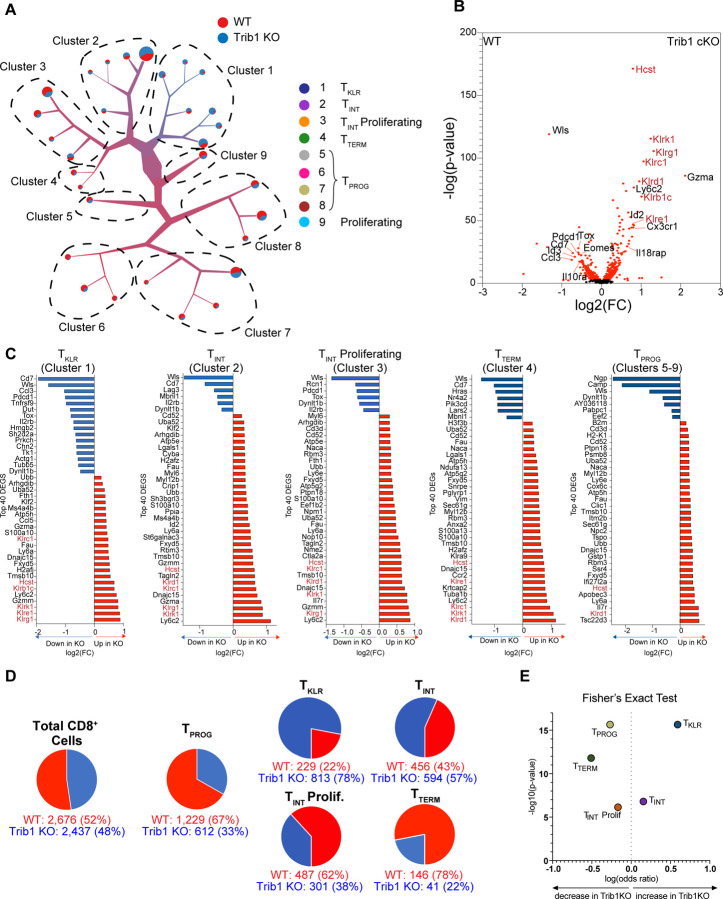
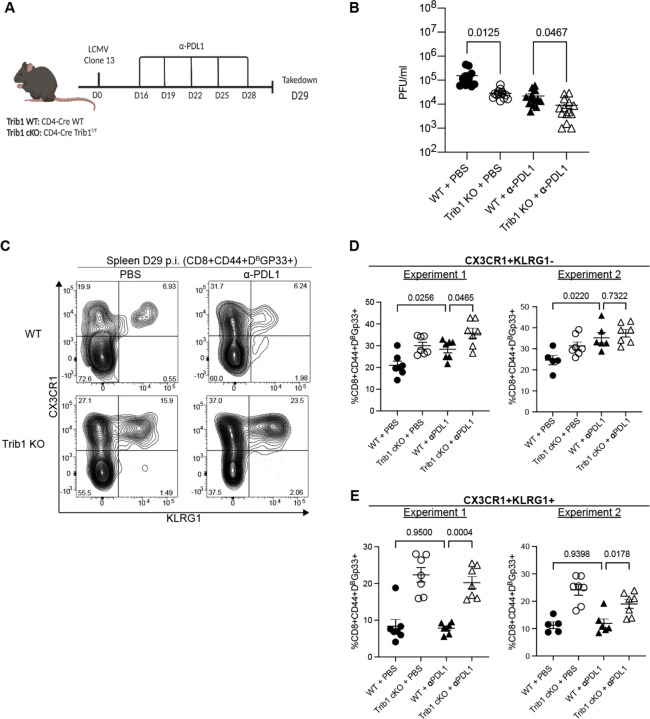
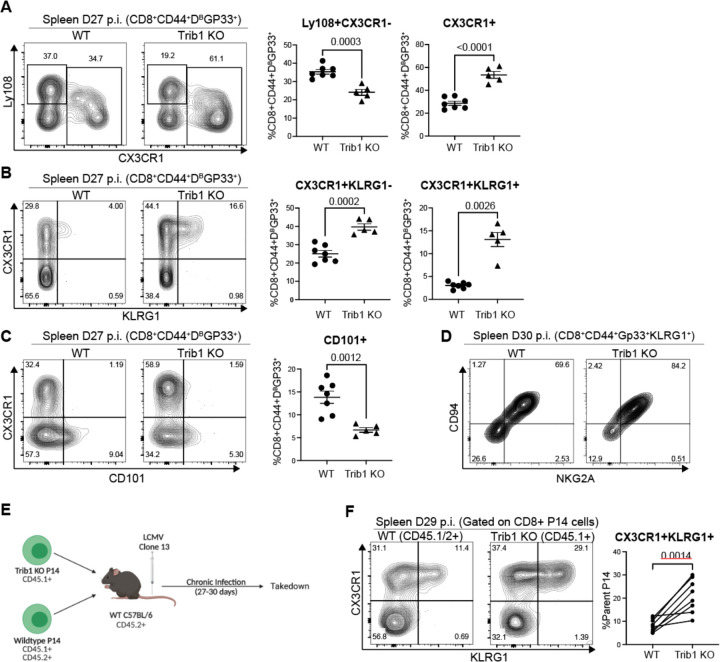
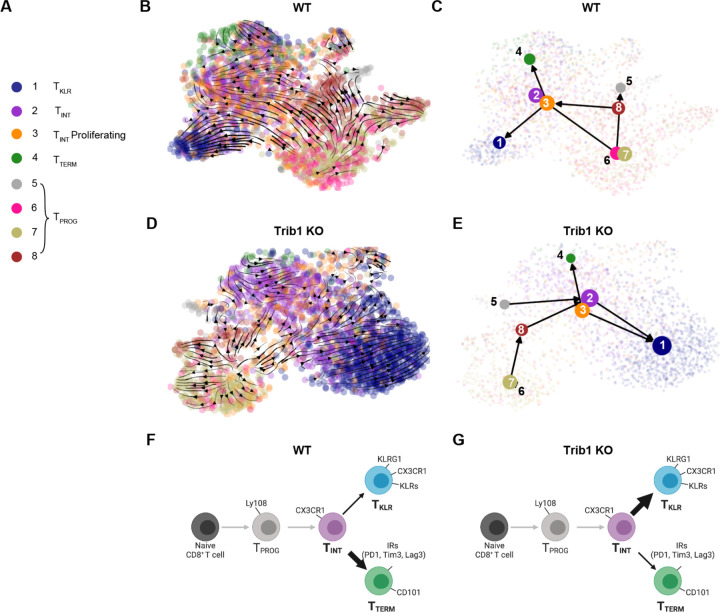
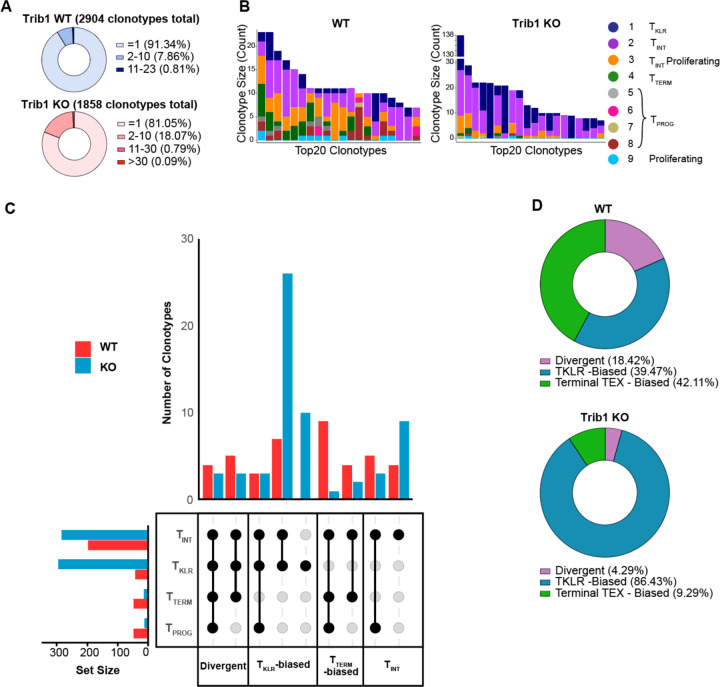
T cell exhaustion (T ) impairs the ability of T cells to clear chronic infection or cancer. While exhausted T cells are hypofunctional, some exhausted T cells retain effector gene signatures, a feature that is associated with expression of KLRs (killer lectin-like receptors). Although KLR T cells may improve control of chronic antigen, the signaling molecules regulating this population are poorly understood. Using scRNA-seq, flow cytometry, RNA velocity, and scTCR-seq, we demonstrate that deleting the pseudokinase Trib1 shifts T towards CX3CR1 intermediates (T ) with robust enrichment of KLR CD8 T cells (T ) via clonal T cell expansion. These changes are associated with globally increased KLR gene expression throughout the exhaustion program. Further, Trib1 loss augments anti-PD-L1 blockade to improve viral clearance by expanding the T population. Together, these data identify Trib1 as an important regulator of T cell exhaustion whose targeting enhances the KLR effector state and improves the response to checkpoint inhibitor therapy.
T细胞耗竭(T )会损害T细胞清除慢性感染或癌症的能力。虽然耗竭的T细胞功能低下,但一些耗竭的T细胞保留了效应基因特征,这一特征与杀伤凝集素样受体(KLRs)的表达相关。尽管KLR T细胞可能会改善对慢性抗原的控制,但调节这一细胞群体的信号分子仍知之甚少。通过单细胞RNA测序(scRNA-seq)、流式细胞术、RNA速度分析和单细胞T细胞受体测序(scTCR-seq),我们证明,删除假激酶Trib1会使T 向CX3CR1 中间细胞(T )转变,通过克隆性T细胞扩增使KLR CD8 T细胞(T )大量富集。这些变化与整个耗竭过程中KLR基因的整体表达增加有关。此外,Trib1缺失通过扩大T 群体增强了抗程序性死亡配体1(PD-L1)阻断作用,从而改善病毒清除。总之,这些数据表明Trib1是T细胞耗竭的重要调节因子,靶向Trib1可增强KLR 效应状态并改善对检查点抑制剂疗法的反应。