Kerexeta Jon, Larburu Nekane, Escolar Vanessa, Lozano-Bahamonde Ainara, Macía Iván, Beristain Iraola Andoni, Graña Manuel
Vicomtech Foundation, Basque Research and Technology Alliance (BRTA), 20009 Donostia, Spain.
e-Health Department, Biodonostia Health Research Institute, Paseo Dr Begiristain s/n, 20014 San Sebastián, Spain.
J Cardiovasc Dev Dis. 2023 Jan 28;10(2):48. doi: 10.3390/jcdd10020048.
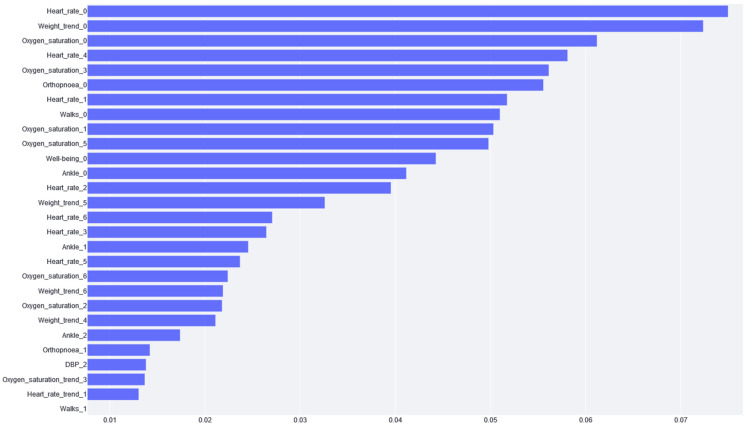
Cardiovascular diseases are the leading cause of death globally, taking an estimated 17.9 million lives each year. Heart failure (HF) occurs when the heart is not able to pump enough blood to satisfy metabolic needs. People diagnosed with chronic HF may suffer from cardiac decompensation events (CDEs), which cause patients' worsening. Being able to intervene before decompensation occurs is the major challenge addressed in this study. The aim of this study is to exploit available patient data to develop an artificial intelligence (AI) model capable of predicting the risk of CDEs timely and accurately. Materials and Methods: The vital variables of patients (n = 488) diagnosed with chronic heart failure were monitored between 2014 and 2022. Several supervised classification models were trained with these monitoring data to predict CDEs, using clinicians' annotations as the gold standard. Feature extraction methods were applied to identify significant variables. Results: The XGBoost classifier achieved an AUC of 0.72 in the cross-validation process and 0.69 in the testing set. The most predictive physiological variables for CAE decompensations are weight gain, oxygen saturation in the final days, and heart rate. Additionally, the answers to questionnaires on wellbeing, orthopnoea, and ankles are strongly significant predictors.
心血管疾病是全球主要的死因,估计每年夺走1790万人的生命。当心脏无法泵出足够的血液来满足代谢需求时,就会发生心力衰竭(HF)。被诊断为慢性心力衰竭的人可能会出现心脏失代偿事件(CDE),这会导致患者病情恶化。能够在失代偿发生之前进行干预是本研究要解决的主要挑战。本研究的目的是利用现有的患者数据开发一种能够及时、准确地预测CDE风险的人工智能(AI)模型。材料与方法:在2014年至2022年期间,对488例被诊断为慢性心力衰竭的患者的重要变量进行了监测。使用临床医生的注释作为金标准,用这些监测数据训练了几个监督分类模型来预测CDE。应用特征提取方法来识别重要变量。结果:XGBoost分类器在交叉验证过程中的AUC为0.72,在测试集中为0.69。对CAE失代偿最具预测性的生理变量是体重增加、最后几天的血氧饱和度和心率。此外,关于幸福感、端坐呼吸和脚踝的问卷答案是非常重要的预测因素。