Toma Temesgen Mohammed, Andargie Kassahun Tamene, Alula Rahel Abera, Kebede Bahiru Mulatu, Gujo Mintesinot Melka
Department of Public Health, Arba Minch College of Health Sciences, P.O.Box: 155, Arba Minch, Ethiopia.
Department of Nursing, Arba Minch College of Health Sciences, P.O.Box: 155, Arba Minch, Ethiopia.
BMC Nutr. 2023 Feb 24;9(1):34. doi: 10.1186/s40795-023-00683-3.
Child undernutrition is a major public health problem in Ethiopia despite different nutrition-specific and sensitive interventions implemented by the government. However, evidence regarding the burden and responsible factors is limited in the South Ari district. Hence, this study aimed to assess factors associated with wasting and stunting among children aged 06-59 months in the South Ari district, Southern Ethiopia, 2021.
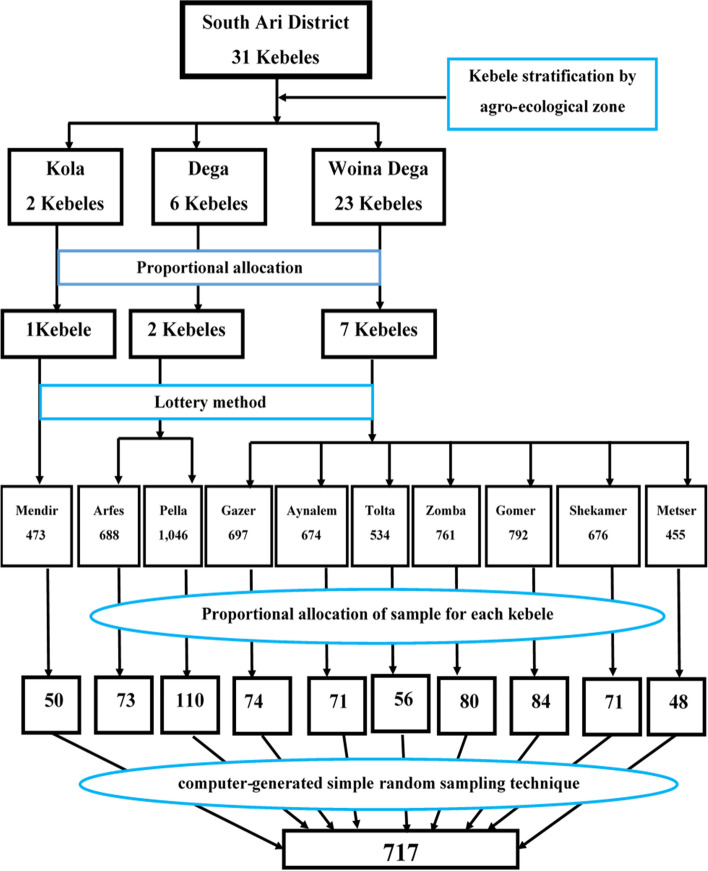
A community-based cross-sectional study was conducted from March 11 to April 11, 2021, among 717 households with at least one child aged 06-59 months. Anthropometric measurements were taken using standard procedures and were converted to height for age Z score and weight-for-height using WHO Anthro software Version 3.2.2. Data were checked and entered into Epi-Data Version 3.1 and analyzed using SPSS Version 25.0. Binary logistic regression analysis was fitted to identify predictors of wasting and stunting. A p-value < 0.05 was used to declare statistical significance.
The prevalence of wasting and stunting among children aged 06-59 months in the district was 9.1% (95% CI: 7.07%, 11.41%) and 59.97% (95% CI: 56.28%, 63.58%), respectively. Family size (8 and above) (AOR = 3.03, 95% CI: 1.31, 7.03), family size (5 to 7) (AOR = 2.05, 95% CI: 1.11, 3.81), poor and medium wealth index (AOR = 3.69, 95% CI: 1.65, 8.26) and (AOR = 2.29, 95% CI: 1.01, 5.16), insufficient maternal knowledge on child feeding practice (AOR = 2.58, 95% CI: 1.31, 5.07), presence of diarrhea in the past two weeks (AOR = 2.05, 95% CI: 1.10, 3.85), non-exclusive breastfeeding (AOR = 2.65, 95% CI: 1.51, 4.65), and birth interval of < 24 months (AOR = 4.49, 95% CI: 2.40, 8.37) were factors significantly associated with wasting. Whereas, children in the age group of 24-59 months (AOR = 2.24, 95% CI: 1.58, 3.16), non-exclusive breastfeeding (AOR = 1.81, 95% CI: 1.24, 2.65), birth interval of fewer than 24 months (AOR = 1.54, 95% CI: 1.11, 2.14), sub-optimal child dietary diversity score (AOR = 1.59, 95% CI: 1.14, 2.22), being a non-beneficiary of productive safety-net program (AOR = 1.91, 95% CI: 1.24, 2.95), and household food insecurity (AOR = 2.60, 95% CI: 1.86, 3.64) were factors significantly associated with stunting.
Wasting and stunting were found to be key public health problems in the South Ari District. Hence, further interventions should consider strategies to enhance household food security and integration of productive safety net programs with primary health care services. Rigorous work is required in advocating and strengthening the provision of family planning services, child care, and integrated management of common childhood illnesses. Moreover, behavioral change communication is highly demanded to improve child feeding practices.
尽管埃塞俄比亚政府实施了不同的营养专项和敏感干预措施,但儿童营养不良仍是该国的一个主要公共卫生问题。然而,关于南方阿瑞地区营养不良负担及其相关因素的证据有限。因此,本研究旨在评估2021年埃塞俄比亚南部南方阿瑞地区6至59个月儿童消瘦和发育迟缓的相关因素。
2021年3月11日至4月11日,在717户至少有一名6至59个月儿童的家庭中开展了一项基于社区的横断面研究。采用标准程序进行人体测量,并使用世界卫生组织Anthro软件3.2.2版将测量结果转换为年龄别身高Z评分和身高别体重。数据经检查后录入Epi-Data 3.1版,并使用SPSS 25.0版进行分析。采用二元逻辑回归分析确定消瘦和发育迟缓的预测因素。p值<0.05被视为具有统计学意义。
该地区6至59个月儿童的消瘦率和发育迟缓率分别为9.1%(95%CI:7.07%,11.41%)和59.97%(95%CI:56.28%,63.58%)。家庭规模(8人及以上)(比值比=3.03,95%CI:1.31,7.03)、家庭规模(5至7人)(比值比=2.05,95%CI:1.11,3.81)、贫困和中等财富指数(比值比=3.69,95%CI:1.65,8.26)以及(比值比=2.29,95%CI:1.01,5.16)、母亲对儿童喂养知识不足(比值比=2.58,95%CI:1.31,5.07)、过去两周内腹泻(比值比=2.05,95%CI:1.10,3.85)、非纯母乳喂养(比值比=2.65,95%CI:1.51,4.65)以及生育间隔<24个月(比值比=4.49,95%CI:2.40,8.37)是与消瘦显著相关的因素。而年龄在24至59个月之间的儿童(比值比=2.24,95%CI:1.58,3.16)、非纯母乳喂养(比值比=1.81,95%CI:1.24,2.65)、生育间隔少于24个月(比值比=1.54,95%CI:1.11,2.14)、儿童饮食多样性得分不理想(比值比=1.59,95%CI:1.14,2.22)、未受益于生产性安全网计划(比值比=1.91,95%CI:1.24,2.95)以及家庭粮食不安全(比值比=2.60,95%CI:1.86,3.64)是与发育迟缓显著相关的因素。
消瘦和发育迟缓是南方阿瑞地区的关键公共卫生问题。因此,进一步的干预措施应考虑加强家庭粮食安全的策略,以及将生产性安全网计划与初级卫生保健服务相结合。在倡导和加强计划生育服务、儿童保健以及常见儿童疾病的综合管理方面需要开展严格的工作。此外,迫切需要通过行为改变沟通来改善儿童喂养方式。
