Chelenko District Health Office, Chelenko Town, East Haraghe Zone, Ethiopia.
Department of Nutrition and Dietetics, School of Public Health, College of Health Sciences, Addis Ababa University, Addis Ababa, Ethiopia.
J Health Popul Nutr. 2022 Apr 5;41(1):13. doi: 10.1186/s41043-022-00291-0.
Undernutrition is one of the major public health problems affecting children in developing settings. Despite impressive interventions like productive safety net program (PSNP), there is limited information on the association between stunting and PSNP implementation in Ethiopia.
Community-based comparative cross-sectional study design was used among systematically selected 1555 children and their mothers/caregivers from households enrolled in PSNP and not, respectively, in Meta District east Ethiopia from 5th-20th of March 2017. Data were collected using pretested structured questionnaire. Measuring board was used to measure length/height of children. Length/height for age Z-score was generated using World Health Organization (WHO) Anthro version 3.2.2. Descriptive statistics was used to describe all relevant variables. Bivariable and multivariable logistic regression analyses were used to identify predictors of stunting. Odds ratio along with 95% confidence intervals were estimated to measure the strength of association. The statistical significance was declared at p value less than 0.05.
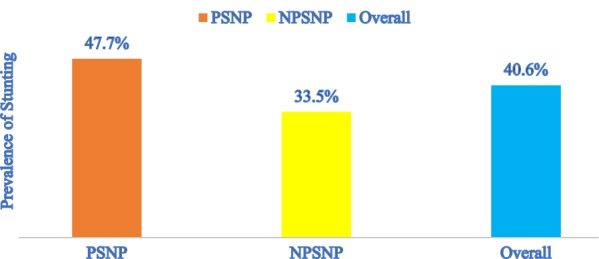
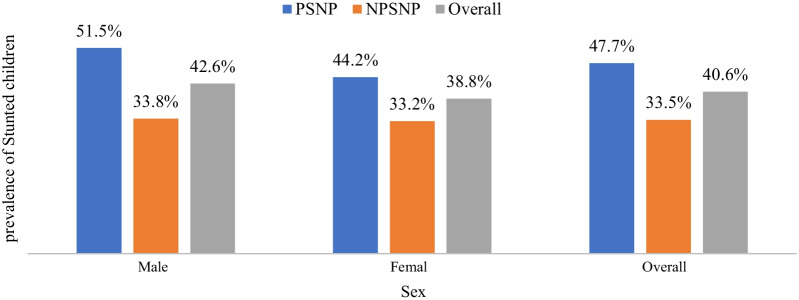
The prevalence of stunting was 47.7%, 95% CI (44.1%, 51.5%) and 33.5%, 95% CI (29.9%, 36.9%) among children from households enrolled in PSNP and non-PSNP ones, respectively. Lack of maternal education [AOR = 3.39; 95% CI (1.12, 5.11)], women's empowerment [AOR = 3.48; 95% CI (2.36, 5.12)] and fourth antenatal care visit [AOR = 4.2, 95% CI (2.5, 6.8)], practicing hand washing [AOR = 0.46; 95% CI (0.28, 0.76)], living in mid-land [AOR = 1.94, 95% CI (1.12, 3.35)] and low-land[AOR = 0.27: 95% CI (0.16, 0.45)] agro-ecological zones, PSNP membership [AOR = 1.82, 95% CI (1.14, 2.89)], childhood illness [AOR = 8.41; 95% CI (4.58, 12.76)], non-exclusive breastfeeding [AOR = 3.6; 95% CI (2.30, 4.80)], inadequate minimum dietary diversity [AOR = 4.7; 95% CI (3.0, 7.40)], child's sex [AOR = 1.73, 95% CI (1.18, 2.53)] and age (24-59 months) [AOR = 3.2; 95% CI (1.6, 6.3)] were independent predictors of stunting.
The prevalence of stunting was high among children from households enrolled in PSNP. Stunting was significantly associated with maternal- and child-related factors. Therefore, women empowerment on household's issues and improving infant and young child feeding practices could reduce the prevalence of stunting and its adverse consequences.
营养不良是影响发展中国家儿童的主要公共卫生问题之一。尽管有生产性安全网计划(PSNP)等令人印象深刻的干预措施,但在埃塞俄比亚,关于发育迟缓与 PSNP 实施之间的关联的信息有限。
2017 年 3 月 5 日至 20 日,在埃塞俄比亚 Meta 区,采用系统选择的方法,在参加 PSNP 的家庭和未参加 PSNP 的家庭中,分别对 1555 名儿童及其母亲/照顾者进行了基于社区的比较横断面研究设计。使用预先测试的结构化问卷收集数据。使用测量板测量儿童的长度/身高。使用世界卫生组织(WHO)Anthro 版本 3.2.2 生成年龄 Z 分数。使用描述性统计方法描述所有相关变量。使用单变量和多变量逻辑回归分析来确定发育迟缓的预测因素。使用优势比(OR)及其 95%置信区间(CI)来衡量关联的强度。p 值小于 0.05 被认为具有统计学意义。
参加 PSNP 的家庭和未参加 PSNP 的家庭的儿童中,发育迟缓的患病率分别为 47.7%(95%CI:44.1%,51.5%)和 33.5%(95%CI:29.9%,36.9%)。母亲缺乏教育(AOR=3.39;95%CI:1.12,5.11)、妇女赋权(AOR=3.48;95%CI:2.36,5.12)和第四次产前护理访问(AOR=4.2,95%CI:2.5,6.8)、洗手(AOR=0.46;95%CI:0.28,0.76)、居住在中地(AOR=1.94,95%CI:1.12,3.35)和低地(AOR=0.27:95%CI:0.16,0.45)农业生态区、PSNP 会员资格(AOR=1.82,95%CI:1.14,2.89)、儿童疾病(AOR=8.41;95%CI:4.58,12.76)、非纯母乳喂养(AOR=3.6;95%CI:2.30,4.80)、最低饮食多样性不足(AOR=4.7;95%CI:3.0,7.40)、儿童性别(AOR=1.73,95%CI:1.18,2.53)和年龄(24-59 个月)(AOR=3.2;95%CI:1.6,6.3)是发育迟缓的独立预测因素。
参加 PSNP 的家庭的儿童发育迟缓患病率较高。发育迟缓与母婴相关因素显著相关。因此,增强妇女在家庭问题上的权能和改善婴幼儿喂养做法,可降低发育迟缓及其不良后果的发生率。