Kalina Elena, Boyd-Frenkel Krystina, Patock-Peckham Julie A, Schneidewent Lauren, Broussard Matthew L, Leeman Robert F
Department of Health Education and Behavior, University of Florida, 1864 Stadium Rd., Gainesville, FL 32611, USA.
Department of Psychology, UC Irvine, Irvine, CA 92617, USA.
Behav Sci (Basel). 2023 Feb 17;13(2):185. doi: 10.3390/bs13020185.
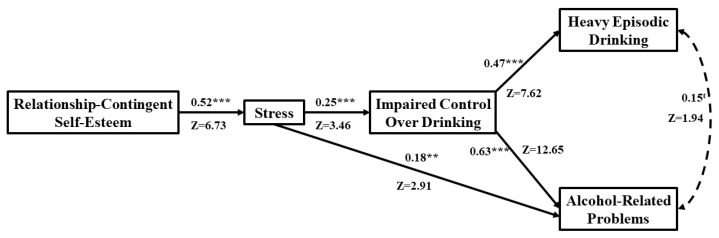
The Appraisal-Disruption Model (ADM) suggests that individuals use alcohol as a means of dampening negative self-talk. Relationship-contingent self-esteem (RCSE) emerges from validating one's self-esteem depending on one's romantic relationship(s) and is known to predict alcohol-related problems. We hypothesized that RCSE indirectly predicts drinking outcomes through the mediating mechanism(s) of stress and impaired control over alcohol (IC; drinking to excess beyond one's own intentions). We fit a multiple-group structural equation model with self-report survey data from 479 college students. We used a 20,000 bootstrap technique to examine possible mediated pathways. Consistent with evolutionary theory, our model was moderated by sex: more variance in alcohol-related problems was explained for women (R = 0.479) than for men (R = 0.280). RCSE was directly linked to more stress. Furthermore, higher levels of RCSE were indirectly linked to more IC through increased stress, and in turn, more heavy episodic drinking and alcohol-related problems for both men and women. Consistent with the ADM, those with higher levels of RCSE experienced more stress and, in turn, more IC and subsequent adverse alcohol outcomes. Thus, therapists targeting alcohol use disorders (AUDs) may wish to determine if their client's self-esteem changes dramatically based on their moment-to-moment appraisal of their intimate relationships.
评估-干扰模型(ADM)表明,个体将酒精作为抑制消极自我对话的一种方式。关系依赖型自尊(RCSE)源于根据个人恋爱关系来验证自尊,并且已知它能预测与酒精相关的问题。我们假设,RCSE通过压力和对酒精控制受损(IC;饮酒超过自己的意图而过量)的中介机制间接预测饮酒结果。我们用479名大学生的自我报告调查数据拟合了一个多组结构方程模型。我们使用20000次自助抽样技术来检验可能的中介路径。与进化理论一致,我们的模型存在性别差异:女性(R = 0.479)比男性(R = 0.280)在与酒精相关问题上的变异解释更多。RCSE与更多压力直接相关。此外,较高水平的RCSE通过增加压力间接与更多的IC相关,进而与男性和女性更多的重度饮酒及与酒精相关的问题相关。与ADM一致,RCSE水平较高的人经历了更多压力,进而有更多的IC及随后不良的酒精后果。因此,针对酒精使用障碍(AUDs)的治疗师可能希望确定他们的客户的自尊是否会根据他们对亲密关系的即时评估而发生巨大变化。