Ghauri Muhammad S, Ou Li
School of Medicine, California University of Science and Medicine, Colton, CA 92324, USA.
Genemagic Biosciences, Media, PA 19086, USA.
Biology (Basel). 2023 Jan 26;12(2):186. doi: 10.3390/biology12020186.
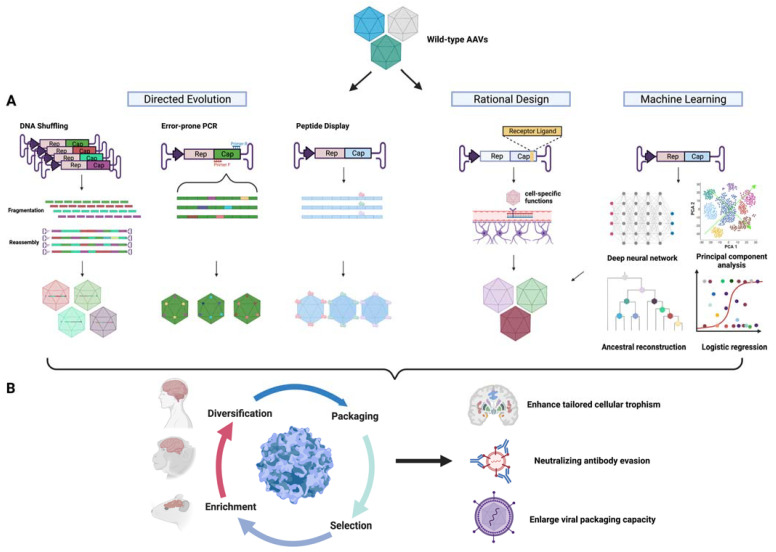
Adeno-associated virus (AAV) is a non-pathogenic virus that mainly infects primates with the help of adenoviruses. AAV is being widely used as a delivery vector for in vivo gene therapy, as evidenced by five currently approved drugs and more than 255 clinical trials across the world. Due to its relatively low immunogenicity and toxicity, sustained efficacy, and broad tropism, AAV holds great promise for treating many indications, including central nervous system (CNS), ocular, muscular, and liver diseases. However, low delivery efficiency, especially for the CNS due to the blood-brain barrier (BBB), remains a significant challenge for more clinical application of AAV gene therapy. Thus, there is an urgent need for utilizing AAV engineering to discover next-generation capsids with improved properties, e.g., enhanced BBB penetrance, lower immunogenicity, and higher packaging efficiency. AAV engineering methods, including directed evolution, rational design, and in silico design, have been developed, resulting in the discovery of novel capsids (e.g., PhP.B, B10, PAL1A/B/C). In this review, we discuss key studies that identified engineered CNS capsids and/or established methodological improvements. Further, we also discussed important issues that need to be addressed, including cross-species translatability, cell specificity, and modular engineering to improve multiple properties simultaneously.
腺相关病毒(AAV)是一种非致病性病毒,主要借助腺病毒感染灵长类动物。AAV正被广泛用作体内基因治疗的递送载体,全球目前有五种获批药物以及超过255项临床试验证明了这一点。由于其相对较低的免疫原性和毒性、持续疗效以及广泛的嗜性,AAV在治疗包括中枢神经系统(CNS)、眼部、肌肉和肝脏疾病在内的多种适应症方面具有巨大潜力。然而,低递送效率,尤其是由于血脑屏障(BBB)导致的CNS递送效率低下,仍然是AAV基因治疗更广泛临床应用的重大挑战。因此,迫切需要利用AAV工程技术来发现具有改进特性的下一代衣壳,例如增强的血脑屏障穿透性、更低的免疫原性和更高的包装效率。已经开发了AAV工程方法,包括定向进化、理性设计和计算机辅助设计,从而发现了新型衣壳(例如,PhP.B、B10、PAL1A/B/C)。在本综述中,我们讨论了确定工程化CNS衣壳和/或建立方法学改进的关键研究。此外,我们还讨论了需要解决的重要问题,包括跨物种可翻译性、细胞特异性以及同时改善多种特性的模块化工程。