Laboratoire de Recherche en Sciences Végétales, CNRS/UPS/INPT, 31320 Auzeville-Tolosane, France.
Epigenetics and Plant Development, Centre for Research in Agricultural Genomics (CRAG), UAB, Cerdanyola del Vallès, 08193 Barcelona, Spain.
Biomolecules. 2023 Jan 19;13(2):206. doi: 10.3390/biom13020206.
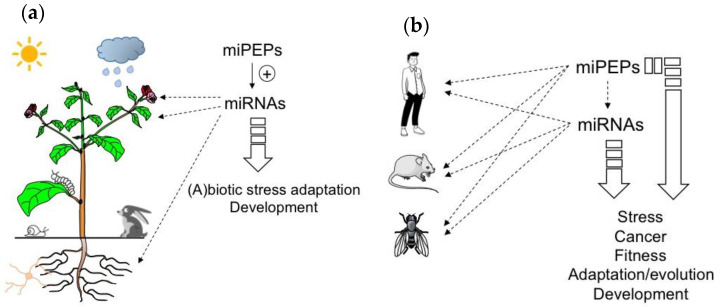
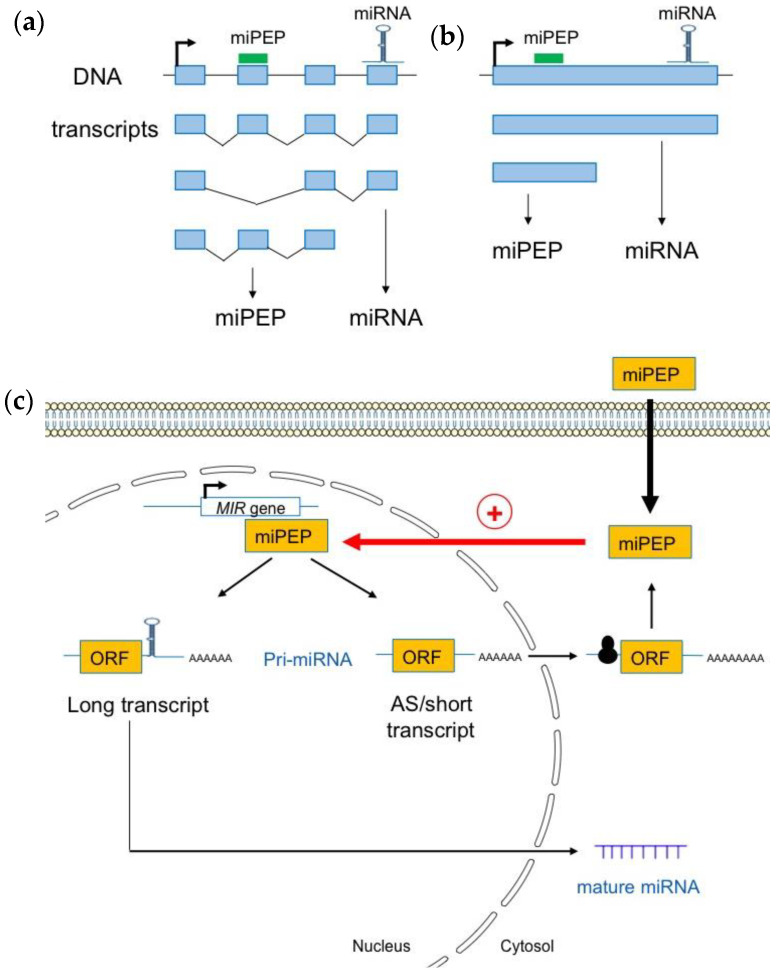
Primary transcripts of microRNAs (pri-miRNAs) were initially defined as long non-coding RNAs that host miRNAs further processed by the microRNA processor complex. A few years ago, however, it was discovered in plants that pri-miRNAs actually contain functional open reading frames (sORFs) that translate into small peptides called miPEPs, for microRNA-encoded peptides. Initially detected in and , recent studies have revealed the presence of miPEPs in other pri-miRNAs as well as in other species ranging from various plant species to animals. This suggests that miPEP numbers remain largely underestimated and that they could be a common signature of pri-miRNAs. Here we present the most recent advances in miPEPs research and discuss how their discovery has broadened our vision of the regulation of gene expression by miRNAs, and how miPEPs could be interesting tools in sustainable agriculture or the treatment of certain human diseases.
miRNA 前体(pri-miRNAs)最初被定义为长非编码 RNA,其可以进一步由 microRNA 处理器复合物加工 miRNA。然而,几年前,人们在植物中发现,pri-miRNAs 实际上含有功能性开放阅读框(sORFs),这些开放阅读框可以翻译成小肽,称为 miPEPs,即 microRNA 编码的肽。miPEPs 最初在 和 中被检测到,最近的研究表明,miPEPs 不仅存在于其他 pri-miRNAs 中,也存在于从各种植物到动物等其他物种中。这表明 miPEP 的数量仍被大大低估,并且它们可能是 pri-miRNAs 的一个共同特征。本文介绍了 miPEPs 研究的最新进展,并讨论了它们的发现如何拓宽了我们对 miRNA 调控基因表达的认识,以及 miPEPs 如何成为可持续农业或治疗某些人类疾病的有趣工具。