Świderek-Matysiak Mariola, Oset Magdalena, Domowicz Małgorzata, Galazka Grażyna, Namiecińska Magdalena, Stasiołek Mariusz
Department of Neurology, Medical University of Lodz, Kościuszki Street 4, 90-419 Lodz, Poland.
Biomedicines. 2023 Feb 1;11(2):425. doi: 10.3390/biomedicines11020425.
Diagnosis of multiple sclerosis (MS) is established on criteria according to clinical and radiological manifestation. Cerebrospinal fluid (CSF) analysis is an important part of differential diagnosis of MS and other inflammatory processes in the central nervous system (CNS).
In total, 242 CSF samples were collected from patients undergoing differential MS diagnosis because of the presence of T2-hyperintensive lesions on brain MRI. The non-MS patients were subdivided into systemic inflammatory diseases with CNS involvement (SID) or cerebrovascular diseases (CVD) or other non-inflammatory diseases (NID). All samples were analyzed for the presence of oligoclonal bands and ELISA was performed for detection of: INF gamma, IL-6, neurofilaments light chain (NF-L), GFAP, CHI3L1, CXCL13, and osteopontin.
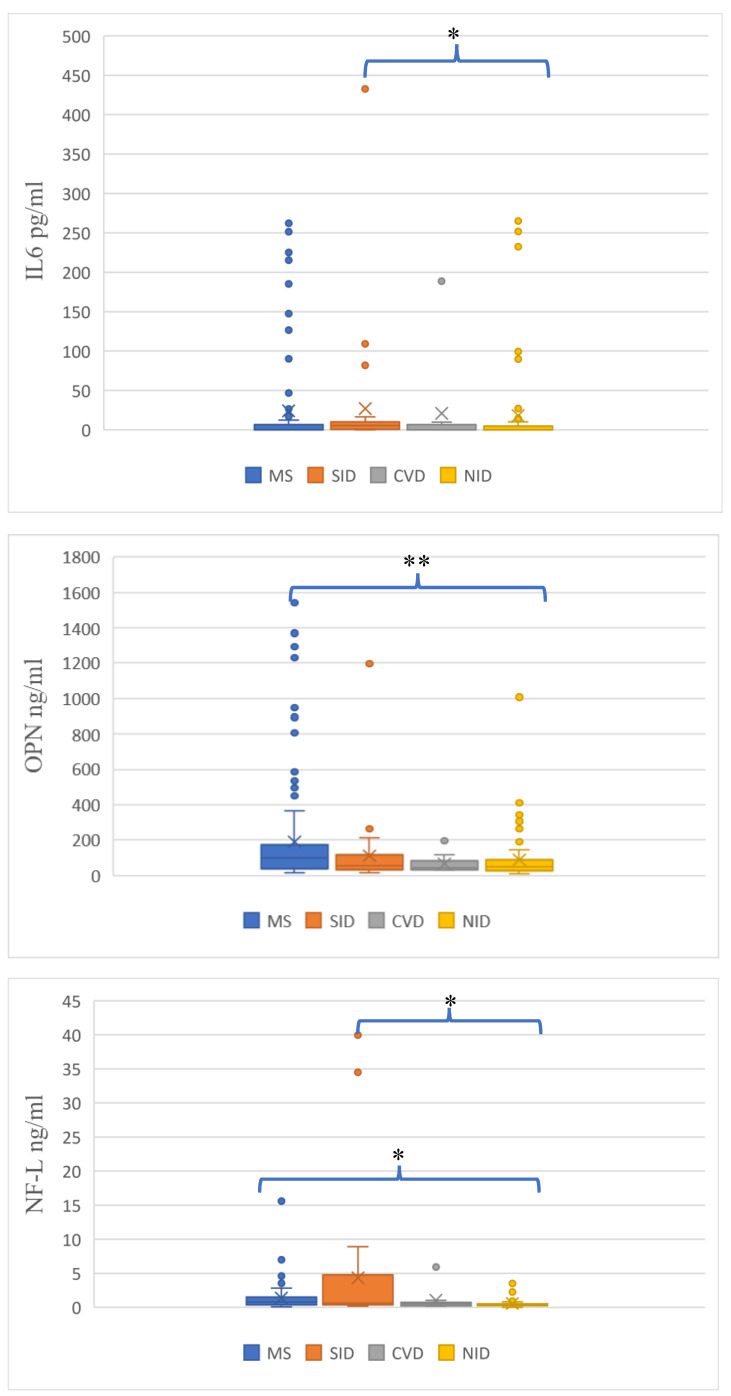
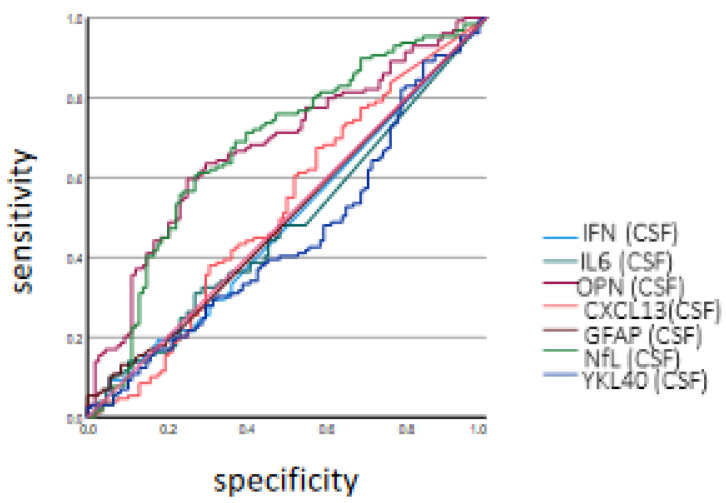
The level of IL-6 ( = 0.024), osteopontin ( = 0.0002), and NF-L ( = 0.002) was significantly different among groups. IL-6 ( = 0.0350) and NF-L ( = 0.0015) level was significantly higher in SID compared to NID patients. A significantly higher level of osteopontin ( = 0.00026) and NF-L ( = 0.002) in MS compared to NID population was noted. ROC analysis found weak diagnostic power for osteopontin and NFL-L.
The classical and non-standard markers of inflammatory process and neurodegeneration do not allow for sufficient differentiation between MS and non-MS inflammatory CNS disorders. Weak diagnostic power observed for the osteopontin and NF-L needs to be further investigated.
多发性硬化症(MS)的诊断是根据临床和影像学表现的标准来确定的。脑脊液(CSF)分析是MS与中枢神经系统(CNS)其他炎症过程鉴别诊断的重要组成部分。
总共收集了242份CSF样本,这些样本来自因脑部MRI出现T2高信号病变而接受MS鉴别诊断的患者。非MS患者被细分为伴有CNS受累的全身性炎症性疾病(SID)、脑血管疾病(CVD)或其他非炎症性疾病(NID)。所有样本均分析是否存在寡克隆带,并进行酶联免疫吸附测定(ELISA)以检测:干扰素γ(INFγ)、白细胞介素-6(IL-6)、神经丝轻链(NF-L)、胶质纤维酸性蛋白(GFAP)、几丁质酶3样蛋白1(CHI3L1)、CXC趋化因子配体13(CXCL13)和骨桥蛋白。
各组间IL-6(P = 0.024)、骨桥蛋白(P = 0.0002)和NF-L(P = 0.002)水平存在显著差异。与NID患者相比,SID患者的IL-6(P = 0.0350)和NF-L(P = 0.0015)水平显著更高。与NID人群相比,MS患者的骨桥蛋白(P = 0.00026)和NF-L(P = 0.002)水平显著更高。ROC分析发现骨桥蛋白和NFL-L的诊断效能较弱。
炎症过程和神经退行性变的经典及非标准标志物无法充分区分MS与非MS炎症性CNS疾病。骨桥蛋白和NF-L观察到的较弱诊断效能需要进一步研究。