Institute of Metabolic and Cardiovascular Diseases (I2MC), INSERM U1297, University of Toulouse III-Paul Sabatier (UPS), CHU, 31432 Toulouse, France.
Department of Pathology, Cancer University Institute of Toulouse Oncopole-IUCT, 31100 Toulouse, France.
Cells. 2023 Feb 14;12(4):620. doi: 10.3390/cells12040620.
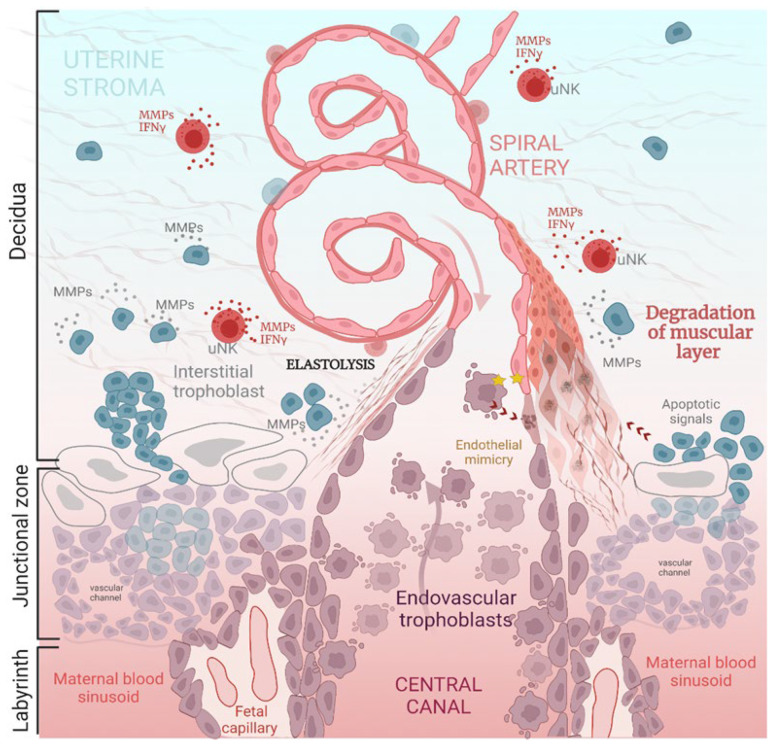
Estrogens, mainly 17β-estradiol (E2), play a critical role in reproductive organogenesis, ovulation, and fertility via estrogen receptors. E2 is also a well-known regulator of utero-placental vascular development and blood-flow dynamics throughout gestation. Mouse and human placentas possess strikingly different morphological configurations that confer important reproductive advantages. However, the functional interplay between fetal and maternal vasculature remains similar in both species. In this review, we briefly describe the structural and functional characteristics, as well as the development, of mouse and human placentas. In addition, we summarize the current knowledge regarding estrogen actions during utero-placental vascular morphogenesis, which includes uterine angiogenesis, the control of trophoblast behavior, spiral artery remodeling, and hemodynamic adaptation throughout pregnancy, in both mice and humans. Finally, the estrogens that are present in abnormal placentation are also mentioned. Overall, this review highlights the importance of the actions of estrogens in the physiology and pathophysiology of placental vascular development.
雌激素主要是 17β-雌二醇(E2),通过雌激素受体在生殖器官发生、排卵和生育中发挥关键作用。E2 也是妊娠期间子宫胎盘血管发育和血流动力学的重要调节剂。小鼠和人类胎盘具有明显不同的形态结构,赋予了重要的生殖优势。然而,在这两个物种中,胎儿和母体血管之间的功能相互作用仍然相似。在这篇综述中,我们简要描述了小鼠和人类胎盘的结构和功能特征以及发育情况。此外,我们总结了目前关于雌激素在子宫胎盘血管形态发生过程中的作用的知识,包括子宫血管生成、滋养细胞行为的控制、螺旋动脉重塑以及整个妊娠期间的血液动力学适应,这些在小鼠和人类中均有涉及。最后,还提到了异常胎盘形成中存在的雌激素。总的来说,这篇综述强调了雌激素在胎盘血管发育的生理学和病理生理学中的重要作用。