Menon Ashwathi Puravankara, Moreno Beatriz, Meraviglia-Crivelli Daniel, Nonatelli Francesca, Villanueva Helena, Barainka Martin, Zheleva Angelina, van Santen Hisse M, Pastor Fernando
Molecular Therapeutics Program, Center for Applied Medical Research, CIMA, University of Navarra, 31008 Pamplona, Spain.
Instituto de Investigación Sanitaria de Navarra (IDISNA), Recinto de Complejo Hospitalario de Navarra, 31008 Pamplona, Spain.
Cancers (Basel). 2023 Feb 13;15(4):1189. doi: 10.3390/cancers15041189.
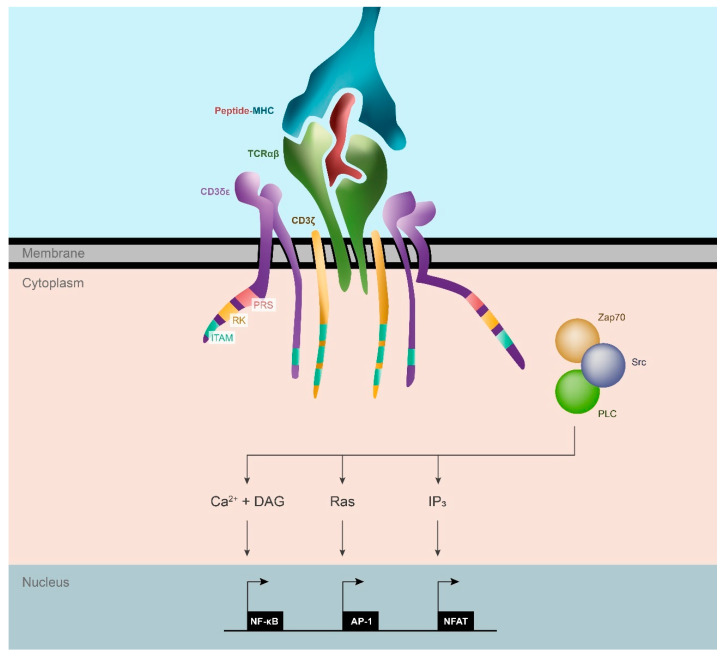
Harnessing the immune system to fight cancer has become a reality with the clinical success of immune-checkpoint blockade (ICB) antibodies against PD(L)-1 and CTLA-4. However, not all cancer patients respond to ICB. Thus, there is a need to modulate the immune system through alternative strategies for improving clinical responses to ICB. The CD3-T cell receptor (TCR) is the canonical receptor complex on T cells. It provides the "first signal" that initiates T cell activation and determines the specificity of the immune response. The TCR confers the binding specificity whilst the CD3 subunits facilitate signal transduction necessary for T cell activation. While the mechanisms through which antigen sensing and signal transduction occur in the CD3-TCR complex are still under debate, recent revelations regarding the intricate 3D structure of the CD3-TCR complex might open the possibility of modulating its activity by designing targeted drugs and tools, including aptamers. In this review, we summarize the basis of CD3-TCR complex assembly and survey the clinical and preclinical therapeutic tools available to modulate CD3-TCR function for potentiating cancer immunotherapy.
随着抗PD(L)-1和CTLA-4免疫检查点阻断(ICB)抗体在临床上取得成功,利用免疫系统对抗癌症已成为现实。然而,并非所有癌症患者都对ICB有反应。因此,需要通过替代策略调节免疫系统,以改善对ICB的临床反应。CD3-T细胞受体(TCR)是T细胞上的典型受体复合物。它提供启动T细胞活化的“第一信号”,并决定免疫反应的特异性。TCR赋予结合特异性,而CD3亚基则促进T细胞活化所需的信号转导。虽然CD3-TCR复合物中抗原感知和信号转导发生的机制仍在争论中,但最近关于CD3-TCR复合物复杂三维结构的发现可能为通过设计靶向药物和工具(包括适体)来调节其活性开辟可能性。在这篇综述中,我们总结了CD3-TCR复合物组装的基础,并概述了可用于调节CD3-TCR功能以增强癌症免疫治疗的临床和临床前治疗工具。