Department of Otorhinolaryngology, Radboudumc, 6525 GA Nijmegen, The Netherlands.
Donders Institute for Brain, Cognition and Behaviour, Radboudumc, 6525 GA Nijmegen, The Netherlands.
Genes (Basel). 2023 Feb 10;14(2):457. doi: 10.3390/genes14020457.
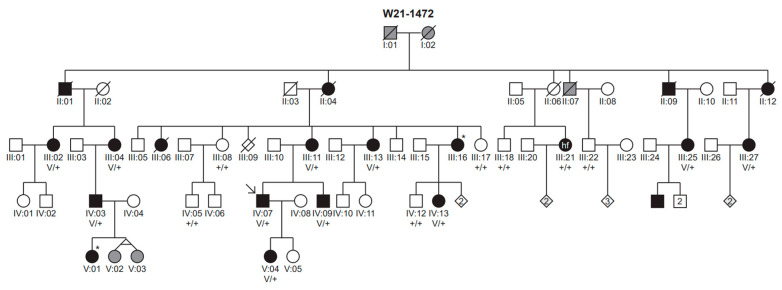
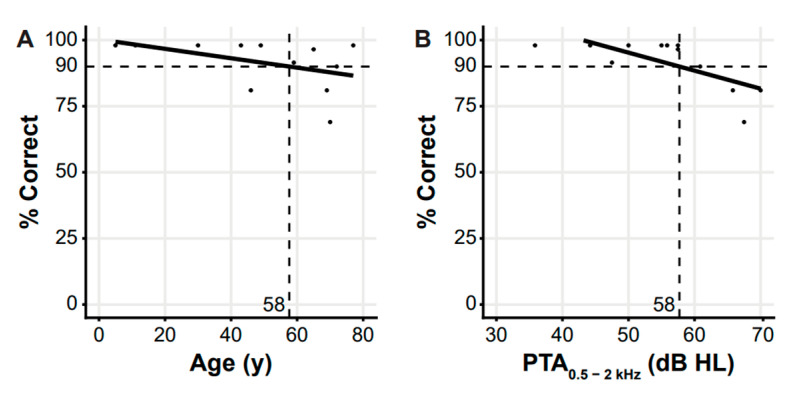
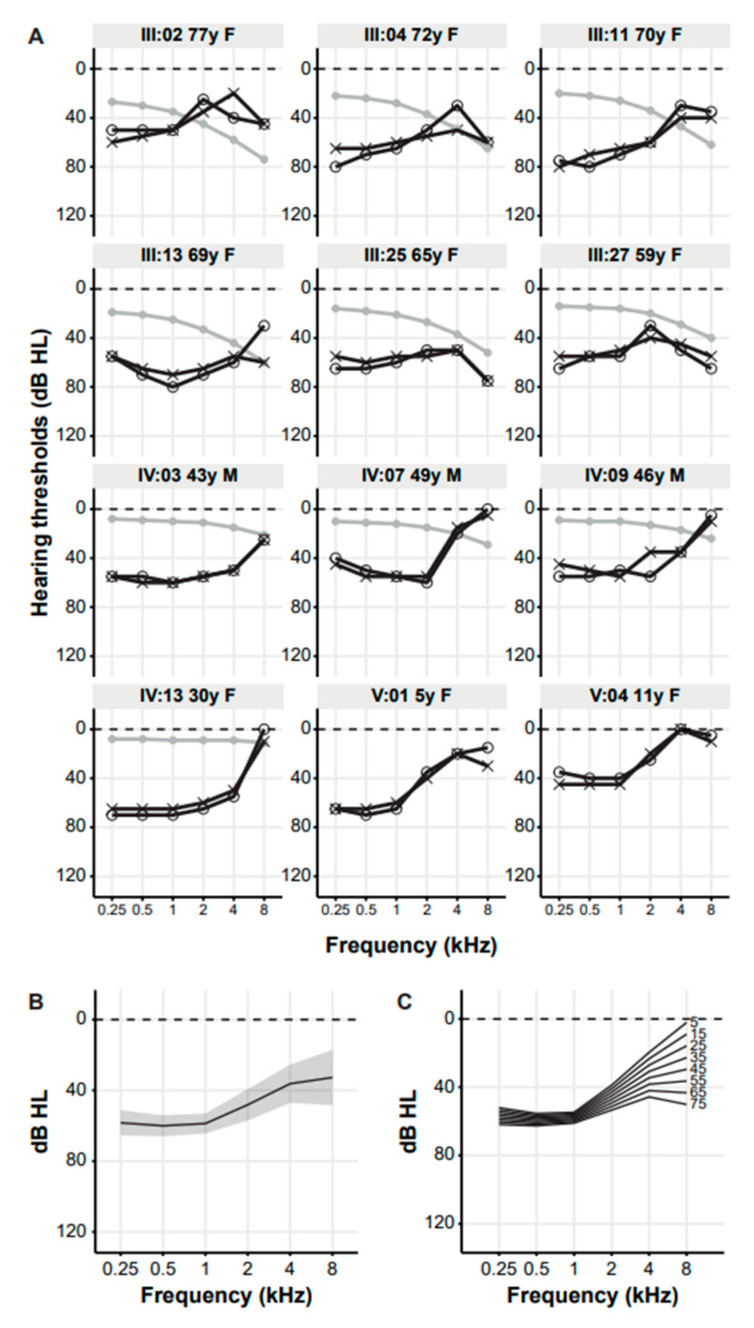
The aim of this study is to contribute to a better description of the genotypic and phenotypic spectrum of DFNA6/14/38 and aid in counseling future patients identified with this variant. Therefore, we describe the genotype and phenotype in a large Dutch-German family (W21-1472) with autosomal dominant non-syndromic, low-frequency sensorineural hearing loss (LFSNHL). Exome sequencing and targeted analysis of a hearing impairment gene panel were used to genetically screen the proband. Co-segregation of the identified variant with hearing loss was assessed by Sanger sequencing. The phenotypic evaluation consisted of anamnesis, clinical questionnaires, physical examination and examination of audiovestibular function. A novel likely pathogenic variant (NM_006005.3:c.2512C>T p.(Pro838Ser)) was identified in the proband and found to co-segregate with LFSNHL, characteristic of DFNA6/14/38, in this family. The self-reported age of onset of hearing loss (HL) ranged from congenital to 50 years of age. In the young subjects, HL was demonstrated in early childhood. At all ages, an LFSNHL (0.25-2 kHz) of about 50-60 decibel hearing level (dB HL) was observed. HL in the higher frequencies showed inter-individual variability. The dizziness handicap inventory (DHI) was completed by eight affected subjects and indicated a moderate handicap in two of them (aged 77 and 70). Vestibular examinations ( = 4) showed abnormalities, particularly in otolith function. In conclusion, we identified a novel variant that co-segregates with DFNA6/14/38 in this family. We found indications of mild vestibular dysfunction, although it is uncertain whether this is related to the identified variant or is an incidental finding. We would like to emphasize that conventional neonatal hearing screening programs are not sensitive to HL in DFNA6/14/38 patients, because high-frequency hearing thresholds are initially preserved. Therefore, we suggest screening newborns in DFNA6/14/38 families with more frequency-specific methods.
本研究旨在更详细地描述 DFNA6/14/38 的基因型和表型谱,并为未来诊断出携带该变异的患者提供咨询。因此,我们描述了一个荷兰-德国大家庭(W21-1472)中常染色体显性非综合征性低频感音神经性听力损失(LFSNHL)的基因型和表型。对先证者进行了外显子组测序和听力障碍基因panel 的靶向分析,以进行基因筛查。通过 Sanger 测序评估所识别的变异与听力损失的共分离情况。表型评估包括病史、临床问卷、体格检查和听前庭功能检查。在该家族中,在先证者中发现了一个新的可能致病性变异(NM_006005.3:c.2512C>T p.(Pro838Ser)),该变异与 LFSNHL 共分离,具有 DFNA6/14/38 的特征。听力损失(HL)的自我报告发病年龄从先天性到 50 岁不等。在年轻受试者中,HL 表现为幼儿期。在所有年龄段,均观察到约 50-60 分贝听力水平(dB HL)的低频感音神经性听力损失(LFSNHL(0.25-2 kHz))。高频 HL 具有个体间的变异性。八位受影响的受试者完成了眩晕残疾量表(DHI),其中两位(77 岁和 70 岁)表现出中度残疾。(= 4)的前庭检查显示异常,特别是在耳石功能方面。总之,我们在该家族中鉴定出一个与 DFNA6/14/38 共分离的新型变异。我们发现存在轻度前庭功能障碍的迹象,尽管尚不确定这是否与所鉴定的变异有关,还是偶然发现。我们想强调的是,常规的新生儿听力筛查方案对 DFNA6/14/38 患者的 HL 不敏感,因为高频听力阈值最初是保留的。因此,我们建议使用更具频率特异性的方法对 DFNA6/14/38 家族的新生儿进行筛查。